


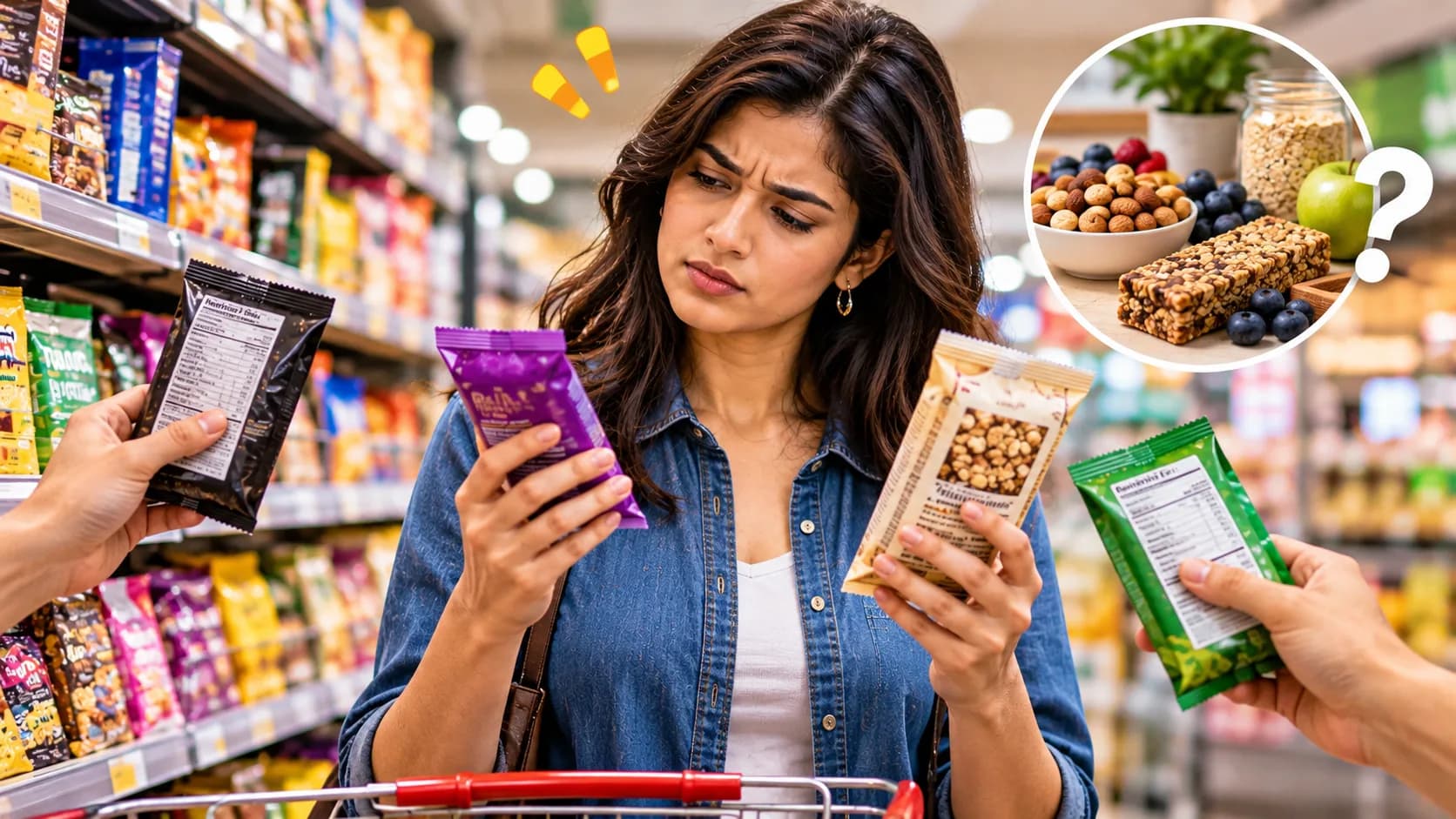
The ₹99 bar and the ₹125 bar
On one grocery app's listing, a single 70 g protein bar costs ₹99. The six-pack of the same bar is ₹749, which is about ₹125 a bar. The page itself labels the pack with a per-100 g price that matches only the single bar, and its title gives the weight as 60 g, not 70 g (BigBasket listing, opened 12 November 2026).
That small muddle is a fair introduction to a bigger one. India's healthy-snack shelf asks shoppers to pay more for products whose appeal rests on a few words on the front: protein, natural, no added sugar, baked. The question this report asks is simple. When you pay the premium, what exactly are you buying?
We do not assume the industry is misleading anyone. Some products plainly offer more protein or fibre than the snack they replace. Others may carry a health halo that the nutrition panel does not support. The honest answer needs the label, not the logo.
India's new appetite for "better" snacks
The money is real, though estimates of the market differ because they count different things. Bain & Company partner Karthik Ganesan put the branded packaged healthy-snack market at about ₹6,000 crore and expects it to grow 17-19% a year to nearly ₹20,000 crore by 2030, Storyboard18 reported in December 2025. A Substack analysis cites a much larger ₹22,000-30,000 crore for FY24, but that figure includes established players and is a weaker source. IFT should use one definition, name it, and not mix the two.
Investors are following. Tracxn data cited in the same report show sector funding of $152 million in 2025, up 18% from $129 million in 2024. Large companies have bought in: ITC took over Yoga Bar's parent, Marico bought True Elements' parent, and Britannia launched a millet cookie. The reported price of the Yoga Bar deal differs by source (₹255 crore in one, a ₹450 crore valuation in another), so we do not quote it.
Consumers say they care. A report from snack brand Farmley, based on more than 6,000 respondents, found 86% say protein matters when choosing a snack. Only 32% said they would pay a premium for protein-rich products. Two cautions: Farmley sells snacks, and the coverage does not describe how the survey was run.
The gap between "matters" and "will pay more" is the commercial heart of the story.
What is actually inside?
The brief asks for 8-12 products compared on pack size, price, protein, sugar, fibre, calories, sodium, ingredients and exact claims. We could not build that table honestly. Brand sites were blocked in this session, and retailer pages were inconsistent. The one product we examined shows why label checks matter.
The Yoga Bar 20 g Protein Bar (Chocolate Brownie) is sold under a name that includes "No Added Sugar". A third-party store page lists, per 70 g bar, 20.4 g of protein, 323 kcal and 251 mg of sodium, and says the bar uses "100% natural ingredients". The same page's ingredient list includes a dark chocolate coating made with brown sugar, and dates (listing). That page also gives the flavour inconsistently, so it may not describe the same recipe as the pack. We are not alleging a breach. The point is the one to check on the physical wrapper: how does "no added sugar" sit beside the ingredient list?
One open-database entry for a product with the same name, meanwhile, describes a salted cashew snack. Crowd-sourced and retailer data can be wrong, which is why the table must come from packs.
The protein promise
India's claims rules set numerical thresholds. Under the Advertising and Claims framework, as summarised in FSSAI's 2019 direction, a solid food can claim to be a "source" of protein if it provides 10% of the recommended dietary allowance (RDA) per 100 g, and "high" or "rich" if it provides 20%. Khaitan & Co notes that the RDA values were revised by an FSSAI direction of 2 August 2021; the gram figure should be checked in the current direction before the article states it.
Three features of that rule matter to a shopper.
First, the test is per 100 g, not per bar. A light bar can be "high protein" on paper and still deliver little protein.
Second, the rule measures quantity. It does not, in the summaries we read, test protein quality, the amino-acid balance and digestibility that nutritionists weigh. A bar built on whey and a bar built on a lower-quality plant blend can carry the same headline number.
Third, protein arrives with other nutrients. On the Yoga Bar example, 323 kcal per bar is about 461 kcal per 100 g, computed from the page's figures. That is a snack, not a free lunch, and no protein claim says anything about it.
An earlier test of protein supplements shows why labels matter. The Citizens Protein Project reported in April 2024 that close to 70% of 36 supplements tested were mislabelled for protein content, per Khaitan's summary. Those were supplements, not snack bars, so the result should not be read across.
Sugar, sodium and the words that hide them
FSSAI's thresholds are narrow. "Sugar free" requires no more than 0.5 g of sugars per 100 g; "low sugar" no more than 5 g per 100 g of a solid. "Source of fibre" needs at least 3 g per 100 g and "high fibre" at least 6 g, per the same direction.
"No added sugar" is different, and contested. We could not open the regulation's exact text on that claim in this session, so the article should quote it from the Gazette before publication. What we can report is enforcement. In June 2026, FSSAI notices reached several brands, including a juice labelled "No Added Sugar" whose ingredients listed sugar cane juice. These are notices, not findings of wrongdoing. Inc42 reports that The Whole Truth has replaced "No Added Sugar" with "Sweetened with Dates" on its products, after a dispute that began in August 2023.
A Zym audit of 119 protein bars, reported by The Federal in September 2025, found only four were truly sugar-free and that 29% lacked full nutrition details. It is a company's own audit; the article does not name brands, and we have not seen the method. Treat it as a lead, not a finding.
The reader's takeaway is not that dates or jaggery are worse than sugar. It is that "natural sweetener" and "low sugar" are different statements, and only the label's sugar line tells you which one you are eating.
The premium price tag
Price is where we have the least verified data. On the one example, the six-pack works out to about ₹125 a bar, and about ₹61 for every 10 g of protein (6 bars at 20.4 g each, for ₹749). The ₹99 single-bar price would be about ₹49 per 10 g. These come from a listing with internal inconsistencies, so they are illustrations, not findings.
The brief asks for a fair comparison with roasted chana, peanuts and sattu. We have not sourced current prices or nutrition values for those, so the article should not assert them. A fair comparison also needs matched servings, and should not assume traditional foods are better. Roasted chana carries fibre and protein, but the comparison depends on the nutrient values and the price, and both need a source.
How marketing does the persuading
A bar that says "20 g protein" on the front invites a shopper to stop reading. Farmley's own survey found 62% say clear ingredient information is the top factor in choosing a brand, ahead of celebrity or influencer endorsement, and 35% say in-store shelf visibility most influences purchases. Both are self-reported and from an interested party.
Regulators are also looking. FSSAI's claims rules prohibit misleading advertising, and the June 2026 notices touched claims as varied as "Heart Pro" and "Lean Muscle Gains". That a notice is issued is not proof of a violation, and companies can respond.
What FSSAI rules say
The Advertising and Claims Regulations, 2018, as amended in 2019, set thresholds for nutrient claims and bar misleading advertising. For "natural", the 2019 direction does not set a nutritional test. It requires a disclaimer when a brand or fancy name that includes "natural" or similar words is likely to mislead: "This is only a brand name or trade mark and does not represent its true nature." The effective date and current status of each provision should be confirmed from the Gazette.
What to check before buying
Read the nutrition table per 100 g first, because per-serving numbers depend on a serving size the brand picks. Then compare:
Protein per 100 g against your own need, and against the calories that come with it.
The sugar line, and the ingredient list for syrups, jaggery, dates, juice concentrates and coatings.
Sodium, if you buy savoury roasted or baked snacks.
Whether "baked", "multigrain" or "natural" appears with numbers or only as a word.
The price per 100 g and per 10 g of protein, not the pack price.
Is healthy snacking worth the money?
Sometimes. A bar with a meaningful amount of protein or fibre, modest sugar and sensible calories can replace a worse snack. A bar that leads with protein and buries sugar, or that charges several times more for words, cannot. On current evidence, IFT cannot say which brands are which. Closing that gap takes packs, receipts and a calculator, and that is the reporting still to be done.
Product comparison data
Only one product is partly sourced; the other 7-11 rows the brief asks for are still to collect from physical packs. Brand sites were not reachable from this session, and the retailer pages we opened were incomplete or inconsistent.
Field | Yoga Bar 20 g Protein Bar, Chocolate Brownie | Source and caveat |
|---|---|---|
Pack | 6 x 70 g (420 g) | BigBasket title also says 60 g; check wrapper |
Price | ₹749 for six; ₹99 single | BigBasket, opened 12 Nov 2026; per-100 g label on page matches single bar only |
Price per bar | ₹124.83 (six-pack) | Computed |
Price per 100 g | ₹178.33 (six-pack); ₹141.43 (single) | Computed |
Protein per bar / per 100 g | 20.4 g / 29.1 g | Third-party store page; not a label photo |
Energy per bar / per 100 g | 323 kcal / 461 kcal | Same page; per-100 g computed |
Sodium per bar | 251 mg | Same page |
Sugar, fibre | Not disclosed on pages we opened | Needed from pack |
Ingredients named | Whey concentrate, almond paste, lentil protein, dark chocolate coating (brown sugar), dates | Third-party page; flavour listed inconsistently |
Claims | "No Added Sugar" (in product name), "100% natural ingredients", "20 grams of complete Protein" | Same page; confirm exact wording on pack |
Price per 10 g protein | ₹61.19 (six-pack); ₹48.53 (single) | Computed from 20 |
Is healthy snacking worth the money?
Sometimes, and the label is where you find out. A bar with real protein or fibre, modest sugar and sensible calories can beat a worse snack. A product that sells on “protein” or “natural” but says little about sugar, calories or price per gram has not earned its premium.
Before paying extra, check the per-100 g column, the sugar line and the ingredient list, then divide the price by the protein.