
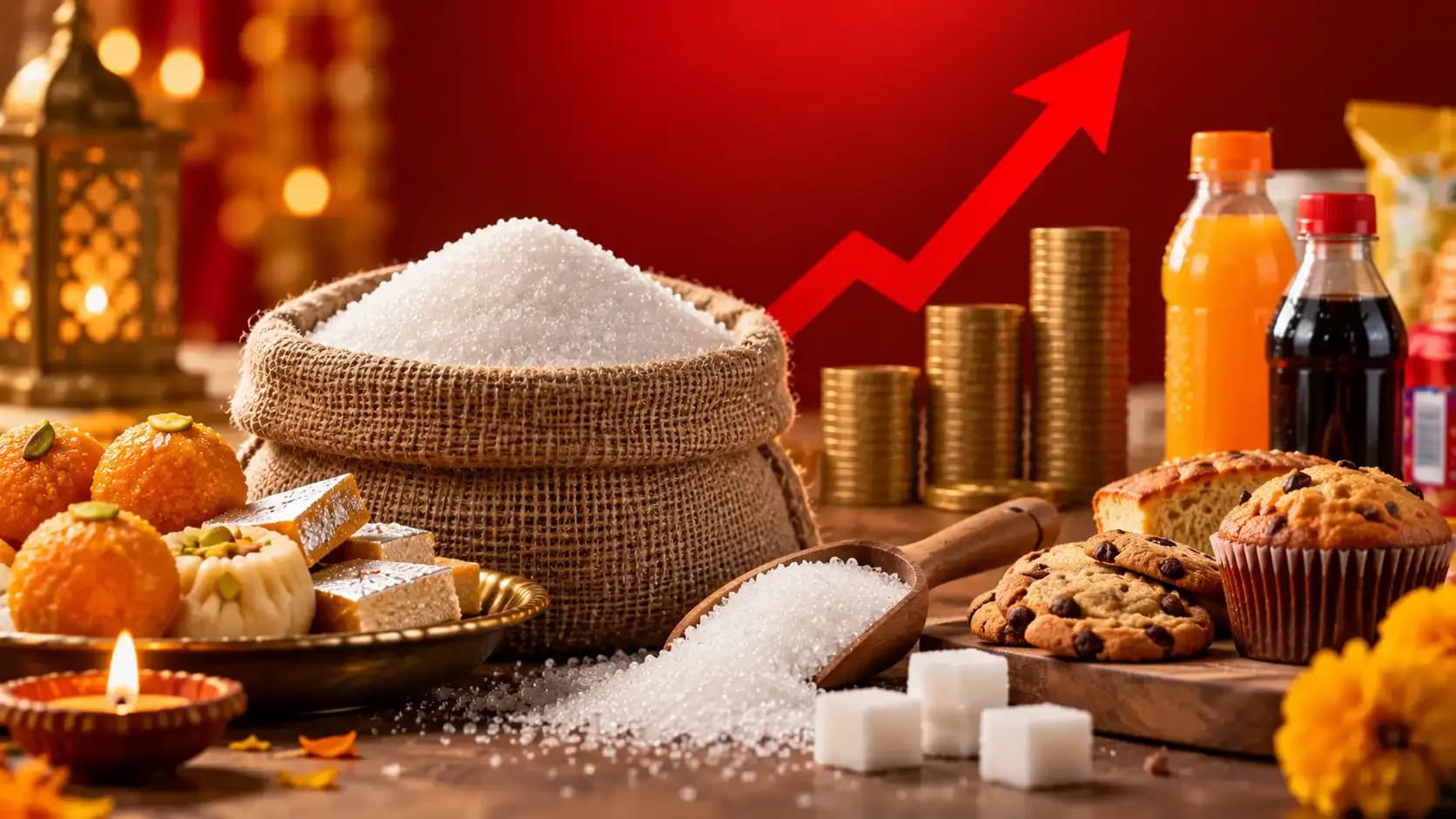
Sugar prices have surged ahead of the festive season, putting fresh pressure on sweet makers, bakeries, beverage companies and FMCG brands. With Diwali approaching, businesses now face a difficult choice: raise prices, absorb higher costs or reduce pack sizes.
India's food industry is heading into the festive season with a new cost challenge — sugar prices remain around 20% higher than they were two months ago.
While prices have cooled from their record levels seen in August, they are still significantly above where they were earlier this year. And the timing is important: India's demand for sweets, confectionery, bakery products and beverages is about to rise as the festive season gets underway.
For consumers, that could mean higher prices for some of their favourite festive foods.
For businesses, it could mean another hit to already-tight margins.
Sugar prices rose sharply in recent months
The increase has been unusually fast.
According to government data, the average retail price of sugar rose from ₹48.18 per kg on July 20 to ₹55.70 per kg on August 20.
Prices climbed further in several markets before coming down from their August peak. As of September 10, the government said sugar prices were still around 20% higher than two months earlier.
The increase is also visible in inflation data. Sugar prices were 24.2% higher than a year earlier in August, while India's overall food inflation rose to 5.95%.
That makes sugar one of the important food costs the industry is watching closely.
Why has sugar become so expensive?
The current price rise is being driven by a combination of supply and market factors.
India's sugar production has fallen significantly, tightening the balance between domestic supply and consumption. Weather conditions have also affected sugarcane availability in some major producing states.
At the same time, international sugar prices have been under pressure, while concerns over stockpiling and speculation have added to the domestic price increase.
The government has said the recent rise cannot be explained by festive demand alone and has warned sugar mills against unjustified price increases.
There has also been debate over the amount of sugarcane being diverted towards ethanol production. However, the Centre has rejected ethanol diversion as the main reason for the current price surge.
The government is turning to imports
To improve domestic availability, the Centre has allowed up to 1 million tonnes of raw sugar to be imported at zero duty.
A large part of the quota has already been allocated, with imported sugar expected to add to domestic supplies.
The government has also allowed port-based refiners to divert refined sugar towards the domestic market. Industry estimates suggest around 250,000 tonnes of refined sugar could be supplied to Indian consumers through this route.
Another major step is the earlier start to the next sugarcane crushing season.
Sugar mills have been directed to begin crushing from October 15, earlier than usual, which could help improve supplies as the season progresses.
Why Diwali is making the situation more important
Sugar prices are rising at exactly the wrong time for the food industry.
India's festive calendar is entering its busiest period, with Navratri, Dussehra and Diwali followed by the wedding season.
This is when demand increases for:
Mithai
Chocolates
Biscuits
Cakes
Bakery products
Desserts
Soft drinks
Packaged beverages
Festive gift boxes
In other words, businesses are preparing to sell more products containing sugar while paying more for one of their key ingredients.
Mithai makers are under pressure
Traditional Indian sweets are among the businesses most directly exposed to higher sugar prices.
Ladoo, barfi, peda, jalebi, gulab jamun, rasgulla and several other popular sweets rely heavily on sugar.
But there is an important point consumers should understand.
A 20% rise in sugar prices does not mean mithai prices will rise by 20%.
Sugar is only one part of the total cost of making sweets.
Sweet shops also have to account for milk, khoya, ghee, dry fruits, labour, gas, electricity, packaging and transportation.
The actual price increase will therefore depend on the type of sweet and the overall cost structure of each business.
Still, the pressure is already showing up in the market.
Bikaji has already increased prices
Organised sweet manufacturers are beginning to respond.
Bikaji Foods has implemented an approximately 2% price increase across its sweets portfolio, according to reports citing company CFO Rishabh Jain.
The company has said its sugar procurement costs remain around 20% higher than they were a few months ago.
The move offers an early indication of how food companies may respond: rather than passing the entire increase to consumers, businesses may make smaller price adjustments while absorbing part of the additional cost themselves.
Bakeries and biscuit companies are watching closely
Sugar isn't just a mithai problem.
It is also an important ingredient in the bakery and packaged-food business.
Products such as biscuits, cookies, cakes, pastries, muffins, rusks and confectionery could all feel some impact from higher sugar costs.
For large FMCG companies, even a small increase in the cost of an ingredient can become significant when products are manufactured and sold at enormous volumes.
Analysts have therefore flagged sugar costs as a potential margin pressure for companies including Britannia, Nestlé, ITC and Hindustan Unilever.
The impact, however, will vary depending on how much sugar each company uses and how effectively it can manage procurement costs.
Beverage companies face another challenge
Soft-drink and other sweetened beverage companies also use large quantities of sugar.
The problem for these companies is that India's beverage market is highly competitive and price-sensitive.
A company facing higher sugar costs has several options:
Raise prices.
Reduce pack sizes.
Cut discounts.
Absorb the additional cost.
But each option comes with a trade-off.
A price increase could affect demand, while absorbing the entire cost could hurt margins.
Smaller packs can protect familiar price points but effectively increase the price consumers pay per litre or per gram.
What will FMCG companies do?
For packaged-food companies, the sugar increase creates a familiar dilemma:
Protect the consumer or protect the margin?
If a company absorbs the entire increase, its profitability takes a hit.
If it raises prices, consumers may buy less or switch to cheaper alternatives.
And if it reduces the pack size, it can maintain the familiar ₹10, ₹20 or ₹50 price point while managing costs.
That is why consumers could see smaller packs or slightly higher prices rather than dramatic price increases.
Will your Diwali sweets become more expensive?
The answer is likely to be yes for some products, but the increase will vary.
A sweet that uses a large amount of sugar will naturally be more exposed than one where sugar makes up a smaller portion of the recipe.
Premium sweets also have other expensive ingredients, such as dry fruits, ghee and milk products, which can have a bigger influence on the final price.
So consumers shouldn't expect a blanket 20% increase across the mithai market.
Instead, the industry could see a combination of:
Higher prices + smaller packs + fewer discounts + businesses absorbing part of the cost.
The next few weeks will be crucial
The government's measures could help bring prices down further.
The additional imports, domestic supply from refiners and earlier crushing season are all designed to improve availability.
But there is one major variable that cannot be ignored:
Diwali demand.
If additional sugar reaches the market quickly enough, prices could moderate further.
If festive demand rises faster than supply, prices could remain elevated and more businesses may be forced to adjust their prices.
What this means for the food industry
The sugar story is bigger than just one commodity.
For a mithai shop, it means higher production costs.
For a bakery, it adds pressure to already rising ingredient costs.
For a beverage company, it could squeeze margins or force pricing decisions.
For an FMCG company, it raises the question of whether to increase prices, reduce pack sizes or absorb the cost.
And for consumers, it could mean paying a little more for the foods that make the festive season sweeter.
With Diwali approaching, the industry will now be watching one number very closely:
Where will sugar prices be when festive demand reaches its peak?
That could determine whether the current sugar shock remains a temporary cost pressure — or turns into a wider round of price increases across India's food and FMCG market.