


Your favourite influencer just called a snack "healthy." Who checks if that's true?
A woman opens Instagram before breakfast. A creator she has followed for two years holds up a jar and says it changed her mornings no added sugar, high in protein, good for gut health. There is no jingle, no studio lighting, no voiceover selling anything. It looks like advice from a friend. It is, in fact, a food advertisement.
This week, the Food Safety and Standards Authority of India told celebrities and influencers to check their facts before making exactly that kind of claim. "With great influence comes great responsibility," the regulator posted on August 11, warning that promoting unverified food claims could invite legal consequences. The Tamil Nadu Food Safety Department followed with its own advisory a day later.
The warning itself is not new. What is worth asking is what happens next because "who checks the claim" and "who answers for it" are two different questions, and India's answer to the second one runs through three separate regulators, each with a different job.
SECTION 1: THE WARNING THAT SHOULD MAKE EVERY FOOD INFLUENCER PAY ATTENTION
FSSAI's advisory named the claims it is watching most closely immunity-boosting effects and high nutritional value chief among them and said such statements cannot be made unless there is evidence behind them and the claim is permitted under food law. The regulator has also directed consumers to its Food Safety Connect platform to report misleading endorsements directly.
The timing is not incidental. In the same week, FSSAI ordered Dabur India to withdraw "100%" claims on certain products after finding them unverifiable, and continued enforcement against several smaller manufacturers over adulterated ghee, mustard oil and mislabelled salt. Influencer content has become one more channel FSSAI now treats as part of the same advertising problem it already polices in packaging and print.
SECTION 2: WHEN DOES A RECOMMENDATION BECOME AN AD?
Not every video of someone eating a snack is regulated advertising. The dividing line, under India's rules, is a "material connection" any payment, free product, discount, gift, trip or other benefit an influencer receives from a brand. Once that connection exists, ASCI's Guidelines for Influencer Advertising in Digital Media require a clear, upfront disclosure label such as "Advertisement" or "Paid Promotion," visible in the post itself and not buried in a hashtag.
Genuinely unpaid opinions fall outside this framework. But the guidelines are written broadly enough that gifted products, long-term brand ambassador arrangements and even non-monetary perks like event invitations can count as a material connection meaning much of what looks like a spontaneous recommendation is, on paper, an undisclosed ad.
SECTION 3: WHAT FSSAI ACTUALLY SAYS
FSSAI's authority comes from the Food Safety and Standards Act, 2006, and specifically the Food Safety and Standards (Advertising and Claims) Regulations, 2018. Section 24 of the Act prohibits false or misleading advertising of food, and Section 53 makes it a punishable offence, carrying penalties of up to ₹10 lakh. An Advertisement Monitoring Committee inside FSSAI actively tracks claims across media, including social platforms a 2023 press note recorded 170 cases of misleading claims flagged over six months, spanning health supplements, organic products and staples.
FSSAI's jurisdiction is specific: it governs claims about the food product itself — its safety, its nutrition, its health effects. It does not govern whether an influencer disclosed that they were paid. That is a separate regulator's job.
SECTION 4: THE RULES BEHIND "HEALTHY," "NATURAL," "HIGH-PROTEIN" AND OTHER CLAIMS
Under the 2018 regulations, a claim has to be truthful, unambiguous and scientifically substantiated and several common phrases have defined thresholds behind them, not just vibes. "Sugar-free" generally requires sugar content below a fixed limit per 100 grams. "High in protein" and "source of" claims are tied to specific nutrient values set against recommended daily intake. Absolute terms like "100% natural" or "100% pure" have drawn direct FSSAI action, including the Dabur order this month, because regulators consider them nearly impossible to verify and inherently likely to mislead.
Words like "ayurvedic," "detox" or "doctor recommended" sit in a greyer zone not automatically banned, but requiring the advertiser to hold real evidence and, in some cases, the credentials to back them up. Vague wellness language ("gut healthy," "boosts metabolism") is where FSSAI and ASCI most often find grounds to act, precisely because it promises an outcome without defining one.
SECTION 5: FSSAI, CCPA OR ASCI WHO ACTUALLY REGULATES WHAT?
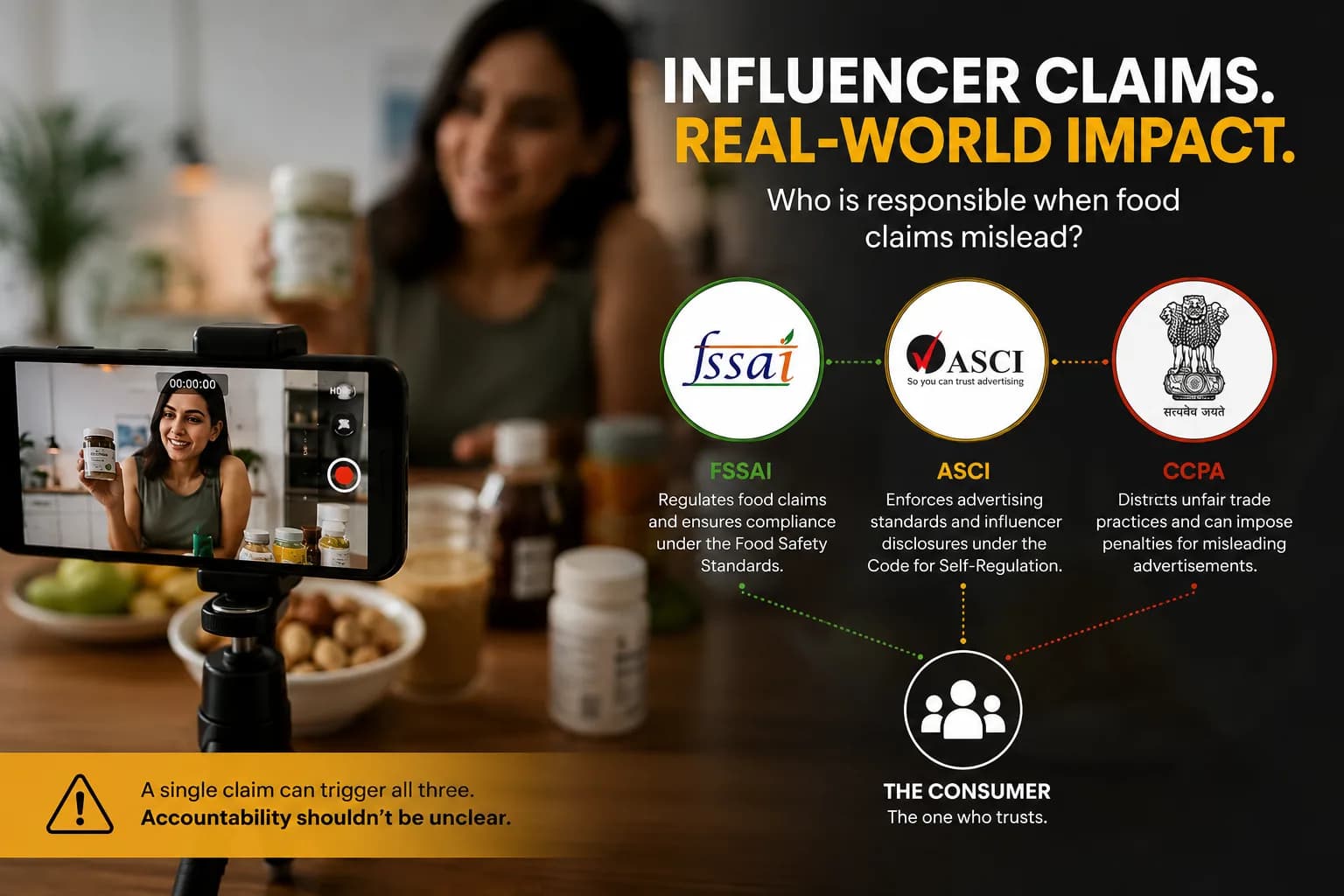
Three systems, three jobs. FSSAI is a statutory regulator that can act on the claim itself ordering a product pulled, a claim withdrawn, or pursuing penalties under the FSS Act. ASCI is a self-regulatory advertising body; its guidelines bind its own members and are not law, but it monitors disclosure, conducts investigations and refers unresolved cases onward. The Central Consumer Protection Authority, created under the Consumer Protection Act, 2019, sits above both in enforcement weight: its 2022 Guidelines for Prevention of Misleading Advertisements, paired with its 2023 "Endorsement Know-Hows" guide, let it fine an endorser up to ₹10 lakh for a first violation and ₹50 lakh for repeat offences, and bar them from endorsing anything for up to three years.
A single influencer post promoting a supplement, in other words, can be reviewed by FSSAI for the claim, by ASCI for the disclosure, and by the CCPA for both simultaneously, and by design.
SECTION 6: THE GREY ZONE OF PAID, GIFTED AND AFFILIATE CONTENT
The hardest cases involve products an influencer was never paid for in cash. ASCI's own guidelines treat free products, discounts and even hotel stays as a "material connection" requiring disclosure but enforcement in practice depends on proving that connection existed, and brands and influencers have successfully argued, in some ASCI cases, that no such relationship existed at the time of posting. Affiliate links and discount codes are more clearly commercial and typically require disclosure. Long-term ambassador deals are the least ambiguous of all: repeated promotion under contract leaves little room to claim spontaneity.
SECTION 7: WHY CONSUMERS TRUST INFLUENCERS
ASCI's most recent complaints data offers a clue to why this matters at scale: in its 2025–26 report, 61% of scrutinised food and beverage advertisements involved misleading health or nutrition claims, and 76% of influencers on Forbes India's Top 100 Digital Stars list were found in violation of advertising rules in 2025 up from 69% the year before. The research literature on parasocial relationships helps explain why these numbers keep climbing rather than falling: familiarity and repeated exposure build a sense of personal trust that a one-off television advertisement never gets the chance to build. A recommendation delivered by someone a viewer has followed for years does not read, to that viewer, as a sales pitch even when it legally is one.
SECTION 8: THE REAL CASES THAT SHOW WHERE THINGS GO WRONG
Four cases illustrate the pattern. In 2019, FSSAI issued a show-cause notice to McDonald's India franchisees over a print advertisement that disparaged vegetables to promote a combo meal an early example of the 2018 Advertising and Claims Regulations being used against a major brand's own messaging. In 2022, ASCI found that influencers, not celebrities, were behind more than 92% of misleading advertisements for crypto assets, a category outside food but instructive for how disclosure failures cluster around influencer-led campaigns specifically. In 2024, the Supreme Court's continuing scrutiny of Patanjali Ayurved over misleading claims including a warning against terms like "permanent relief" led to the suspension of manufacturing licences for 14 products after the company continued using contested language despite an earlier assurance to the court. And this August, FSSAI's order against Dabur over "100%" claims shows the same regulations reaching a familiar household brand, not just a small manufacturer.
None of these cases alone proves an epidemic. Together, they show a consistent enforcement pattern: regulators act on specific, named claims, not on influencer culture in the abstract and action tends to follow evidence, not popularity.
SECTION 9: WHAT HAPPENS WHEN A CLAIM IS MISLEADING?
The process typically starts with monitoring by FSSAI's Advertisement Monitoring Committee, by ASCI's proactive scanning, or by a consumer complaint through Food Safety Connect or ASCI's Grievances Against Misleading Advertisements portal. A flagged claim usually draws a notice asking for evidence or correction first; FSSAI's recent action against Dabur followed an earlier notice that went unaddressed. Non-compliance can escalate to product withdrawal orders, fines, or in CCPA's case, formal bans on future endorsements. ASCI's latest data shows the system resolving most cases without a fight around 88% voluntary compliance but also shows the number of ads requiring modification climbing each year, suggesting new violations are outpacing corrections.
SECTION 10: WHO SHOULD BE HELD ACCOUNTABLE : BRAND OR INFLUENCER?
Under the CCPA's guidelines, the answer is not either-or. Manufacturers, advertisers, advertising agencies and endorsers can each be held liable, and the guidelines specifically place a due-diligence burden on the influencer they are expected to have some basis for believing a claim before repeating it, not simply take a brand's word for it. FSSAI's action tends to land on the product's manufacturer or marketer, since that is where its statutory power over food itself sits. ASCI's leverage works best against influencers who are difficult for a statutory body to reach directly, since ASCI can act on disclosure regardless of who made the underlying claim. In effect: the brand usually owns the claim, the influencer usually owns the disclosure, and both can be pursued for either failure.
SECTION 11: WHAT CONSUMERS SHOULD LOOK FOR
A visible "Advertisement" or "Paid Promotion" label is the clearest signal that a recommendation is commercial. Specific, checkable numbers a defined protein content, a stated sugar limit carry more weight than adjectives like "healthy" or "clean," which have no fixed legal meaning on their own. Claims tied to medical outcomes, especially for children, the elderly or people managing conditions like diabetes, warrant the most scepticism, since these are exactly the claims regulators scrutinise hardest. A product's own label, not the video promoting it, remains the more reliable source for what is actually inside.
SECTION 12: HAS INDIA'S REGULATORY SYSTEM CAUGHT UP?
The evidence points toward a specific, narrower conclusion than either extreme. The rules themselves are not thin FSSAI, ASCI and the CCPA between them cover claims, disclosure and endorser liability with real penalties attached, and enforcement actions against McDonald's, Patanjali and Dabur show none of the three is purely theoretical. What is falling behind is capacity relative to volume: ASCI's own reporting shows violations rising faster than compliance is improving, and a system built on monitoring, complaints and after-the-fact correction will always be a step behind a format that produces millions of new videos every week. The gap is not an absence of law. It is the distance between a rule that exists and a claim that has already reached a few million people before anyone reviews it.
That gap is what a viewer inherits every time a trusted face on their screen says a jar of something is good for them. The claim may be true. It may be exaggerated. It may be entirely fabricated. Right now, the only way to know is to wait and see whether anyone with the authority to check gets there in time.