
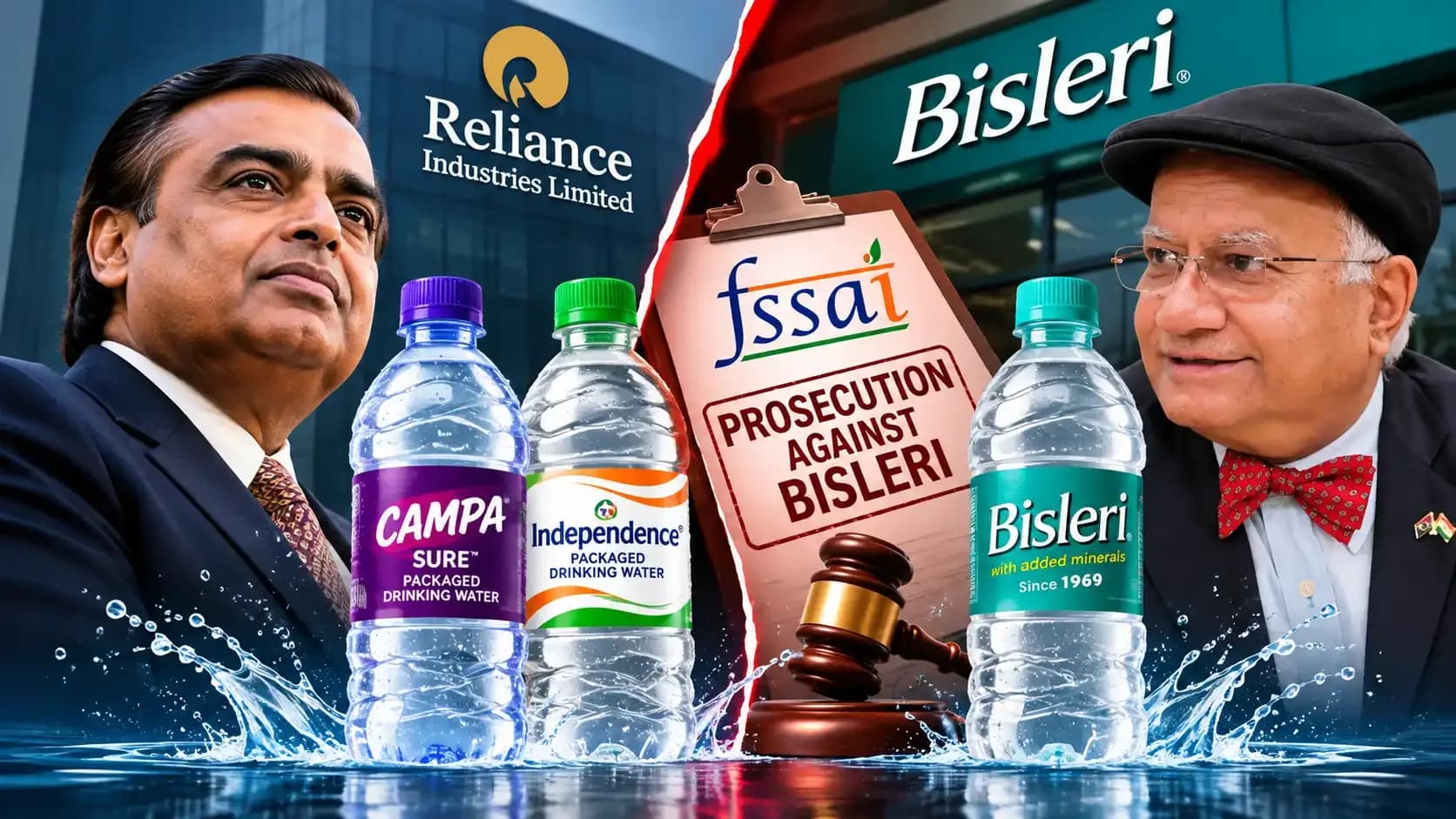
A new challenger enters the water market. An old market leader faces regulatory trouble.
India's bottled water market is witnessing an interesting development, and the timing is difficult to ignore.
On one side, Reliance Industries, through its consumer products arm, is aggressively expanding its packaged drinking water business with Campa Sure and Independence. On the other, Bisleri, one of India's most recognisable bottled water brands, is facing prosecution proceedings initiated by the country's food safety regulator over alleged chemical non-compliance.
Is this simply a case of a new competitor entering the market while an established player faces regulatory scrutiny? Or does the situation deserve a closer examination?
There is no publicly established evidence connecting Reliance's market expansion with the FSSAI action against Bisleri. However, the sequence of events raises questions that deserve answers.
The timeline that has attracted attention
Reliance's entry into packaged drinking water was not a sudden development.
In September–October 2025, Reliance Consumer Products introduced Campa Sure, positioning it as an affordable alternative to established bottled water brands.
The pricing strategy was aggressive:
Campa Sure 1 litre: ₹15.
Established competitors such as Bisleri: approximately ₹20.
Campa Sure 2 litres: ₹25.
Competing brands: approximately ₹30–35.
Reliance also brought its Independence brand into the packaged water category, strengthening its presence across the consumer essentials segment.
The company was clearly looking to challenge established players through pricing, distribution and manufacturing partnerships.
But another development had already taken place.
On September 30, 2025, FSSAI collected six water samples from Bisleri's Goa manufacturing facility.
Five reportedly complied with applicable standards. One sample recorded bromate levels of 12 micrograms per litre against the prescribed limit of 10 micrograms per litre.
Following Bisleri's appeal, the sample was referred to another laboratory, which subsequently identified polynuclear aromatic hydrocarbons (PAHs) and declared it unsafe.
In November 2026, FSSAI sanctioned prosecution against Bisleri.
The sample collection preceded Reliance's Campa Sure launch, while the prosecution announcement arrived approximately 14 months later.
That distinction matters. The timeline does not establish a connection between the two developments, but it certainly deserves transparent examination.
Why is Bisleri questioning the regulator?
Bisleri has challenged the findings and the way the matter has progressed.
According to the company's public statement, the initial sample testing found that five samples met the applicable standards, while one recorded bromate levels marginally above the prescribed limit.
The company further stated that an independent FSSAI-approved laboratory found bromate levels within the permissible limit.
Bisleri also questioned the referral laboratory's findings and said it had submitted its independent test results to FSSAI in February 2026.
The company claims it received no further communication and understood the matter to have been closed.
It has also said that it had not received the reported notice through email or in hard copy.
These are the company's claims, not a final determination that the regulator's findings are incorrect.
FSSAI, meanwhile, has maintained its unsafe-food finding following referral testing.
The question is no longer simply whether a water sample failed a test. It is also about how regulatory findings are communicated, challenged and eventually converted into prosecution proceedings.
The bigger question: Is India's bottled water market entering a new competitive battle?
India's packaged drinking water market is a significant business opportunity.
For years, Bisleri has built a strong distribution network and consumer recognition. Kinley, Aquafina, regional bottlers and other players have also established their presence.
Reliance's strategy is different.
The company has demonstrated in other consumer categories that it is willing to use aggressive pricing and extensive distribution to challenge established businesses.
Its entry into bottled water could put pressure on competitors across retail outlets, restaurants, hotels, offices and institutional distribution channels.
Campa Sure's lower pricing makes the competitive challenge even more interesting.
When a company with Reliance's financial resources and distribution capabilities enters a category, the competitive dynamics can change significantly.
But competition should be determined by product quality, pricing, distribution and consumer trust, not by regulatory action against a competing brand.
Also read: FSSAI Moves to Prosecute Bisleri Over Unsafe Water: What Was Found in the Sample?
The uncomfortable question: Are food safety standards being applied equally?
This is where the issue becomes bigger than Bisleri and Reliance.
If a packaged drinking water sample is found unsafe, regulatory action is necessary. Consumer health cannot be compromised, regardless of the company's size, reputation or market position.
But the same standards must apply to every manufacturer.
If Bisleri is being investigated over chemical non-compliance, consumers have every right to expect equally rigorous testing of Campa Sure, Independence, Kinley, Aquafina and regional packaged water brands.
The regulator must ensure that enforcement is consistent, evidence-based and transparent.
A major company's entry into a market should not create suspicion about regulatory proceedings. Equally, a legacy brand's reputation should not protect it from legitimate enforcement.
The credibility of India's food safety system depends on treating both situations independently.
What consumers and the industry should demand
There are several questions that deserve clear answers:
Why did the prosecution announcement come approximately 14 months after the original sample collection?
What were the complete findings of the initial and referral laboratory reports?
How were the conflicting bromate findings evaluated?
Was the company formally informed of the final findings and given an opportunity to respond?
Are competing packaged drinking water brands being subjected to equally rigorous testing?
Will FSSAI make comparable testing results available to consumers?
These questions are not allegations. They are legitimate questions about food safety, regulatory accountability and fair competition.
Coincidence, competition or a bigger regulatory question?
The timing of Reliance's expansion and FSSAI's action against Bisleri has certainly attracted attention.
However, there is currently no evidence establishing that the two developments are connected or that Reliance benefited from or influenced the regulatory proceedings.
What is established is that Reliance entered an established market with aggressive pricing, Bisleri's sample was collected before that launch, and the regulator announced prosecution proceedings approximately 14 months later.
The real issue is whether India's food safety enforcement system can demonstrate the same level of transparency and consistency when dealing with powerful corporations, established market leaders and smaller regional manufacturers.
Because when it comes to drinking water, the consumer should never become collateral damage in a corporate competition.
India does not need a winner between Bisleri and Reliance. India needs safe drinking water, fair competition and a regulator whose decisions are beyond reasonable doubt.
Also read: Reliance Enters Bottled Water Market with Campa Sure at ₹15, Undercutting Bisleri and Kinley