

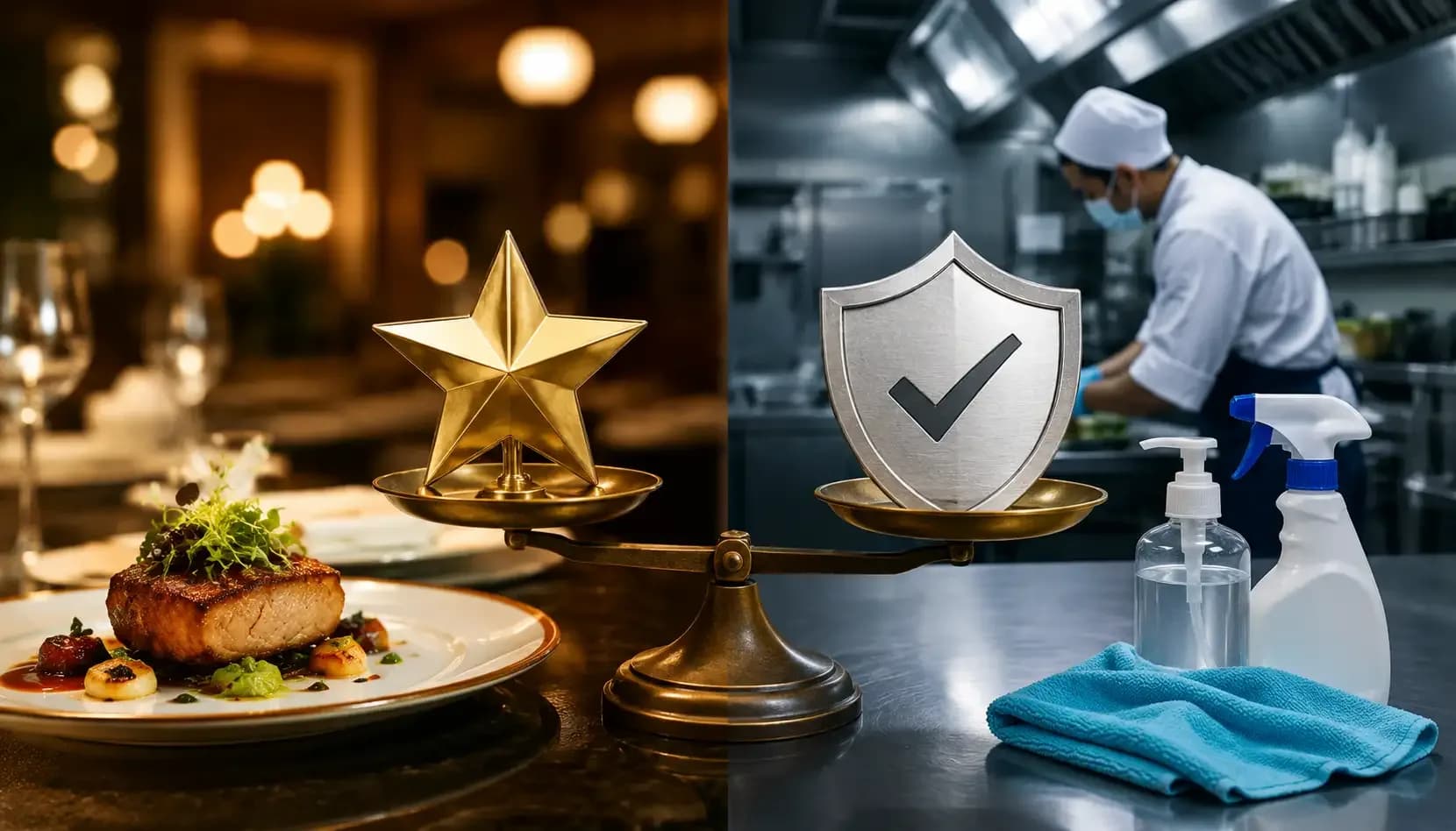
A restaurant can have a famous chef, beautiful interiors, premium ingredients, thousands of positive reviews and even international recognition.
But before taking the first bite, there is one question every customer should be able to answer:
How safe and hygienic is the food being prepared?
Today, restaurant ratings have become one of the most powerful tools influencing where people eat. A 4.5-star rating, a viral Instagram reel, a celebrity chef or a Michelin distinction can instantly create trust.
But what exactly does that rating tell us?
Does a 4.7-star restaurant necessarily have a 4.7-star kitchen?
Not necessarily.
And that is why it may be time to look at restaurant ratings differently.
We Rate Taste. So Why Not Hygiene?
When customers rate a restaurant, they usually consider several things:
Taste and food quality
Service
Ambience
Presentation
Value for money
Staff behaviour
Overall experience
Cleanliness
The problem is that these factors are often combined into one overall rating.
A customer may give a restaurant five stars because the food was exceptional and the ambience was beautiful. But that customer may never have seen the kitchen, food-storage areas or food-handling practices.
In other words:
A great dining experience does not automatically mean great food-safety practices.
This doesn't make restaurant reviews meaningless. Reviews are extremely useful for understanding customer experience.
But customer experience and food safety are two different things.
What Does a Michelin Star Tell Us?
A Michelin Star represents culinary excellence. It is associated with factors such as the quality of ingredients, cooking technique, harmony of flavours, consistency and the personality of the cuisine.
It is an extraordinary achievement for a restaurant.
But a Michelin Star is not designed to be a food-safety certification.
And that distinction is important.
A restaurant can be recognised for exceptional cuisine while food safety is evaluated separately under an entirely different framework.
So the question isn't:
“Michelin or food safety?”
The real question is:
Why do we treat culinary recognition and food-safety information as though they answer the same question?
They don't.
🛡️ Food Safety Answers a Much More Fundamental Question
Food safety is concerned with what happens behind the scenes.
For example:
Is food stored appropriately?
Are raw and cooked foods kept separate?
Are refrigerators and storage areas properly maintained?
Are food-contact surfaces clean?
Are food handlers following hygiene practices?
Is pest control being maintained?
Is potable water being used?
Are cleaning and sanitation procedures being followed?
Is the restaurant maintaining the required food-safety practices?
Is the business complying with applicable food-safety requirements?
These aren't luxury features.
They are basic requirements for protecting consumers.
And unlike ambience or presentation, poor food-safety practices can have consequences far beyond a disappointing dining experience.
India Already Has a Hygiene Rating System
Interestingly, India has already taken an important step in this direction.
The Food Safety and Standards Authority of India (FSSAI) operates a Hygiene Rating Scheme for eligible food businesses, including restaurants and other food-service establishments.
The scheme is designed to help consumers make informed choices while encouraging food businesses to improve and maintain hygiene standards.
Under the scheme, food businesses can receive a 1-to-5 hygiene rating, based on food-safety and hygiene conditions observed during an audit or inspection.
FSSAI also provides an online platform where consumers can search for the hygiene rating of participating eateries.
So India doesn't have to start this conversation from zero.
The system already exists.
The bigger question is:
Why isn't a verified hygiene rating as visible and influential as a restaurant's customer rating?
🧼 What Does a Hygiene Rating Actually Look At?
A meaningful hygiene rating should go much deeper than whether a restaurant's dining area looks clean.
Food-safety assessments can consider areas such as:
Kitchen & Premises
Cleanliness and maintenance of the premises, equipment and food-contact surfaces.
Food Storage
How food is stored, protected and handled, including appropriate temperature control and prevention of contamination.
Personal Hygiene
Practices followed by food handlers, including appropriate hygiene procedures and training.
Pest Control
Measures to prevent and control pests.
Water & Waste Management
Availability and management of safe water and proper waste disposal.
Food-Safety Management
Systems and practices that help ensure food is handled safely and consistently.
FSSAI's inspection framework also covers areas including design and facilities, operational controls, maintenance and sanitation, personal hygiene, and training and complaint handling.
This is fundamentally different from asking a customer whether they enjoyed their meal.
⭐ Imagine Restaurant Ratings Becoming More Transparent
Today, a restaurant might appear online as:
Restaurant XYZ⭐ 4.7/512,000 reviews
Now imagine seeing:
Customer Experience⭐ 4.7/5
Taste⭐ 4.8/5
Service⭐ 4.6/5
Ambience⭐ 4.7/5
Value⭐ 4.3/5
🛡️ Verified Hygiene Rating
4/5
Last inspection: June 2026
That is a completely different level of transparency.
The consumer can now make a decision based on both experience and safety.
Why Should Hygiene Be a Separate Rating?
1. Customers Can't See Everything
A customer can see the dining room.
They can taste the food.
They can judge the service.
But they generally cannot see what happens in the kitchen before their meal arrives.
That makes food safety one of the most important—and least visible—parts of eating out.
2. Popularity Is Not Proof of Hygiene
A restaurant can have 20,000 reviews and still require proper hygiene oversight.
A large number of positive reviews tells us that customers enjoyed their experiences.
It does not automatically establish compliance with food-safety standards.
Popularity and food safety should never be treated as synonyms.
3. Cleanliness Shouldn't Depend Only on Customer Reviews
A customer might notice a dirty table.
Another might notice an unclean washroom.
Someone else might see poor handling of food.
These observations are useful, but customers are not food-safety inspectors.
A proper hygiene rating should be based on defined standards and an appropriate inspection or audit process.
The Most Important Number Could Be the Date
There is another important point that consumers need to understand.
A hygiene rating is not a permanent guarantee.
FSSAI explains that its Hygiene Rating reflects the food hygiene and safety standards found at the time of inspection.
That means a consumer shouldn't simply see:
Hygiene: ⭐⭐⭐⭐
They should ideally also see:
Last inspected: June 2026
This makes the information far more meaningful.
A restaurant's hygiene status is not something that should be treated as permanently fixed.
What If Food Apps Displayed Hygiene Separately?
This could potentially be a major step forward.
Imagine opening a restaurant listing and seeing:
Customer Rating
⭐ 4.7/5
Verified Hygiene Rating
🛡️ 4/5
Last Hygiene Assessment
June 2026
FSSAI Status
Verified
Suddenly, consumers have two different pieces of information:
“Do people like eating here?”
and
“What does the verified hygiene assessment say?”
Those are both valuable questions.
Customer Reviews Still Matter
This idea isn't about replacing reviews.
Reviews are important.
Consumers should still be able to rate:
Food
Taste
Service
Ambience
Value
Overall experience
But hygiene deserves its own category.
And even customer-reported cleanliness should be separated from an official hygiene assessment.
For example:
Customer cleanliness rating: ⭐ 4.2/5
Verified hygiene rating: 🛡️ 4/5
The distinction matters because one is based on customer experience, while the other is based on a structured assessment.
Michelin Star vs Hygiene Rating
The comparison becomes much clearer when we look at what each represents.
Michelin / Culinary Recognition | Hygiene Rating |
|---|---|
Culinary excellence | Food-safety compliance |
Quality of ingredients | Food handling |
Cooking technique | Hygiene practices |
Flavour and consistency | Sanitation |
Dining experience | Consumer protection |
Culinary assessment | Food-safety assessment |
One celebrates how exceptional the food is.
The other helps answer how safely the food is being prepared.
There is no reason a restaurant shouldn't aim for both.
Should Hygiene Ratings Become More Visible?
This is where the conversation becomes interesting.
FSSAI already has a Hygiene Rating Scheme, and the rating is intended to be displayed prominently to help consumers make informed choices.
But imagine if hygiene ratings became a standard part of restaurant discovery across the digital ecosystem.
Food delivery platforms.
Restaurant websites.
Google listings.
Review platforms.
Travel websites.
Social media restaurant guides.
Imagine seeing a hygiene rating alongside the traditional customer rating.
That could change consumer behaviour.
Restaurants would have another reason to invest in:
clean kitchens, trained staff, proper storage, pest control and consistent food-safety practices.
And consumers would have another piece of information when choosing where to eat.
But Should Hygiene Ratings Be Mandatory?
This is perhaps the most controversial part of the debate.
There is a strong argument for making verified hygiene information more visible.
But any mandatory system would need to be designed carefully.
It would need:
Consistent inspection standards
Transparent scoring criteria
Clearly defined validity periods
Regular reassessment
Accessible public records
A mechanism for restaurants to correct deficiencies
Clear distinction between inspection findings and customer complaints
Appropriate oversight of auditors and inspectors
A rating system should create trust, not simply another badge for businesses to display.
The Restaurant Industry Could Benefit Too
A transparent hygiene rating isn't necessarily bad news for restaurants.
In fact, it could become a competitive advantage.
Imagine two restaurants with similar prices and similar food ratings.
Restaurant A:
Customer Rating: 4.5 ⭐Hygiene Rating: 3/5
Restaurant B:
Customer Rating: 4.5 ⭐Hygiene Rating: 5/5
For many consumers, the second restaurant could immediately become more attractive.
That creates an incentive for restaurants to compete not only on taste and presentation but also on food-safety standards.
And that is a competition consumers should welcome.
The Future: From Restaurant Rating to Food Trust Score
Perhaps the future of restaurant discovery isn't one giant star rating.
Perhaps it looks something like this:
FOOD TRUST PROFILE
Taste: ⭐ 4.8Service: ⭐ 4.6Ambience: ⭐ 4.7Value: ⭐ 4.3Hygiene: 🛡️ 4.5
Last hygiene assessment: July 2026
Now the customer isn't simply asking:
“Is this restaurant good?”
They are asking:
“Is this restaurant good, and can I trust its food-safety standards?”
That is a much more informed way to choose where to eat.
So, Michelin Star or Food Safety Certificate?
The answer should be:
Both.
A Michelin Star can represent culinary excellence.
Customer reviews can represent the dining experience.
But a verified hygiene rating addresses something fundamentally different:
food safety.
A beautiful restaurant can create an unforgettable evening.
A talented chef can create an extraordinary dish.
But ultimately, consumers should not have to choose between great food and safe food.
They deserve both.
The Indian Food Times Take
We rate the food.
We rate the ambience.
We rate the service.
We rate the value.
We rate the experience.
So why shouldn't we clearly rate the hygiene?
India already has an FSSAI Hygiene Rating Scheme. The opportunity now is to make consumers more aware of it and make verified hygiene information easier to find and understand.
Because a restaurant's most important rating may not always be the one with the most stars.
Taste brings customers in.
Trust brings them back.
And when it comes to food, safety should never be an invisible rating.