
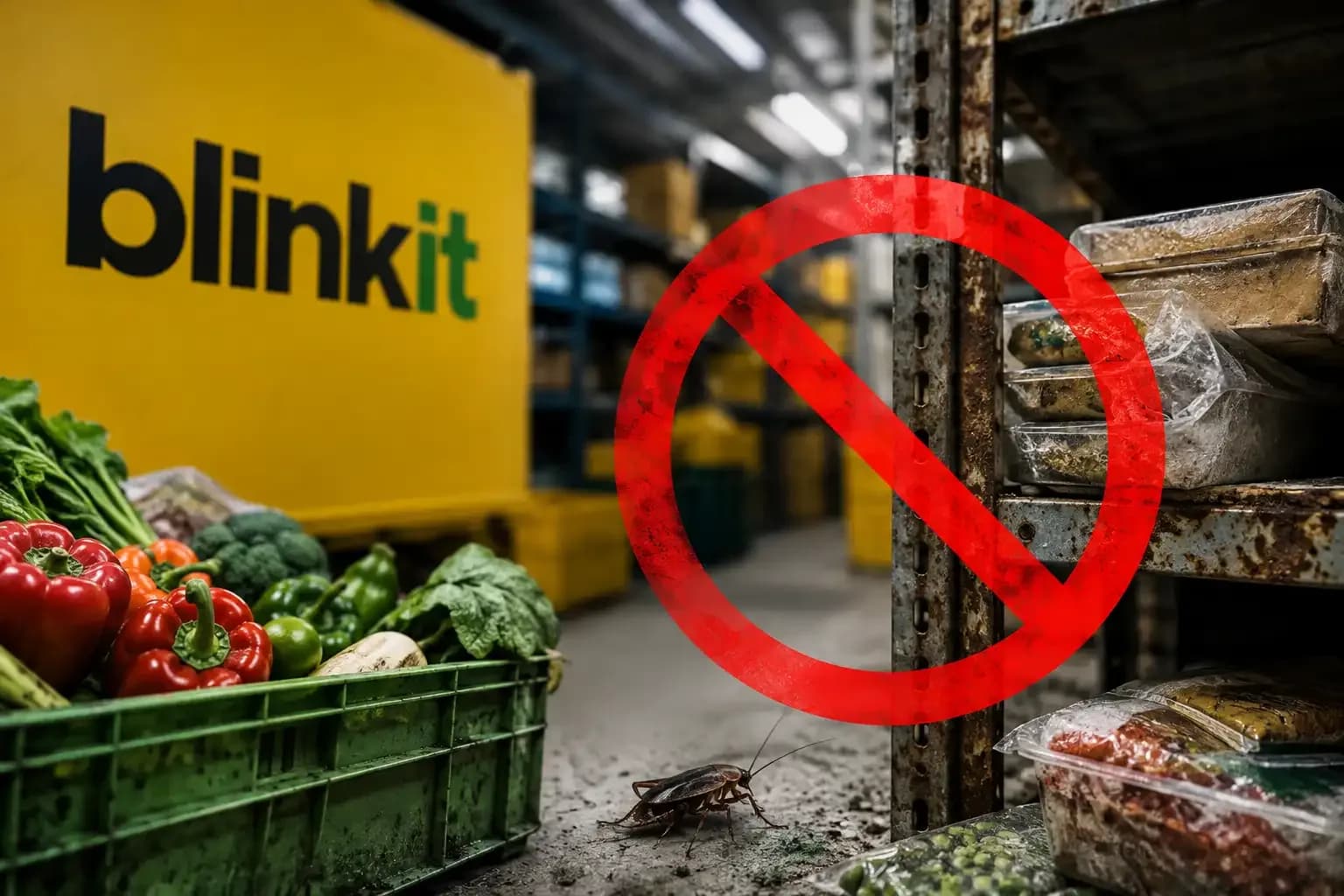
A Blinkit facility in Mumbai’s Malad West has had its food licence suspended by the Maharashtra Food and Drug Administration (FDA) after a regulatory inspection uncovered a series of serious food-safety and hygiene violations, including an extensive cockroach infestation, improperly stored food, expired and damaged products and inadequate pest-control measures.
The action was taken against Blink Commerce Pvt. Ltd., the entity operating the Blinkit facility at Sarvodaya Bhuvan in Malad West.
According to the Maharashtra FDA, food safety officers from its Brihanmumbai division inspected the facility on August 7, 2026, and found conditions that the regulator considered serious enough to warrant suspension of the establishment’s food licence.
The licence, bearing FSSAI Licence No. 11524010000119, has been suspended under Section 32(3) of the Food Safety and Standards Act, 2006, along with the applicable food-business licensing regulations. The establishment has been prohibited from selling, distributing or conducting food business during the suspension period.
Cockroaches Found in Fruit and Vegetable Storage Area
Among the most serious findings was what the FDA described as an extensive cockroach infestation inside the facility.
The infestation was particularly reported in the fruit and vegetable storage areas, raising concerns about the possibility of contamination of food products.
For a facility handling a large volume of groceries and other food products, the finding is significant because pest control is a basic requirement of food-storage and handling operations.
The FDA also flagged inadequate pest and rodent-control measures across the facility.
Food Found on Rusted Racks and Directly on the Floor
The inspection also found deficiencies in the way food products were being stored.
According to the regulator, food was found stored on rusted racks as well as directly on the floor, while some products were kept in improper and disorganised conditions.
The findings raise questions about whether adequate separation between food products and potentially contaminated surfaces was being maintained inside the dark store.
The FDA also found shortcomings in general cleanliness and maintenance of the premises.
Expired, Damaged and Tampered Food Found in Cold Storage
The problems extended to the facility's cold-storage area.
The FDA said the cold-storage section was not adequately cleaned and that inspectors found expired, damaged and tampered packaged food products, including products inside the cold room.
This is particularly significant because cold-storage facilities are expected to maintain appropriate hygiene and ensure that food products are stored under suitable conditions throughout their shelf life.
FIFO and FEFO Rules Were Not Being Followed
The inspection also highlighted failures in inventory management.
The facility was reportedly not following the standard FIFO (First In, First Out) and FEFO (First Expired, First Out) systems.
These practices are particularly important in grocery and food distribution facilities.
Under FIFO, older stock should generally be moved before newer stock. FEFO places greater emphasis on expiry dates, ensuring products with the earliest expiry are prioritised for dispatch.
Failure to properly manage these systems can increase the risk of expired products remaining in active inventory.
Food-Handler Records and Personal Hygiene Also Flagged
The FDA's findings were not limited to storage and pest control.
Officials also identified shortcomings relating to employees handling food.
According to the regulator, the facility did not have adequate medical examination and health records for food handlers.
The inspection also found deficiencies involving personal hygiene and protective equipment for workers.
Waste Management and Maintenance Were Also Found Lacking
The FDA further identified shortcomings in waste management, cleanliness and general maintenance of the facility.
Taken together with the pest infestation, improper storage and expired products, the regulator's findings point to failures across several aspects of food-safety management rather than an isolated hygiene issue.
Licence Suspended With Immediate Effect
Following the inspection, the Maharashtra FDA suspended the food licence associated with the establishment.
The regulator said the suspension was imposed under Section 32(3) of the Food Safety and Standards Act, 2006 and relevant licensing regulations.
During the suspension, the facility is prohibited from:
Selling food products
Distributing food products
Conducting food business from the establishment
The FDA has also warned that legal action could follow if the establishment is found operating in violation of the suspension order.
This Is Not a Ban on Blinkit Across Mumbai
The action should not be interpreted as a suspension of Blinkit's entire Mumbai operation.
The FDA action concerns the specific Blink Commerce facility at Sarvodaya Bhuvan in Malad West and the food licence associated with that establishment.
The licence cited by the regulator is 11524010000119.
There is currently no indication in the FDA statement that Blinkit's entire Mumbai network, or all Blinkit dark stores in Maharashtra, has been shut down.
That distinction is important because the regulatory action is establishment-specific.
What Happens Next?
The immediate question is whether the Malad facility will be allowed to resume food operations.
The suspension remains in force until further orders, meaning the establishment will need to address the violations and satisfy the regulatory requirements before normal food-business operations can resume.
The FDA's findings suggest that corrective measures would need to cover several areas, including:
Comprehensive pest-control measures
Cleaning and sanitisation
Proper food storage
Removal of expired and damaged products
Correct stock rotation through FIFO/FEFO
Cold-storage hygiene
Waste management
Food-handler health documentation
Personal hygiene and protective equipment
General premises maintenance
The regulatory action therefore puts the focus not only on cleaning the facility but also on whether the underlying food-safety systems are properly implemented.
Blinkit Yet to Respond
As of the latest reports, Eternal, the parent company of Blinkit, had not immediately responded to requests for comment regarding the FDA action.
A company response could provide further clarity on whether the violations were immediately rectified, whether operations at the particular facility have been stopped, and what corrective measures are being undertaken.
Why the Malad Action Matters for Quick-Commerce
The incident raises a larger question for India's rapidly expanding quick-commerce sector.
Platforms such as Blinkit operate through a network of dark stores designed to process grocery orders at high speed. While the model is built around rapid inventory movement, the food products inside these facilities remain subject to the same food-safety requirements governing conventional food-storage and distribution businesses.
The Malad inspection demonstrates why speed of delivery cannot come at the expense of storage hygiene, pest control, expiry management and food-handler safety.
A customer ordering fruits, vegetables, dairy products, packaged foods or other groceries through a quick-commerce platform may never see the facility where those products were stored.
That makes regulatory inspections particularly important.
The Maharashtra FDA's action is therefore more than a routine compliance matter. It puts a spotlight on the conditions inside the increasingly important last-mile food-storage infrastructure powering India's quick-commerce economy.