

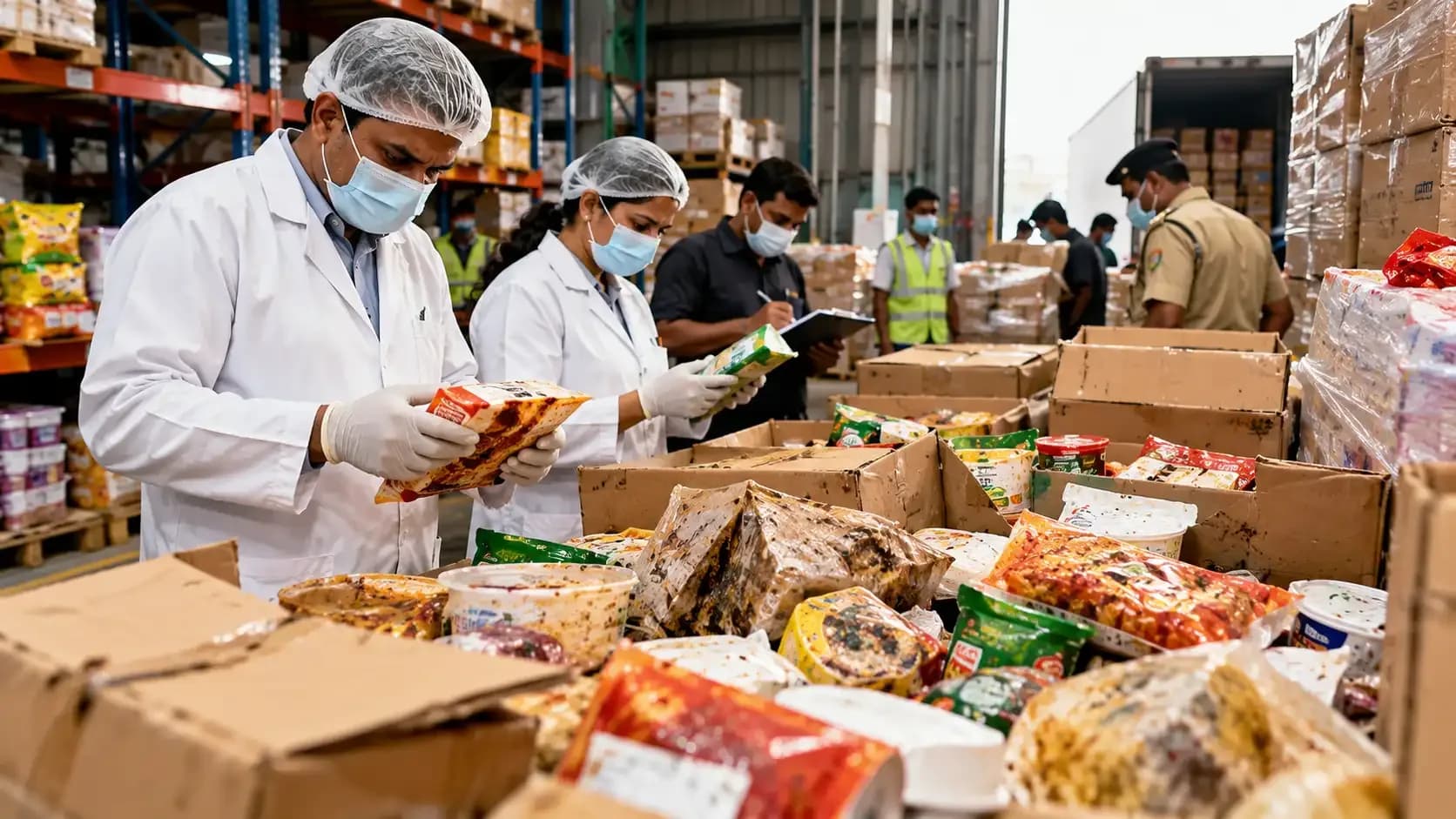
Maharashtra’s Food and Drug Administration (FDA) has launched a criminal investigation into the alleged diversion and resale of expired, damaged and rejected food products, with an FIR reportedly naming 10 people associated with Reliance Consumer Products, Reliance Retail, Blinkit Commerce, Zomato Hyperpure and local businesses involved in disposal and trading.
The case follows inspections conducted on October 14 and 15 at multiple premises in Maharashtra, including facilities in Thane and Pune districts. According to a PTI report published by The Telegraph on October 17, investigators seized food stock valued at approximately ₹48.09 lakh during the operation and examined the handling and disposal of products that should not have re-entered the consumer market.
The investigation centres on allegations that food products designated for disposal or destruction were diverted through intermediaries and subsequently offered for sale. The allegations raise questions about the controls governing expired inventory, the verification of destruction records and accountability across the food supply chain.
The FIR represents the initiation of a criminal investigation. It does not establish that every named individual or company committed an offence.
Senior Executives and Supply-Chain Personnel Named
Among those reportedly named in the FIR are V. Subramaniam, identified as a whole-time director of Reliance Consumer Products Ltd., and Arbinder Singh Dhinsa, identified as a whole-time director of Blinkit Commerce Pvt. Ltd.
The list also reportedly includes Ashok Kumar Singh of Reliance Consumer Products; Vijay Bhikaji Kharmale and warehouse manager Nilesh Ramdasrao Deshmukh of Reliance Retail; Deepak Singh of Blinkit Commerce; and Abid Shaikh of Zomato Hyperpure.
Three other individuals reportedly named are Babar Miya Ahmed Siddiqui, associated with disposal business M/s B K Dispose; Gulzar Abdul Khan, identified as a local supplier; and Abdul Mobin Khan, associated with Discount Store in Bhiwandi.
The inclusion of corporate directors alongside warehouse personnel, a disposal operator and local traders suggests that investigators are examining several links in the alleged stock movement and disposal chain.
However, the available reports do not establish the specific role, knowledge or level of involvement of each individual. Those questions will depend on the evidence collected during the investigation.
What the FDA Allegedly Found
According to published reports, the FDA’s inspections covered a disposal yard in Bhiwandi, a Reliance Consumer Products warehouse at Vadpe, a Zomato Hyperpure facility at Usatane and a retail outlet in Gulzar Nagar, Bhiwandi.
The reported stock values included more than ₹24 lakh at a disposal yard, approximately ₹4.92 lakh at the Reliance Consumer Products warehouse and approximately ₹7.81 lakh at the Zomato Hyperpure facility. Investigators also reportedly found expired and leaking products at a local retail outlet.
A separate report by Aaj Tak cited approximately 4,659 kg of expired stock valued at ₹3.72 lakh and 1,414.19 kg of damaged stock valued at ₹1.20 lakh at the Reliance Consumer Products warehouse in Vadpe.
These findings form part of the reported investigation into how food stock was stored, handled, documented and disposed of. The presence of stock at a facility does not, by itself, establish that the facility sold it to consumers or that the products reached the retail market.
Disposal Records and Stock Movement Under Investigation
A key aspect of the case is the alleged diversion of products assigned for destruction.
Food businesses routinely need procedures to identify expired or damaged inventory, segregate it from saleable goods and ensure that it is disposed of in accordance with applicable regulations. Disposal records and certificates are intended to provide an auditable trail of what happened to such stock.
Reports on the Maharashtra operation indicate that investigators are examining alleged discrepancies in disposal documentation, including inconsistencies in stock quantities and consignor–consignee details. The investigation is also reported to involve questions about the handling of products at sorting yards and the possible movement of stock to intermediaries and local suppliers.
If investigators establish that products designated for destruction were deliberately diverted for resale, the case could expose weaknesses in inventory reconciliation, contractor oversight and the verification of disposal activities.
The critical question is whether the documentation accurately reflects the physical movement and final destruction of the products, and who was responsible for ensuring compliance at each stage.
₹48 Lakh Seizure and a Separate ₹33.71 Crore Figure
The case has also generated questions about the value of the products involved.
The PTI report published by The Telegraph cited approximately ₹48.09 lakh as the value of food stock seized during the operation. A separate Aaj Tak report cited ₹33,71,30,552—approximately ₹33.71 crore—in connection with the wider FIR-related material.
The two figures should not be treated as equivalent. The available reports do not fully reconcile the scope and calculation of the larger amount, including whether it represents a broader inventory or a different valuation basis.
Until the underlying FIR, seizure schedules and supporting inventory records are examined, the ₹33.71 crore figure should not be described as the value of products physically seized or conclusively proven to have been sold to consumers.
FDA Orders and Enforcement Action
The FDA’s action reportedly extended beyond the seizure of food stock. According to the published account, licences of five establishments were suspended, while operations at four unlicensed premises were stopped following hearings on October 15.
The operation also reportedly involved inventory checks, collection of samples, recording of statements and directions concerning the handling and movement of seized products.
The reported licence suspensions and stoppage orders relate to the establishments covered by the enforcement action. They should not be interpreted as a blanket suspension of the licences or operations of every corporate group named in the FIR.
The criminal investigation and the regulatory proceedings are separate aspects of the case. Their outcomes will depend on the evidence and the applicable legal provisions.
Why the Case Matters for Quick Commerce and FMCG
India’s quick-commerce and organised retail sectors depend on complex networks of warehouses, suppliers, distributors, logistics providers and third-party service contractors. That complexity makes inventory traceability and the handling of rejected or expired products important operational and compliance priorities.
The case highlights three areas of potential concern.
First, inventory traceability. Companies need reliable records linking products marked for disposal to their physical removal and final destruction. Discrepancies between inventory systems and actual stock movements can undermine those controls.
Second, third-party oversight. Disposal contractors and intermediaries form part of the broader supply chain. Businesses must be able to verify that outsourced disposal processes comply with contractual obligations and applicable regulations.
Third, consumer protection. Expired and damaged food products must be prevented from entering channels where they could be sold or consumed. Investigators will need to establish whether the stock under scrutiny reached consumers, which products were involved and whether any safety risks materialised.
For quick-commerce operators and FMCG companies, the case reinforces the importance of documented disposal procedures, regular audits, supplier checks and clear accountability for stock movement.
The investigation will need to establish the origin and ownership of the stock, the parties responsible for handling it, the accuracy of disposal records and whether products designated for destruction were subsequently diverted for commercial sale.
It will also be important to determine the precise allegations against each person named in the FIR and whether the evidence supports further criminal or regulatory action.
The available reports do not establish that all the products involved reached consumers, nor do they establish that every named executive had direct knowledge of the alleged diversion. Those distinctions are essential to assessing the case fairly.
The investigation places food-disposal practices and supply-chain accountability under renewed scrutiny. Its broader significance for India’s organised retail, quick-commerce and FMCG sectors will depend on whether investigators can establish how the alleged diversion occurred and where responsibility lay.