

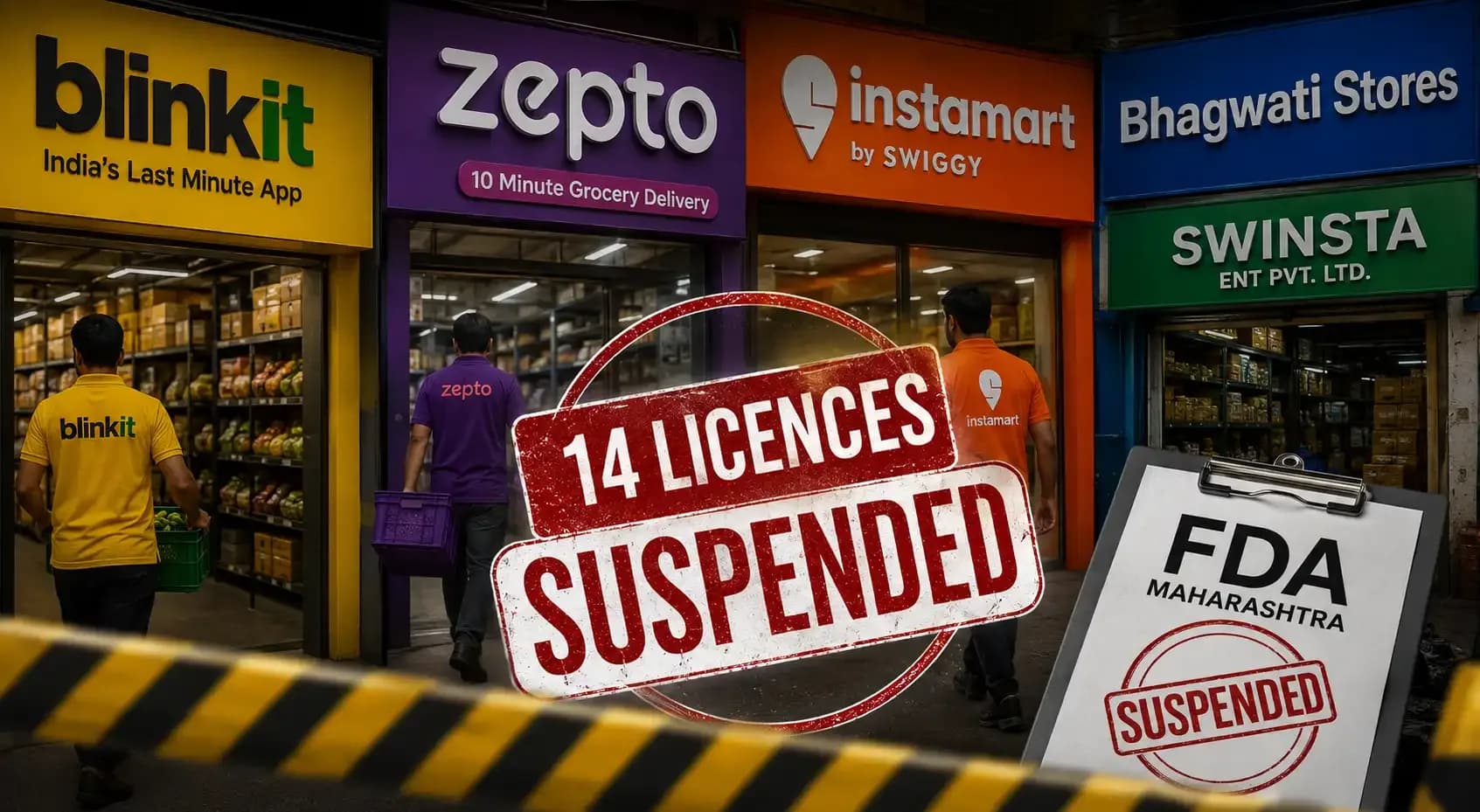
Maharashtra's Food and Drug Administration (FDA) has launched one of its strongest recent crackdowns on the rapidly expanding quick-commerce food supply chain, suspending 14 food-business licences linked to Blinkit, Zepto, Instamart and other establishments after a statewide inspection drive uncovered serious food-safety and hygiene violations.
The action followed inspections of 86 establishments involved in selling and delivering food through online platforms on August 13. The regulator issued 60 improvement notices and directed one establishment to temporarily stop business operations. Importantly, the FDA said that no licence was cancelled during the drive; the 14 licences were suspended over serious non-compliance.
The suspended licences included five Blinkit establishments, five Zepto establishments, two Instamart establishments, one Bhagwati Stores establishment and one Swinsta ENT Pvt Ltd establishment.
The findings ranged from cockroach and rodent infestations to expired food, poor temperature control, food being stored directly on floors, rusted racks, inadequate segregation of food and non-food products, poor personal hygiene and failures to follow prescribed stock-rotation procedures.
For an industry built around delivering groceries and food within minutes, the findings raise a larger question: how much attention is being given to food safety inside the warehouses that consumers never see?
What Maharashtra FDA found
The inspections were not limited to checking whether an establishment possessed an FSSAI licence.
FDA teams examined food storage, temperature control, cleanliness, pest control, personal hygiene of food handlers, FIFO/FEFO stock rotation, food-safety records and licence display, among other requirements. The regulator said suspension was imposed where it found serious non-compliance.
In several facilities, inspectors found conditions that could directly affect the safety and quality of food reaching consumers.
Reported findings included:
Cockroach infestations
Rodent and pest droppings near food
Rotten vegetables
Expired food products
Food stored directly on the floor
Rusted and damaged storage racks
Poor segregation of food products
Problems with refrigeration and temperature control
Inadequate pest-control measures
Poor housekeeping
Inadequate personal hygiene
Missing medical fitness records for food handlers
Failure to follow FIFO/FEFO practices
Failure to properly display FSSAI licences.
Blinkit: Five licences suspended
Blinkit was among the most affected platforms, with five licences suspended.
At a Blinkit facility in Malad West, Mumbai, inspectors found the chiller-room temperature at 6°C, which the FDA said was above the required level. Around 40 food handlers had not undergone medical examinations, and the required records were unavailable.
The inspection also found handlers without appropriate headgear, aprons and gloves. Storage was described as disorganised, with damaged and rusted racks and inadequate segregation of vegetarian, non-vegetarian, cooked and dairy products. The FDA also cited shortcomings in training and food-safety supervision.
The Malad action had already emerged earlier this week after an inspection on August 7. Reports from the inspection described cockroach infestation, poor storage conditions and problems involving food stock.
At another Blinkit facility in Ghatkopar, the inspection recorded inadequate drainage and waste-disposal arrangements, problems with frozen-food temperature control, unprotected lighting fixtures in an unpacked-food storage area and poor housekeeping.
The establishment scored 34 out of 74, or about 46 per cent, and was classified as non-compliant.
The FDA also took action against a Blinkit operation in Karad, Satara district, where officials checked 125 two-wheeler delivery riders. The riders reportedly did not have identity cards or medical fitness records, while the principal food business's FSSAI licence was not displayed on delivery carts, bags or boxes.
The FDA ordered the two-wheeler delivery activity to stop until the deficiencies were rectified.
Zepto: Expired food and cold-chain concerns
Zepto also had five licences suspended.
One of the most significant actions was against a Zepto establishment in Lohegaon, Pune.
According to the FDA, some food products had been kept beyond their declared "Use By" dates. Inspectors also found that FIFO and FEFO stock-rotation practices were not being followed.
The inspection further recorded unhygienic storage, inadequate pest control and serious personal-hygiene deficiencies. The FDA said Zepto's response during the subsequent hearing was unsatisfactory.
In Mulund, Mumbai, another Zepto establishment was found to have inadequate waste-disposal facilities, temperature-control problems, lighting deficiencies and issues with separate storage facilities.
The establishment scored 81 out of 180, or approximately 45 per cent, and was classified as non-compliant. It also reportedly failed to prominently display its FSSAI licence.
A reinspection of Zepto's Gola Unit in Goregaon found deficiencies in temperature control, lighting, food storage, personal-hygiene facilities and cleanliness.
Interestingly, the facility scored 98 out of 142, or about 70 per cent, but was still classified as non-compliant. This underlines that food-safety enforcement is not necessarily determined by a single overall score; specific critical deficiencies can also trigger regulatory action.
Reuters also reported that at a Zepto warehouse in Nashik, delivery staff were entering storage areas wearing street footwear, creating a potential cross-contamination risk. FDA photographs showed rusted and dirty racks, including cockroaches around food items.
Instamart: Food packets found on the floor
Two Instamart-linked licences were suspended.
At an Instamart facility in Andheri, Mumbai, FDA inspectors found food packets stored directly on the floor.
The inspection also identified inadequate storage space, congestion involving food products and packaging material, temperature-control deficiencies, lighting problems and shortcomings in cleanliness and personal hygiene.
The facility scored 76 out of 140, or approximately 55 per cent, and was recorded as non-compliant.
At a Rajidi Retail Private Limited unit in Bandra West, inspectors reportedly found large quantities of rodent droppings near food packets along with a lizard infestation. The Indian Express reported that an FDA official said Rajidi and Bhagwati were different names under which Instamart was operating.
Swinsta ENT: Cockroaches and cold-chain failures
The FDA also suspended the licence of Swinsta ENT Pvt Ltd at Warje Jakat Naka in Pune.
Inspectors found cockroach infestation, inadequate maintenance of the cold chain for frozen products, temperature-control problems and serious shortcomings in hygiene and pest-control practices.
Bhagwati Stores also among those affected
One licence belonging to Bhagwati Stores was also suspended, taking the overall total to 14.
The FDA's breakdown was:
Platform / Establishment | Licences suspended |
|---|---|
Blinkit | 5 |
Zepto | 5 |
Instamart | 2 |
Bhagwati Stores | 1 |
Swinsta ENT Pvt Ltd | 1 |
Total | 14 |
The FDA's official breakdown is also consistent with reporting by Business Standard and the Indian Express.
86 establishments inspected, 60 improvement notices issued
The scale of the operation is perhaps more significant than the headline number of 14 suspensions.
On August 13, the Maharashtra FDA inspected 86 establishments involved in online food sales and delivery across the state.
Of these:
14 licences were suspended
60 improvement notices were issued
1 establishment was ordered to temporarily stop business operations
The FDA said no licence was cancelled as part of the drive.
This distinction is important. A suspension is not the same as cancellation. The regulator has temporarily stopped the affected food businesses from operating under the suspended licences, while corrective action and further regulatory review can determine what happens next.
This crackdown did not begin with the August 13 raid
The latest action comes against the backdrop of increasing scrutiny of quick-commerce food operations.
Earlier inspections had already resulted in regulatory action against individual facilities. The current campaign has now expanded the focus to a much larger number of establishments and platforms.
The August 7 inspection of the Blinkit facility in Malad West, followed by the August 13 statewide inspection drive, illustrates how the regulator's scrutiny has intensified in recent days.
Reuters reported that the latest campaign is part of a broader food-safety crackdown under Maharashtra FDA chief Tukaram Mundhe, which has also included action against restaurants and food businesses.
Why the action matters for quick commerce
Quick-commerce companies have changed the way Indians buy groceries.
A customer can order milk, vegetables, packaged food, dairy products and other groceries and receive them within minutes. But behind that convenience is a network of dark stores and warehouses where thousands of food products are received, stored, picked and packed.
Consumers rarely see those facilities.
That makes regulatory inspections particularly important.
A delivery app can make the ordering experience look clean and seamless, but the food still passes through a physical storage environment before reaching the consumer.
The Maharashtra inspections suggest that speed cannot come at the expense of basic food-safety controls.
Temperature management, pest control, stock rotation, worker hygiene and proper storage are not cosmetic requirements. They are fundamental controls intended to prevent contamination and deterioration before food reaches the customer.
The bigger concern: what happens inside the dark store?
The latest findings raise a question that goes beyond Blinkit, Zepto or Instamart.
If a warehouse stores food directly on the floor, has pest activity, fails to maintain temperatures or keeps products beyond their declared use-by dates, the problem isn't simply about the appearance of the warehouse.
It potentially affects the entire food-safety chain.
And because quick-commerce companies operate at enormous scale, even a problem at a relatively small number of facilities can become significant if it involves large volumes of food moving through those facilities.
Reuters reported that Blinkit has around 2,200 delivery outlets in India, while Zepto and Instamart each have roughly 1,100, citing Datum Intelligence.
The immediate question is whether the affected establishments will be able to demonstrate corrective compliance and regain their licences.
The FDA has made clear that it expects food businesses selling through online platforms to maintain prescribed standards for food safety, hygiene and storage.
For the quick-commerce industry, the message is straightforward: the five-minute or ten-minute delivery promise does not reduce the responsibility to maintain food safety standards.
The regulator's latest action also signals that dark stores and online food-delivery warehouses are increasingly being treated as an important part of the food-safety ecosystem rather than simply logistics facilities.
For consumers, the episode is a reminder of something easy to overlook: when a grocery order arrives at the doorstep in minutes, the most important part of the journey may have happened somewhere the customer never sees.
And that is precisely where regulators are now looking.
The Maharashtra FDA's action is therefore not just a story about 14 suspended licences. It is a test of whether India's quick-commerce model can maintain its extraordinary speed without compromising the basic standards expected of any business handling food.