
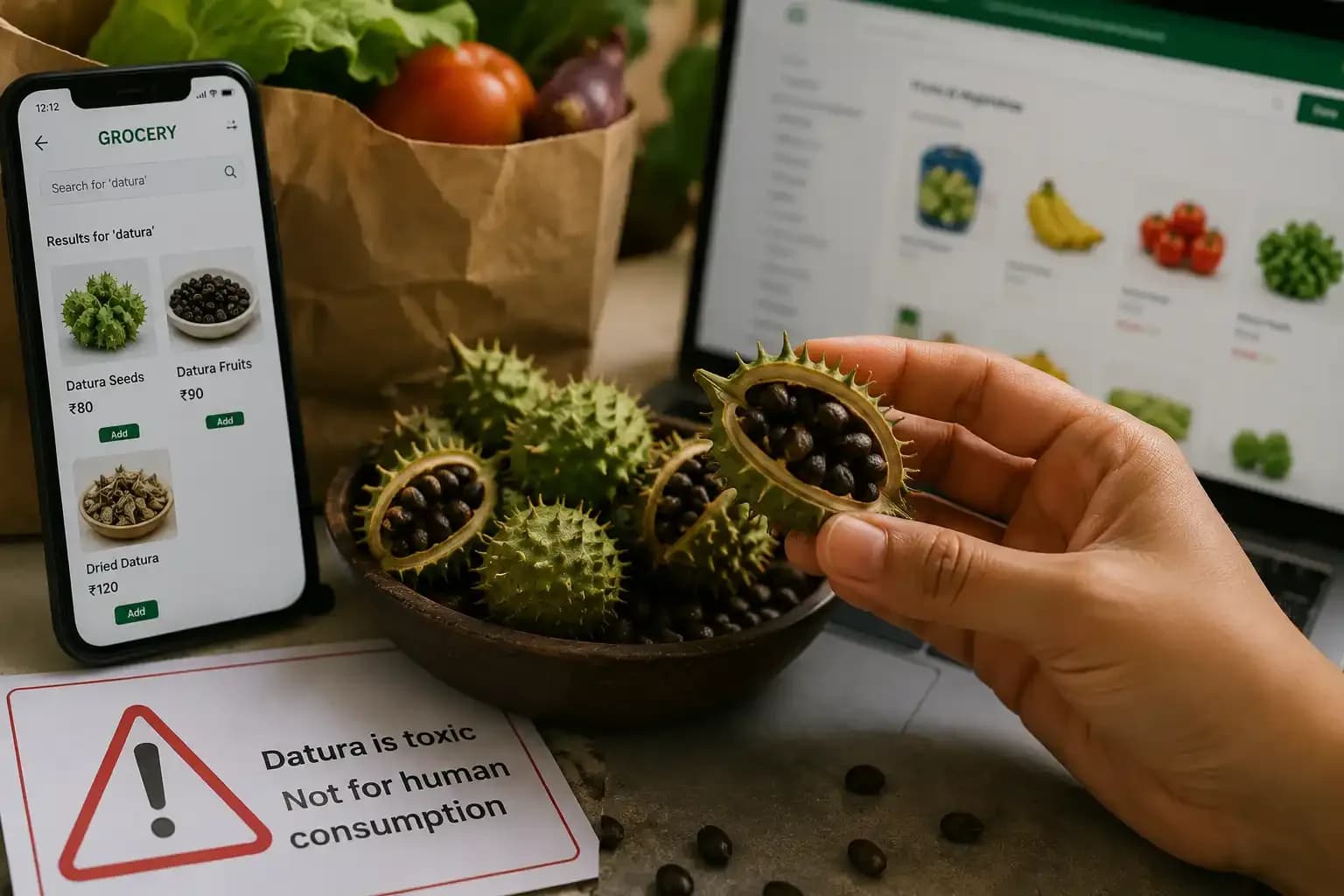
A poisonous plant that should never have been sold as food has triggered one of Karnataka's strongest recent actions against online food marketplaces.
The Karnataka Food Safety and Drugs Administration (KFSDA) has ordered the suspension, until further orders, of food licences and registrations associated with Amazon, Swiggy Instamart and BigBasket after officials found Datura fruits and seeds being offered online as food products for human consumption.
The regulator has also ordered action against suppliers and sellers linked to the products, making the episode bigger than a simple dispute over third-party marketplace listings.
The case raises an uncomfortable question for India's rapidly expanding quick-commerce and e-commerce food sector: when an unsafe product reaches a consumer through a digital marketplace, where does responsibility ultimately lie?
What Karnataka Found
According to the food-safety authorities, inspections found Datura fruits and seeds stored in warehouses, packed and offered through online platforms as food products.
In some cases, the products reportedly carried FSSAI licence or registration numbers, despite the fact that Datura is poisonous and its sale or distribution as food presents a serious public-health risk.
The findings prompted an inquiry into the sale and online listings.
The Karnataka Food Safety and Drugs Administration subsequently directed the concerned platforms to immediately:
Remove Datura-related listings and advertisements.
Stop selling or distributing Datura as a food product.
Stop displaying or promoting Datura fruits and seeds for human consumption.
Submit compliance reports to the authorities.
The action has been initiated under the Food Safety and Standards Act, 2006, and the applicable food-safety rules and regulations.
Why Is Datura Such a Serious Food-Safety Concern?
Datura, commonly known as Dhatura, is a highly poisonous plant belonging to the nightshade family.
Its fruits and seeds contain potent toxic compounds and can cause serious poisoning if consumed. Reported effects can include severe neurological symptoms, abnormal heart rhythms, respiratory problems and, in serious cases, coma or death.
The plant does have traditional uses in certain religious, medicinal and cultural contexts. But that does not make its raw fruits or seeds suitable for sale as ordinary food.
That distinction is central to the Karnataka regulator's action.
The issue was not simply that Datura appeared on an e-commerce website. Authorities specifically found it being stored, packed, listed and offered in the context of food or human consumption.
Amazon, Instamart and BigBasket: What Happened?
Representatives of the companies appeared before the authority during proceedings on August 24.
Their responses, however, differed.
Amazon did not submit a response to the notice, according to the commissioner's order.
Swiggy Instamart sought additional time to submit documents explaining the action it had taken after receiving the department's notice.
BigBasket said it had stopped the online sale of the Datura product and indicated that future labelling would clearly state that it was “not for human consumption.”
The regulator nevertheless considered the responses unsatisfactory in view of the potential public-health risk.
That led to the order for suspension of the food licences until further orders.
The Action Is Not Limited to the Platforms
One of the most significant aspects of the case is that Karnataka has also moved against the suppliers and sellers associated with the Datura products.
Authorities have ordered suspension of their food licences and registrations and directed the relevant licensing authorities to consider further action, including cancellation where legally applicable and after following due process.
This is important because it establishes that the regulator is examining the entire chain:
Supplier → Seller → Marketplace → Consumer
Rather than treating the incident solely as a platform-listing problem, the authorities are examining the food businesses involved in putting the product into the market.
Why the FSSAI Number Makes This Case More Serious
Perhaps the most troubling detail is that officials reportedly found Datura products carrying food registration or licence numbers.
An FSSAI number on a package can create an impression of regulatory legitimacy for consumers.
But an FSSAI licence does not mean every individual product sold by a business is automatically safe or compliant. Food businesses remain responsible for complying with applicable food-safety requirements, while marketplaces and sellers also face questions about how products are identified, categorised and presented.
In this case, the presence of food-registration details on products that authorities say were poisonous and impermissible to sell as food adds another layer to the investigation.
The Bigger Question: Who Is Responsible When Unsafe Food Is Sold Online?
This is where the Datura episode becomes particularly significant for India's digital food economy.
Traditional food retail has a relatively straightforward chain of accountability. A manufacturer produces a product, a distributor moves it, a retailer sells it and regulators can inspect those businesses.
Online marketplaces complicate that chain.
A single platform can host thousands of sellers and millions of product listings. Quick-commerce platforms can also combine digital catalogues with warehouses and highly accelerated delivery systems.
That creates a fundamental food-safety challenge:
How effectively can platforms verify what is being sold before it reaches consumers?
The Karnataka action suggests that regulators are increasingly prepared to examine the role of the marketplace itself rather than simply treating the platform as a passive noticeboard.
At the same time, the case also demonstrates why responsibility cannot automatically be placed on one party.
The seller who supplied the product, the business that packaged it, the entity that represented it as food and the platform through which consumers could purchase it may all have different responsibilities under the law.
The precise liability of each party will ultimately depend on the facts, applicable licences, contractual arrangements, the nature of the listing and the regulatory proceedings.
A Warning for Quick-Commerce Platforms
The incident comes at a time when consumers increasingly rely on apps for groceries, fresh produce, packaged foods, snacks and other food products.
Convenience has become the selling point.
But food safety cannot operate at the same speed as a simple product search.
A consumer searching for an unusual seed, herb or traditional ingredient may not necessarily know whether the item is:
legally permitted as food;
intended only for non-food use;
poisonous in its raw form;
appropriately labelled;
or being sold by a legitimate food business.
That places greater importance on seller verification, product classification, catalogue monitoring, labelling checks and rapid removal mechanisms.
The Datura case shows what can happen when those safeguards fail.
The suspension is currently reported to remain in force until further orders.
The companies and other affected food businesses have been given an opportunity to respond, and further action is expected after compliance reports and the applicable legal process.
The authorities have also indicated that separate orders may follow after the concerned parties submit their compliance information and are given an opportunity to present their case.
That means the August 25 action should not necessarily be viewed as the final outcome of the matter.
It is, however, a significant regulatory signal.
The Bigger Food-Safety Lesson
The Datura episode is about much more than one poisonous plant.
It exposes a growing challenge for India's food-safety ecosystem: the digital marketplace is increasingly becoming part of the food-supply chain.
When a consumer orders food through an app, the expectation is simple — the product should be legal, correctly represented and safe to consume.
If a poisonous substance can be packaged, assigned food-registration details and presented online as a food product, the question is no longer only about one seller.
It is about whether the safeguards surrounding India's rapidly expanding digital food marketplace are strong enough.
For regulators, platforms and food businesses alike, Karnataka's action sends a clear message:
Food safety does not end at the warehouse — and it certainly does not end at the upload button.
The next question will be whether this case leads to stronger marketplace-level checks across India's online food and quick-commerce sector.