

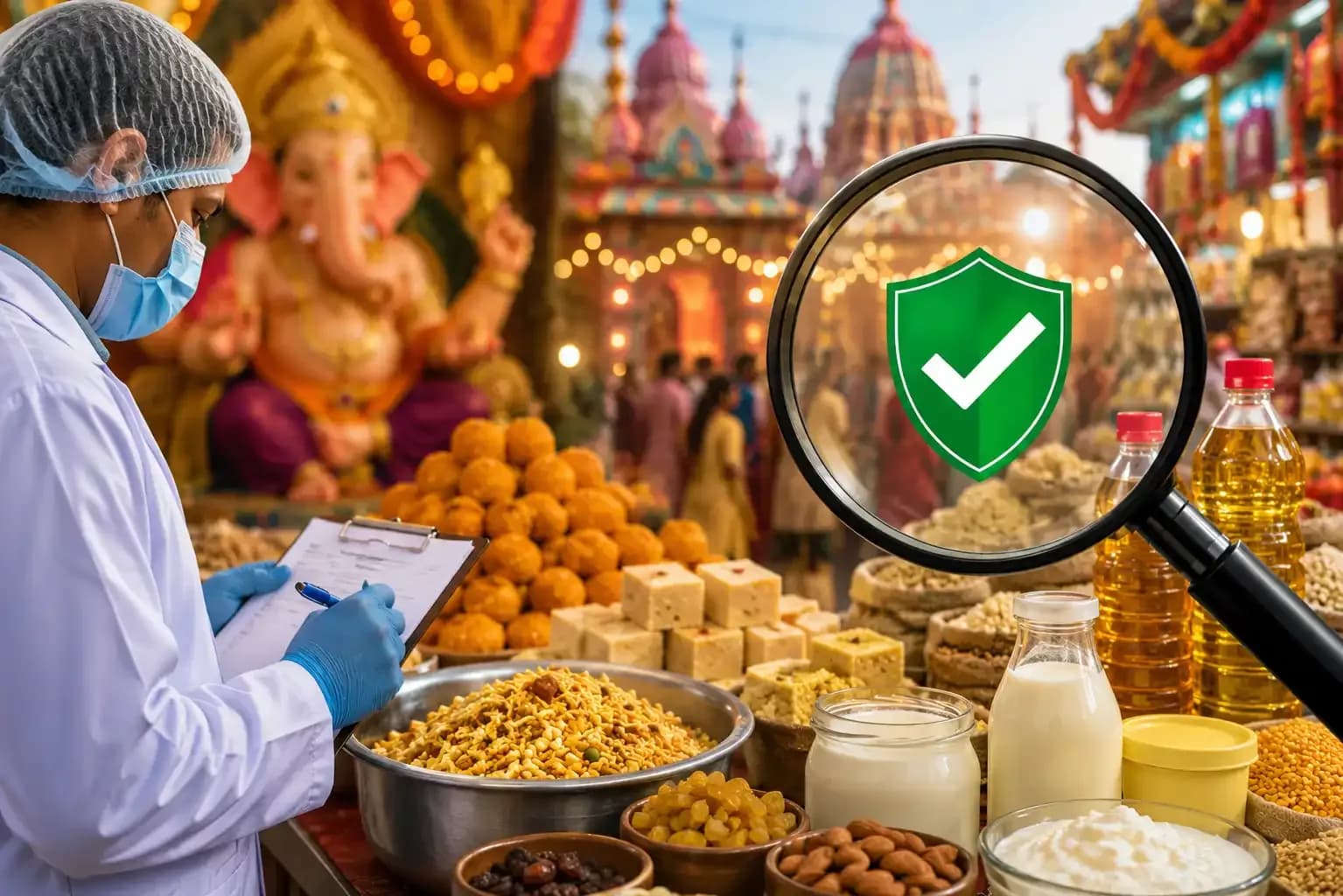
Maharashtra's Food and Drug Administration (FDA) has moved to a year-round, planned approach to festival food-safety enforcement, introducing a permanent “Festival Enforcement Calendar” covering major festivals, religious seasons, yatras and local gatherings across the state.
The new framework replaces the earlier practice of issuing separate enforcement directions for individual festivals. Instead, the FDA will now identify food-safety risks in advance and plan inspections, sampling, laboratory testing and enforcement action around the festival calendar.
The move comes against the backdrop of a predictable rise in demand for sweets, dairy products, snacks, edible oils, meat and other food items during festive periods — a surge that the department says can increase the risk of adulteration and unsafe food practices.
Maharashtra FDA Commissioner Tukaram Mundhe said the objective is to ensure that enforcement is planned rather than reactive, with the intensity of surveillance determined by the nature and risk profile of each festival.
Three-tier system for festivals
Under the new framework, festivals and gatherings have been divided into three levels.
Level 1 covers major state-wide festivals where a comprehensive four-phase enforcement exercise will be mandatory. These include Ganeshotsav, Navratri, Diwali, Eid-ul-Fitr, Eid-ul-Adha, Christmas and New Year's Eve.
Level 2 covers festivals and religious occasions requiring regional, risk-based enforcement. The list includes Makar Sankranti, Mahashivratri, Holi, Rangpanchami, Gudi Padwa, Akshaya Tritiya, Vat Purnima, Raksha Bandhan, Nag Panchami, Janmashtami, Dahi Handi, Dussehra, Kojagiri Pournima, Tulsi Vivah and Guru Nanak Jayanti, along with the Ashadhi and Kartiki Wari and the month of Shravan.
Level 3 covers local festivals and gatherings, including village-level celebrations, jatras, Urus, palkhi festivals, fairs and other local events.
The categorisation is intended to allow the FDA to deploy resources according to the potential food-safety risk instead of applying the same level of enforcement everywhere.
Enforcement will begin weeks before the festival
One of the most significant changes is the timing of inspections.
For major festivals, enforcement will follow a four-phase cycle beginning as early as 21 days before the event and continuing for up to 30 days afterwards.
During Phase 1, 21 to 15 days before the festival, FDA teams will map high-risk areas, gather intelligence on food businesses and products and plan manpower, sampling requirements and laboratory capacity. Rapid-testing equipment will also be positioned in advance.
Phase 2, from 14 to seven days before the festival, will focus on the supply chain. Officials will inspect production centres, khava markets, cold-storage facilities and godowns, collect samples and verify raw materials. Transport vehicles carrying food commodities may also face checks, including interception at night.
Phase 3, covering the festival period, will shift the focus to market surveillance. Sweet shops, food establishments and other high-risk businesses will be inspected, with on-the-spot testing through facilities such as Food Safety on Wheels.
The final phase will continue for up to 30 days after the festival. During this period, officials will follow up on laboratory reports, prepare cases and initiate adjudication or other legal action wherever violations are established. Unsafe food can be confiscated and disposed of as required.
The order also directs officials to initiate proceedings under Section 32(3) within 14 days of receiving an analysis report, with accountability to be fixed where this timeline is not followed. Inspections and sampling are to be uploaded on the FoSCoS portal, while areas with no activity will require a Nil Report.
FDA identifies festival-specific food risks
Rather than relying solely on generic inspections, the new system identifies specific foods that are more vulnerable during particular festivals.
During Mahashivratri and Navratri, for example, the FDA will focus on fasting foods such as bhagar, kuttu, shingada and rajgira flour, sabudana and related products. The aim is to detect contamination, including contamination by poisonous weeds, at production and wholesale centres.
Milk and dairy products will receive particular attention during Janmashtami, Ramzan Eid, Kojagiri, Ganeshotsav, Diwali and Holi, with inspections of milk transportation and efforts to trace synthetic milk and adulterated khava back to their source.
During Eid and other occasions involving large-scale meat consumption, officials will inspect meat shops for cleanliness and cold-chain compliance.
The festival-specific checks will also cover sweets, khava, silver varakh, edible oils, dry fruits, bakery products, cakes, ice, packaged drinking water, fruits and imported food products.
For Christmas, bakery products will come under particular scrutiny, while the FDA plans targeted action against the illegal chemical ripening of fruits around Akshaya Tritiya.
Used cooking oil also comes under the scanner
The new framework sets out a specific enforcement position on repeatedly used frying oil.
The FDA has stated that edible oil containing more than 25 per cent Total Polar Compounds (TPC) is considered unfit for human consumption and should not be reused. Such oil is to be transferred only to authorised RUCO (Repurpose Used Cooking Oil) aggregators.
The department will also take action against the use of aluminium in place of pure silver for food-grade varakh and against the use of newspaper or printed paper for wrapping food.
Bhandaras, Mahaprasad and Langars brought into the framework
The new enforcement system extends beyond commercial food businesses.
Large-scale community food distribution programmes such as Mahaprasad, Iftar meals, Annachhatras, Langars and Bhandaras will also come under food-safety surveillance.
The FDA has directed organisers to engage licensed or authorised caterers and provide advance information to the concerned authorities. Caterers are expected to provide details about their operations and sources of raw materials.
According to the framework, caterers must inform the designated officer seven days before such an event, allowing food-safety officials to carry out checks where required.
This follows an earlier FDA push to bring large community food-distribution events within the formal food-safety system, including requirements around temporary registration or licensing.
Food businesses face tighter compliance expectations
The calendar is not only an enforcement tool for FDA officers. It also sets out expectations for food business operators.
Businesses have been directed to prominently display their valid food licence or registration and Food Safety Connect QR code, purchase raw materials only from authorised or registered suppliers and maintain purchase records.
Food handlers are required to have annual medical fitness certificates, while establishments employing 25 or more food handlers must have at least one FoSTaC-certified food safety supervisor for every 25 handlers.
The FDA has also reiterated restrictions on prohibited colours and industrial chemicals being used in food.
From festival raids to planned enforcement
The significance of the new calendar lies less in the individual inspections and more in the change in enforcement strategy.
Until now, food-safety drives around festivals have often been organised as separate campaigns. The new standing framework attempts to make those interventions predictable and systematic — identifying vulnerable foods, locations and supply chains before demand peaks.
For consumers, that could mean greater scrutiny of the food entering markets during the periods when consumption rises sharply. For food businesses, however, it also means that compliance cannot be treated as a last-minute festival exercise.
The FDA has said the system is intended to maintain zero tolerance for serious food-safety violations while avoiding unnecessary disruption to compliant businesses.
The department has also urged consumers to check licence information and QR codes and use its complaint mechanism when they encounter suspected food-safety violations. Complaints can be submitted in Marathi, Hindi or English, with the FDA providing a toll-free helpline at 1800-222-365.
With Ganeshotsav, Navratri and Diwali among the major festivals covered by the new system, the coming festive season will provide the first major test of Maharashtra's new year-round enforcement model.