

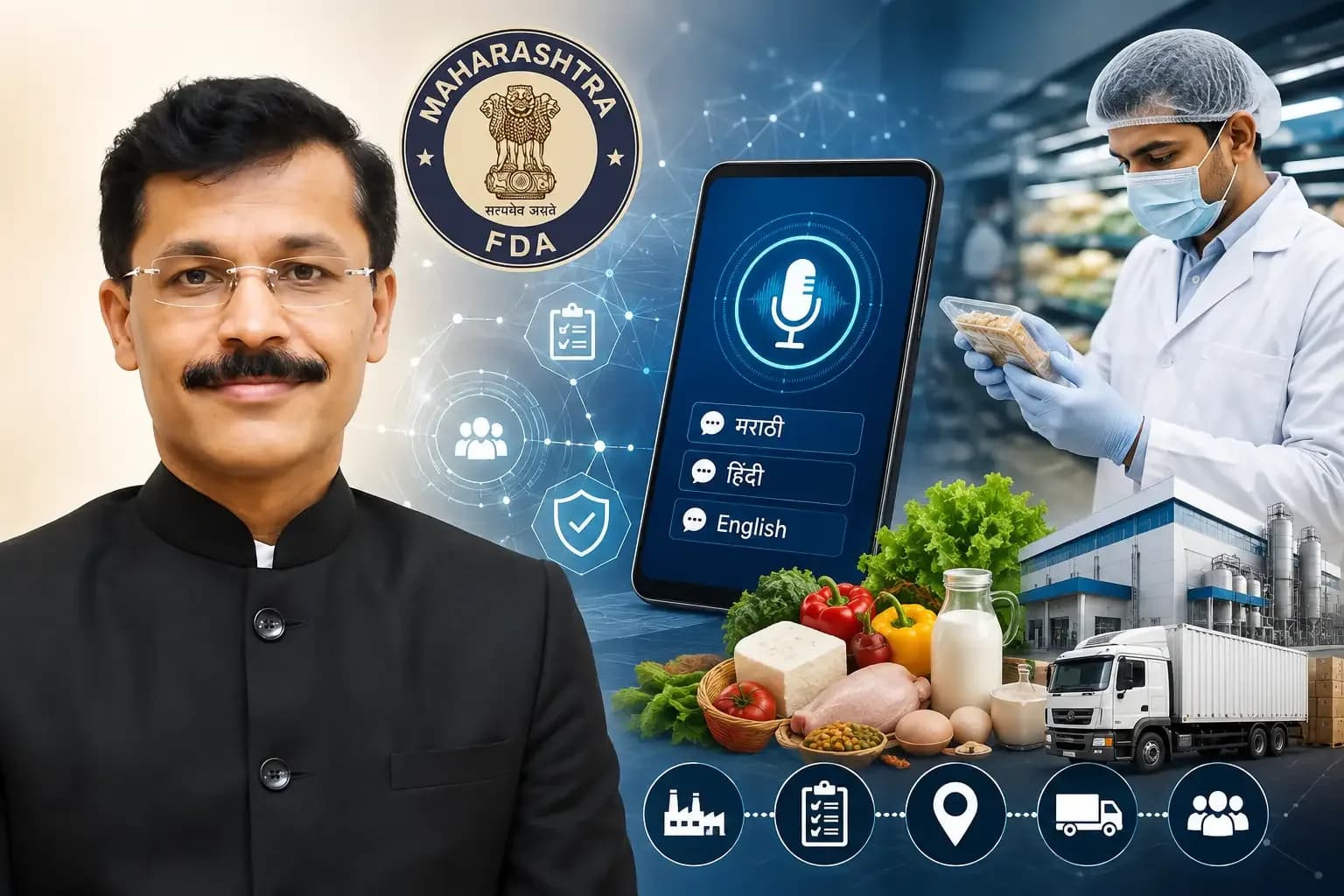
Maharashtra's food safety enforcement system is undergoing a major digital transformation, with the Maharashtra Food and Drug Administration (FDA) introducing an AI-powered grievance portal and planning a wider technology-driven system to track food businesses, complaints, inspections and violations.
The initiative, being led under FDA Commissioner Tukaram Mundhe, aims to make food safety enforcement more accessible to consumers while creating greater accountability within the regulatory system.
AI-powered portal allows consumers to report food safety violations
The Maharashtra FDA's new Food & Drug Grievance Portal allows citizens to submit complaints related to unsafe food, adulteration, hygiene violations, medicines and other issues under the department's jurisdiction.
One of the key features is voice-based complaint registration. Consumers can describe their complaint verbally, with the system supporting Marathi, Hindi and English.
Artificial intelligence is used to structure and classify the information before the complaint is routed to the appropriate authority.
This could make it considerably easier for consumers who may struggle with lengthy online forms or technical terminology to report food safety concerns.
Complaints to be automatically assigned and escalated
The new system is designed not only to receive complaints but also to create a digital accountability trail.
Once a complaint is submitted, it can be routed to the relevant Food Safety Officer or Drug Inspector. Citizens can subsequently track the status of their complaint.
The system also incorporates automatic escalation mechanisms for cases that are not acted upon within the prescribed timeframe.
According to the FDA's stated process, a regional Joint Commissioner is required to take cognisance of a complaint within 24 hours and assign it to the appropriate officer.
The objective is to reduce the possibility of complaints remaining unattended and to make responsibility easier to establish.
Maharashtra FDA plans integrated digital food-safety system
The grievance portal is only the first stage of the department's broader digital strategy.
The FDA has announced plans for an integrated digital platform that could bring together licensing, inspections, industry information, consumer complaints, enforcement actions and food-product traceability.
The proposed system is intended to give regulators a more complete picture of food businesses and their compliance history rather than treating individual inspections or complaints as isolated events.
The department has indicated that it wants to develop the system within a timeframe of approximately six months to one year.
Blockchain could be used to maintain violation records
One of the more ambitious elements of the proposed transformation is the possible use of blockchain technology.
The FDA is considering blockchain-based records for violations and regulatory actions, which could help create a more permanent and traceable compliance history.
Under such a system, repeated violations by a business could potentially be linked to its previous regulatory record rather than being viewed as individual incidents.
However, the blockchain component is currently part of the department's proposed digital overhaul and should not be interpreted as an already operational statewide blockchain system.
One business entity could be linked to multiple outlets
The FDA is also developing a database capable of connecting multiple food businesses operated by the same entity through a common identifier.
This could have significant implications for restaurant chains, food manufacturers, hotel groups, cloud kitchens and other businesses operating multiple establishments.
For example, if one outlet belonging to a larger business group is found violating food-safety requirements, regulators could potentially identify other establishments associated with the same entity and use the information for risk-based inspections.
The proposed approach could therefore move enforcement from an outlet-by-outlet model toward a broader entity-level compliance system.
End-to-end food traceability planned
Another major component of the proposed system is food traceability.
The FDA wants to improve its ability to track food products across the supply chain, potentially connecting manufacturers, processors, distributors, wholesalers, retailers and food-service businesses.
Such a system could become particularly valuable during contamination incidents or product recalls.
If a particular food product is found to be unsafe, digital traceability could help regulators identify where it originated and which businesses may have received or sold it.
Milk and dairy products are among the areas where traceability has become particularly important amid concerns over adulteration and supply-chain controls.
Industry data could become part of the regulatory system
The proposed digital architecture is also expected to involve greater participation from the food industry.
Businesses could provide operational and compliance information that regulators can compare with inspection findings and other available data.
This could eventually allow the FDA to identify patterns and prioritise inspections based on risk rather than relying solely on routine or manual inspection processes.
Such a model would represent a shift toward preventive and data-driven food safety enforcement.
Consumer complaints could become an important source of intelligence
The new AI-powered grievance system could also provide the FDA with a much larger pool of real-time information from consumers.
Instead of complaints being treated only as individual cases, aggregated data could potentially help identify recurring problems, geographic hotspots or businesses repeatedly associated with food-safety concerns.
For consumers, the most immediate benefit is the ability to report problems more easily and track what happens after a complaint is filed.
For regulators, the larger opportunity is the creation of a continuously updated source of food-safety intelligence.
A significant shift for Maharashtra's food industry
The digital transformation comes at a time when Maharashtra FDA has intensified inspections and enforcement action against food businesses across the state.
Recent action against restaurants, dairies and other food establishments has highlighted the department's increasingly strict approach to hygiene, licensing and food-safety compliance.
The proposed digital system could take that enforcement model a step further by giving regulators access to a consolidated history of businesses, complaints, inspections and violations.
For food businesses, this means compliance could increasingly become a continuous responsibility rather than something addressed only when an inspection takes place.
What is operational and what is still planned?
It is important to distinguish between the technology that has already been introduced and the wider system still being developed.
Currently introduced:
AI-powered food and drug grievance portal
Voice-based complaint submission
Marathi, Hindi and English support
AI-assisted complaint processing
Automatic complaint assignment
Complaint tracking
Escalation and accountability mechanisms
Planned as part of the wider digital transformation:
Integrated FDA regulatory platform
End-to-end food traceability
Industry data integration
Entity-level business identification
Blockchain-based violation records
Broader digitalisation of inspections and enforcement
The Maharashtra FDA's approach signals a shift from traditional, largely manual regulatory enforcement toward a system built around AI, data, traceability and digital accountability.
If the proposed integrated platform is implemented as planned, Maharashtra could become an important test case for how technology can be used to monitor food businesses, respond to consumer complaints and trace food-safety risks across an entire state-level supply chain.