

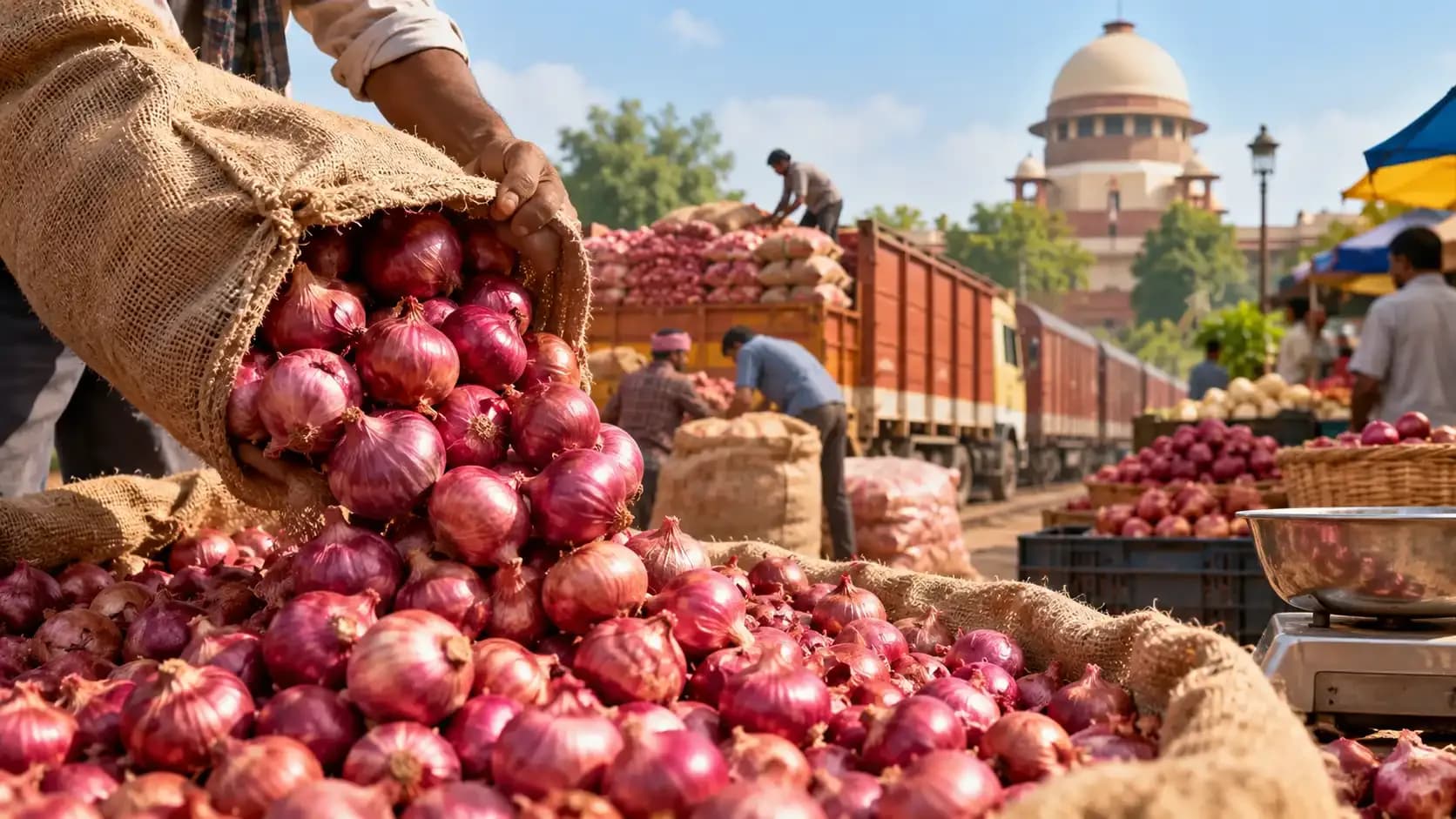
The government has sold around 4,000 tonnes of onions from its buffer stock across 17 cities in just 10 days, stepping up efforts to contain rising retail prices and improve supplies in key consumption centres.
The intervention comes as onion prices remain elevated across several markets, putting pressure not only on household budgets but also on restaurants, caterers, hotels, QSRs, cloud kitchens and food manufacturers, for whom onions are a critical everyday ingredient.
The government is selling the buffer onions at ₹35 per kg through retail channels operated by agencies including the National Cooperative Consumers’ Federation (NCCF) and NAFED.
But there is a catch: despite the intervention, the national average retail price has not yet fallen.
4,000 tonnes sold, but prices remain under pressure
The Centre created a 1.21 lakh-tonne onion buffer stock for 2026, which it can release into the market when prices rise sharply or supplies become constrained.
Of this stock, roughly 4,000 tonnes have already been sold through the latest retail intervention. That represents only about 3.3% of the government's total buffer, leaving significant inventory available for further market intervention if prices remain elevated.
NCCF alone has sold around 1,500 tonnes.
The onions are being moved from producing regions to major consumption centres through a combination of road transportation and rail.
The government has also deployed dedicated railway services, including the “Kanda Express”, to move large consignments quickly from producing areas to deficit markets.
The first Kanda Express rake carried around 450 tonnes from Nashik to Delhi, while another shipment of approximately 840 tonnes reached Chennai.
The strategy is straightforward: move government-held onions into markets where availability is tight, sell them at a controlled price and increase supply quickly enough to moderate prices.
Why are onion prices rising?
The immediate pressure is linked to the availability of the rabi onion crop.
According to the government, untimely rainfall during harvesting damaged part of the rabi crop, affecting the quantity available for storage and subsequent market supply.
That matters because rabi onions play an important role in India's onion supply chain. They are harvested earlier in the year and are stored for consumption over the following months.
When stored supplies are damaged or depleted faster than expected, markets can experience a supply squeeze.
The government is now attempting to bridge that gap until the next major crop arrives.
The kharif onion crop is expected to begin arriving from around mid-October, which could provide some relief to the market.
Until then, the buffer stock remains an important tool for preventing a sharper price escalation.
The ₹35 onion — and the ₹50.79 reality
The government's headline intervention price is ₹35 per kg.
But consumers in many markets are still paying considerably more.
The average all-India retail price of onions stood at around ₹50.79 per kg on September 5, compared with approximately ₹48.50 per kg when the subsidised retail intervention began on August 28.
In other words, while government onions are available at ₹35 per kg in selected channels, the intervention has not yet translated into a nationwide decline in retail prices.
Reported prices have also varied significantly across cities, with prices reaching around ₹58 per kg in Delhi, ₹53 per kg in Mumbai and ₹63 per kg in Chennai.
This highlights one of the biggest challenges of commodity-price interventions: moving enough stock to influence the broader market is different from making subsidised stock available in selected outlets.
NCCF has indicated that the intervention has helped reduce prices by around ₹2–3 per kg in some markets. However, the national average suggests that broader price pressures remain.
Where the onions are going
The Centre's retail intervention has expanded across major consumption markets, with onions being supplied through government and cooperative channels.
The wider distribution network includes cities such as Delhi, Jaipur, Jammu, Dehradun, Shimla, Amritsar, Chandigarh, Kolkata, Guwahati, Lucknow, Varanasi, Patna, Bhubaneswar, Chennai, Madurai, Thrissur and Kochi, among others.
The distribution model combines:
Retail outlets
Mobile vans
Cooperative societies
Government-linked retail channels
Road transportation
Railway consignments
The objective is not simply to increase supply, but to target price-sensitive consumption centres where consumers are facing higher prices.
Why this matters to restaurants and food businesses
For India's food industry, the onion story is more than a household inflation story.
Onions are a fundamental ingredient across the country's food-service ecosystem.
Restaurants use them in gravies, curries and biryanis. QSRs use them in burgers, wraps and sandwiches. Caterers purchase them in large volumes for weddings and events. Cloud kitchens depend on them across multiple menu categories.
Food manufacturers also use onions in products ranging from sauces and condiments to frozen foods, ready-to-eat meals, snacks and processed foods.
For a household buying a few kilograms, a ₹5–10 increase may be manageable.
For a commercial kitchen purchasing hundreds of kilograms every week, the economics are different.
A sustained increase in onion prices can push up food costs and squeeze already-tight margins.
Businesses then have a few choices: absorb the additional cost, reduce wastage, renegotiate procurement, change sourcing strategies or eventually pass some of the increase on to consumers.
That makes onion prices a significant operating variable for India's food-service sector.
But government retail onions may not solve the industry's wholesale problem
There is an important distinction here.
The government's ₹35-per-kg intervention is primarily a retail mechanism. It does not mean every restaurant, caterer or food manufacturer can procure onions at ₹35 per kg.
Commercial buyers generally operate through wholesale markets, traders, aggregators and direct procurement networks.
The benefit of the intervention therefore depends on local market conditions and the availability of government-distributed onions.
However, the government's broader objective — increasing supply and preventing excessive price escalation — can still indirectly benefit commercial buyers if wholesale prices begin to soften.
This is why the arrival of the next crop will be closely watched by the food industry.
The farmer-consumer balancing act
The onion buffer system is designed to address a difficult policy problem: protecting both farmers and consumers.
The government procures onions from farmers, builds a strategic buffer and subsequently releases the stock when market prices rise.
During the current procurement cycle, the government says around ₹210 crore has been paid directly to approximately 3,400 farmers.
The system therefore works in both directions.
When prices are too low, government procurement can provide farmers with an additional market.
When prices become too high, the government can release the stored onions to increase availability.
The objective is to reduce extreme price volatility rather than simply keep prices permanently low.
The next few weeks could be crucial.
The government still has a substantial quantity of buffer onions available, meaning it has room to increase releases if prices continue to rise.
But the longer-term solution is expected to come from the supply side.
The arrival of the kharif onion crop from around mid-October could significantly improve availability and ease prices.
Until then, the government is effectively trying to build a bridge between two crops.
For consumers, that could mean continued access to subsidised onions in selected markets.
For food businesses, the key indicator will be wholesale prices rather than the ₹35 retail headline.
And for policymakers, the bigger question will be whether the government's intervention can contain prices without creating distortions for farmers.
India's onion market illustrates how quickly an agricultural supply shock can travel through the country's food economy.
An issue that begins with crop damage and weather conditions can eventually show up as higher restaurant food costs, tighter QSR margins, increased catering expenses and higher grocery bills.
The government has already demonstrated that it is willing to deploy its buffer aggressively, including using dedicated rail logistics to move onions across the country.
But with the national average retail price still above its level at the start of the intervention, the battle is far from over.
The government has 1.21 lakh tonnes in the buffer. The market now has to determine how much of that stock will be needed before the next crop arrives.
For India's food industry, the answer could directly influence the cost of putting onions on the plate over the next several weeks.