

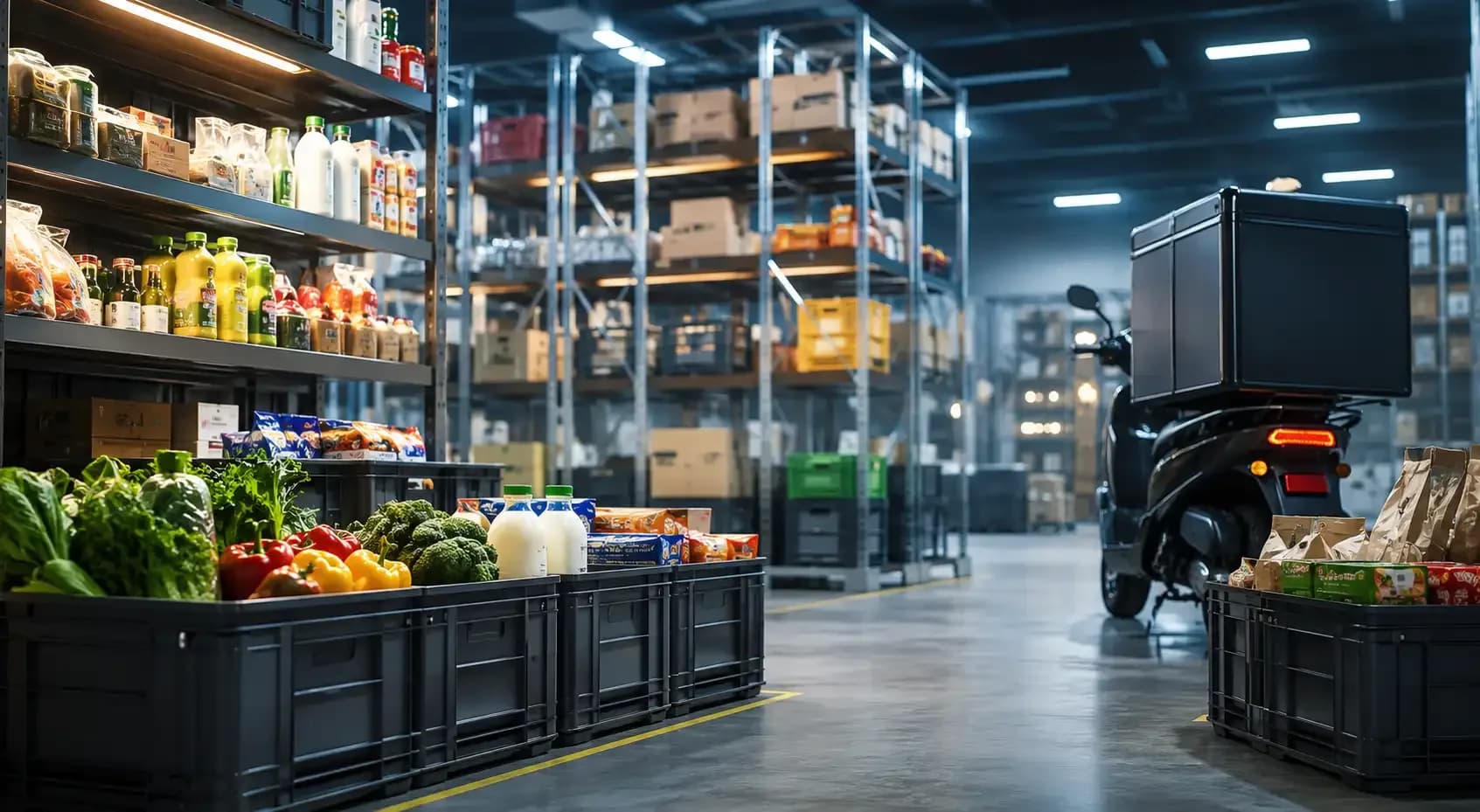
India's quick-commerce boom is now facing a new regulatory question: how much inventory can a dark store safely hold within the space it has?
The All India Consumer Products Distributors Federation (AICPDF) has urged the Union Health Ministry and the Food Safety and Standards Authority of India (FSSAI) to introduce mandatory storage and infrastructure standards for quick-commerce dark stores, arguing that some facilities are packing tens of thousands of stock-keeping units (SKUs) into premises that may not have adequate space or infrastructure to handle them safely.
The federation says many dark stores are storing 60,000–70,000 SKUs in congested premises, raising concerns over unsafe stacking, restricted movement, inadequate ventilation and sanitation, ineffective pest control, poor inspection access and improper segregation of food and non-food products.
At the centre of its proposal is a scientific formula linking the number of SKUs to the minimum floor area available for storage and operations.
A proposed SKU-to-space formula
AICPDF has proposed that quick-commerce dark stores should have a minimum floor area based on the number of SKUs they handle. Its suggested benchmark is 0.35–0.40 square feet per SKU.
If applied to a facility handling around 65,000 SKUs, the formula would translate into approximately 23,000–26,000 sq ft of floor area.
The federation, however, is not presenting the formula as an existing regulatory requirement. Instead, it wants FSSAI to scientifically evaluate the methodology and develop a statutory standard that takes into account the nature of products being stored, refrigeration requirements, movement of workers, picking and packing operations and food-safety considerations.
The objective, distributors argue, is to ensure that inventory capacity is not determined purely by commercial requirements while physical infrastructure remains inadequate.
More than just floor space
AICPDF's proposal goes beyond setting a minimum area.
The federation has called for mandatory standards covering ventilation, sanitation, pest management, temperature and humidity control, fire safety, aisle width and emergency access.
It has also sought mandatory segregation of different categories of products, including fresh produce, dairy, frozen foods, packaged foods, household chemicals, personal-care products and other non-food items.
The concern is particularly significant in dark stores because the same facility may handle a wide variety of products, from chilled dairy and frozen foods to cleaning chemicals and personal-care products.
The distributors argue that inadequate segregation and overcrowded storage can make routine inspection, cleaning and stock rotation more difficult while increasing the possibility of contamination or product deterioration.
Heat and temporary structures under scrutiny
The federation has also raised concerns over dark stores operating from temporary or inadequately insulated tin-sheet structures.
According to AICPDF, food products—particularly perishables—should not be stored in such structures unless they have appropriate thermal insulation, ventilation and scientifically designed air-conditioning or temperature-control systems capable of maintaining safe storage conditions.
The issue is particularly relevant for products whose quality and safety depend on maintaining the required temperature throughout the storage and delivery process.
A push for tighter FSSAI licensing
AICPDF wants storage capacity to become a more explicit part of the FSSAI licensing framework.
Under its proposal, every licence for a quick-commerce dark store would specify both the approved storage area and the maximum permissible SKU capacity.
If a facility increases its inventory beyond the approved capacity, the federation wants the licence and approved capacity to be revised automatically rather than allowing operators to expand inventory without corresponding changes to infrastructure.
It has also proposed digital maintenance of inventory records so regulators can better assess whether a facility is operating within its approved limits.
Maharashtra inspections add urgency
The demand comes amid heightened scrutiny of quick-commerce food-storage operations in Maharashtra.
A recent inspection drive by the Maharashtra Food and Drug Administration covered 86 establishments involved in online food storage and delivery, with AICPDF stating that 14 food-business licences linked to Blinkit, Zepto and Swiggy Instamart were suspended following reported deficiencies involving storage, hygiene, temperature control, pest management and food handling.
The federation has also pointed to reports of expired products at a Zepto facility and incidents involving alleged pest infestation at quick-commerce outlets.
These episodes have brought the physical infrastructure behind India's 10-minute delivery promise into sharper focus.
For consumers, the transaction may happen through an app and the delivery may take only minutes. But the product can spend considerably longer inside a dark store before reaching the doorstep.
Distributors want regular audits, not reactive enforcement
AICPDF has argued that regulatory action should not begin only after a complaint, inspection failure or viral video brings a facility into the spotlight.
The federation has therefore sought annual infrastructure and food-safety audits, along with surprise inspections of dark stores.
It has also proposed strict penalties for facilities that exceed approved storage limits, including suspension or cancellation of licences in serious cases.
Existing dark stores, meanwhile, should be given a defined transition period to comply with any new standards, according to the proposal.
The larger question for quick commerce
The dispute comes at a time when quick commerce has become an increasingly important sales channel for India's FMCG industry.
For brands and distributors, dark stores are no longer simply back-end fulfilment points. They have become a critical part of the supply chain through which groceries, packaged foods, dairy, frozen products and other consumer goods reach households.
That makes storage conditions increasingly important for the entire ecosystem—not just the delivery platforms.
The debate, therefore, is moving beyond how quickly an order can be delivered to whether the infrastructure supporting that speed is capable of maintaining product quality and food safety.
AICPDF's position is that digital retail should not operate under a different food-safety standard from traditional distribution and retail.
The federation is not calling for an end to quick commerce. Instead, it wants the sector's rapid expansion to be accompanied by clearly defined physical and operational standards.
For FSSAI, the challenge will be to determine whether a single SKU-to-space formula can work across vastly different product categories and business models, or whether dark-store standards will need to account for factors such as product type, refrigeration, turnover, inventory density and handling requirements.
What is increasingly clear, however, is that the dark store itself is becoming a regulatory priority.
As quick commerce moves deeper into India's food and FMCG supply chain, the next phase of the industry's growth may depend not only on faster delivery—but on building storage infrastructure that can safely support it.