


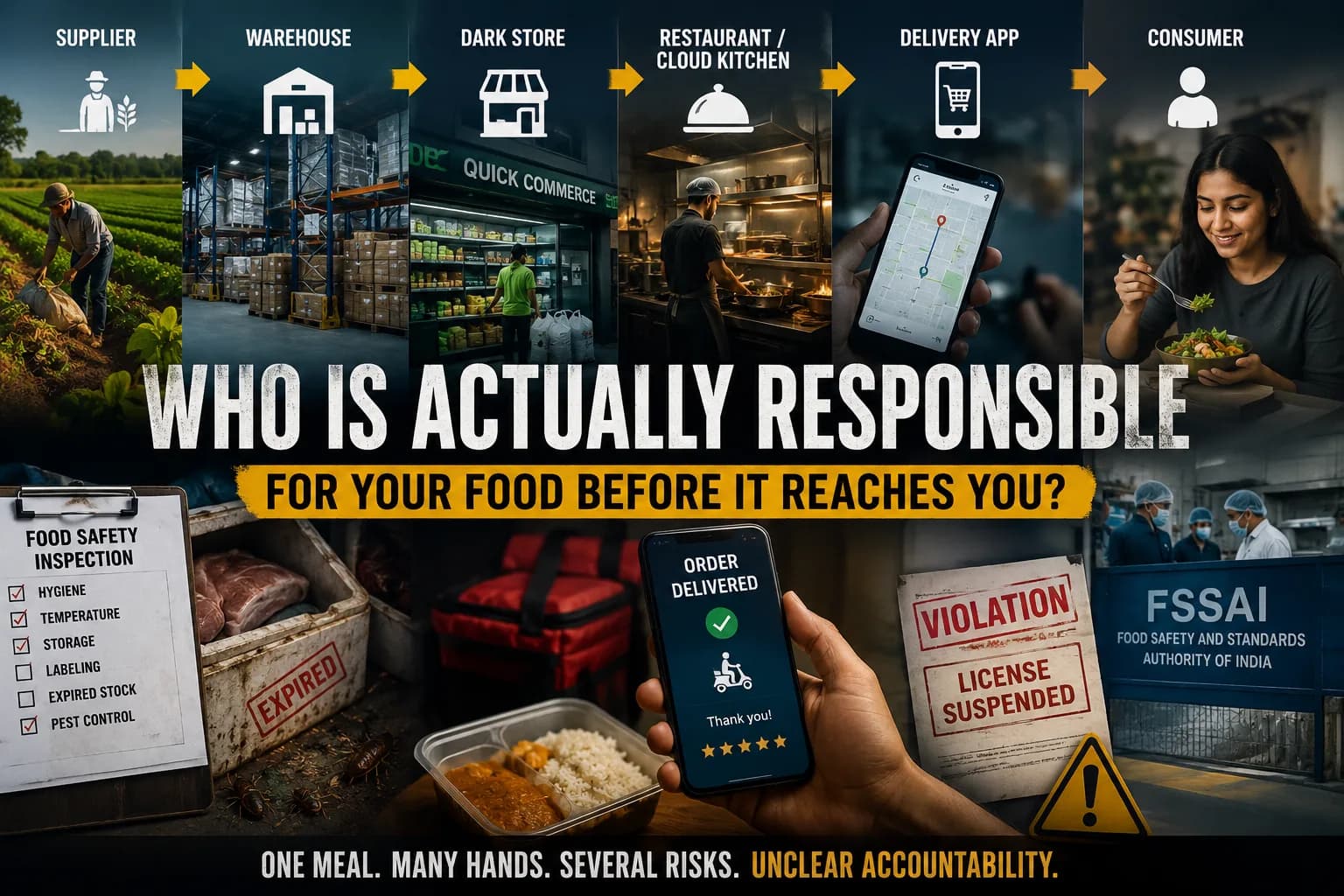
From five-star hotel kitchens to quick-commerce dark stores, India's food-safety enforcement has been unusually busy this year. The raids tell one story. The regulatory gaps between them tell another.
You order dinner on your phone. Twenty-five minutes later, it's at your door. Somewhere in that window, the meal or its ingredients passed through a farm or wholesale market, a processor, a transport vehicle, a warehouse, possibly a dark store, and a kitchen, before a rider carried it the final stretch. You saw none of it.
For most of this year, that invisibility has been getting more attention than usual. In the first two weeks of August alone, food-safety officials in Bengaluru inspected 26 three-star and five-star hotels and seized expired meat, fish and milk from properties including Taj Yeshwantpur, Radisson Blu and The Lalit Ashok. In Mumbai, the state FDA shut two IIT-Bombay hostel canteens, suspended the licences of five prominent clubs, and pulled the food licence of a Blinkit dark store in Malad West after finding a cockroach infestation and expired stock. These sit alongside earlier action against Zepto's Dharavi facility, another Blinkit warehouse in Pune, and nine notices FSSAI sent Swiggy Instamart in July over complaints of spoiled and contaminated products.
Read on their own, these look like a string of unrelated enforcement stories. Read together, they raise a sharper question: as food in India moves through more intermediaries than it used to, does anyone hold clear responsibility for it at every step or does that responsibility quietly change hands somewhere between the warehouse and the doorstep?
The Food Journey Has Changed
A decade ago, the food-safety story mostly began and ended at the restaurant kitchen visible, walk-in, inspectable. That's no longer where most of the risk sits. A meal or grocery order today can pass through a processor, a distributor, a temperature-controlled warehouse, a dark store built for 10-minute delivery, and a cloud kitchen with no dine-in area at all, before a platform hands it to a rider. Each additional link is a place where something can go wrong and, just as importantly, a place where it's less obvious whose job it was to prevent it.
Quick commerce has been the fastest-growing part of that chain. India had more than 2,500 operational dark stores by October 2025, concentrated mostly in Tier-1 cities and expanding fast into smaller ones, per figures cited in Business Standard's reporting on the sector. That scale is exactly why regulators have started paying closer attention to what happens inside these facilities spaces most consumers will never see, ordering from an app that shows a delivery estimate, not a hygiene score.
The New Food-Safety Blind Spots
Warehouses and dark stores operate differently from a restaurant kitchen or a retail shelf. A dark store exists purely to fulfil online orders no walk-in customers, no public storefront, often a few thousand square feet packed with fast-moving inventory. Cold-chain consistency, expiry tracking and separation of food from non-food items all depend on how well that one location is run, not on any centralised system watching over it.
Subarna Mukherjee, founder and global CEO of marketplace-growth consultancy Shop Culture, points to this decentralisation as one of the sector's core operational risks: cold-chain discipline, product segregation and shelf-life tracking all rest on local execution rather than central oversight. Cloud kitchens carry a related but distinct problem. Because they're delivery-only, with no dining area for an inspector to walk into mid-service, their food-safety record is shaped almost entirely by what happens behind a door most customers never see.
What Recent Inspections Are Revealing
The pattern of enforcement over the past two years is worth laying out plainly, because no single incident tells the full story on its own.
Bengaluru, August 7–8, 2026. Thirty inspection teams from Karnataka's Food Safety and Drug Administration checked 26 three-star and five-star hotels, collecting 35 samples for lab testing. Officials found expired meat, fish and milk, fungal growth on vegetables, improper FSSAI labelling, and a failure to segregate vegetarian and non-vegetarian stock. At The Lalit Ashok, they seized and destroyed 76 kg of meat, 200 kg of vegetables and 32 litres of expired milk; Radisson Blu (Atria) had roughly 105 kg of meat, fish and vegetables seized. Notices went out, and the department said legal proceedings would follow wherever violations were confirmed. In a related Bengaluru action, the FDA also shut the kitchen at Skyye Lounge, UB City, after finding rotten meat.
Mumbai, July 27, 2026. A special FDA drive covered seven food establishments across Greater Mumbai. Five had their licences suspended the Cricket Club of India, RK Juhu Gymkhana, Aparna Juhu Gymkhana, MIG Cricket Club in Bandra East, and the Willingdon Sports Club over cockroach and fly infestation, mouldy vegetables, expired items and condensation in cold rooms. The same week, two IIT-Bombay hostel canteens were shut for operating without valid food licences, and the Dadar outlet of Eat Nino (Nino's Burger) had its licence suspended after inspectors found insect infestation, poor personal hygiene among staff, and missing FoSTaC training and medical fitness records.
Mumbai, August 7, 2026. The Maharashtra FDA suspended the food licence of Blink Commerce Pvt Ltd's Blinkit warehouse in Malad West, after an inspection reportedly found stock stored on rusted racks or directly on the floor, expired and tampered products, and cockroaches among stored fruit and vegetables.
Pune, late July 2026. A second Blinkit warehouse, this one in Viman Nagar, had its licence suspended over hygiene violations the second Pune facility to face action in just over a year.
Mumbai, 2025. The Maharashtra FDA suspended Zepto's Dharavi dark store over fungal growth on stored food, stagnant water near storage areas, poor cold-storage temperatures, and expired stock mixed in with fresh inventory. Around the same time, a separate Blinkit facility in Pune's Baner-Balewadi area was shut for operating without any valid licence at all.
Hyderabad, June 2024. A Telangana food-safety task force raided a Blinkit warehouse in Devarayamjal and found the premises disorganised and dusty, cosmetic products stored alongside food, and handlers working without gloves or headgear an early sign that the pattern now visible in Mumbai and Pune isn't new, and isn't confined to one company or city.
Laid end to end, these cases span three states and three companies over more than two years. That's not a run of isolated lapses. It's evidence of a recurring operational problem across the quick-commerce warehouse model itself.
Who Is Actually Responsible?
Here the picture gets more layered than a single-villain story would suggest. Under the Food Safety and Standards Act, 2006, and the Food Safety and Standards (Licensing and Registration of Food Businesses) Regulations, 2011, any entity that stores, distributes, processes or sells food is a Food Business Operator an FBO and is legally answerable for the safety of whatever passes through its hands. That covers a supplier's warehouse, a distributor's cold-storage truck, a dark store, a restaurant kitchen and a cloud kitchen equally. Each FBO owns its own link in the chain.
FSSAI, the national regulator sitting under the Union Health Ministry, sets standards and issues licences centrally. But actual enforcement inspections, sampling, penalties rests with state food-safety departments, working through Designated Officers and Food Safety Officers on the ground, according to Professor Manish Gangwar of the Indian School of Business.
In other words: the body that writes the rules is, in most cases, not the one that walks into a warehouse to check them.
The Quick-Commerce Problem
This is where the responsibility question gets genuinely murky. Dark stores have no separate legal category under Indian food law they're regulated exactly like any other food storage and sale facility, under the same 2011 licensing regulations that apply to a neighbourhood grocery store. There's no dark-store-specific checklist. And unlike a restaurant, which most consumers assume faces some kind of periodic check, a dark store has no fixed inspection schedule at all. Frequency varies by state and is increasingly risk-based weighted by product type, a facility's compliance history and its scale with consumer complaints still doing much of the work of triggering a targeted check, per Gangwar.
Sameer Varma, executive director at ColdStar Logistics, points to a complication upstream of all this: food-safety risk often starts before a warehouse ever sees the product. The first break, he argues, may occur at the farm, in transit, or in a wholesale market and downstream cold storage can slow deterioration that's already begun, but it can't reverse it. On the platform side, FSSAI's 2020 e-commerce advisory requires that anything sold through online grocery and food-delivery platforms retain at least 30% of its shelf life, or a minimum of 45 days, before expiry at the point of delivery a rule aimed directly at keeping near-expiry stock out of the fast-turnover quick-commerce pipeline.
Whether the penalties on the books match the scale of the industry is a separate question. Regulators can issue improvement notices, impose fines, suspend or cancel licences, order seizures and recalls, and prosecute serious violations. But Mukherjee notes that fines typically run ₹25,000 to ₹10 lakh a range she calls close to a rounding error against a quick-commerce sector valued in the billions of dollars and that outright licence suspensions remain comparatively rare. She points to the Zepto Dharavi case, where the suspension was lifted after re-inspection, and to Blinkit's history of drawing notices over issues like spoiled curd or substandard eggs rather than facing prolonged shutdowns. Her summary of the typical sequence: notice, response, and business as usual.
Restaurants Are Only One Piece of the Puzzle
None of this means restaurant-level enforcement has gone soft the Bengaluru hotel raids and Mumbai's club and canteen suspensions make plain it hasn't. But restaurant inspections, however thorough, only ever cover one node in a chain that now runs through several stages first. A five-star kitchen can pass every hygiene check on the day of inspection and still receive meat or produce that was already compromised before it arrived a possibility the Bengaluru findings, with expired stock turning up inside supposedly premium kitchens, illustrate directly. Restaurant-only oversight checks the last visible step. It doesn't necessarily catch what went wrong earlier.
Cloud kitchens complicate this further. They're classified as ordinary FBOs and need Basic, State or Central FSSAI licences depending on turnover thresholds revised upward from April 1, 2026, alongside a shift to licences and registrations that no longer expire. But because they have no dine-in area, they present none of the visible cues a dirty table, a chaotic kitchen pass-through that might otherwise prompt a walk-in complaint. Their compliance is judged almost entirely on inspection records, not everyday visibility.
What the Rules Actually Say
Stripped of jargon, the framework works roughly like this. Every food business needs an FSSAI Basic Registration, State Licence or Central Licence, tiered by annual turnover and geographic spread after the April 2026 amendment, that's registration up to ₹1.5 crore turnover, a state licence up to ₹50 crore, and a central licence above that. E-commerce platforms separately need their own Central FSSAI licence, and must verify that every food business they list restaurant, cloud kitchen or dark-store seller holds a valid licence before onboarding it. A March 2026 FSSAI circular went further still, setting out compliance responsibilities specifically for e-commerce food businesses operating through decentralised models like ONDC, effective from April 1.
Platforms are also expected to display sellers' FSSAI numbers to consumers and enforce the shelf-life rule at the point of delivery. When they fail to verify a listed seller's licence, FSSAI can issue show-cause notices, levy penalties, or in principle move to suspend the platform's own licence the regulatory basis for the nine notices Swiggy Instamart received on July 11, 2026, following complaints of expired and contaminated products reaching customers. What the framework notably doesn't do is treat a dark store, a cloud kitchen and a traditional restaurant as functionally different categories requiring different inspection regimes. All three sit inside the same 2011 rulebook written well before quick commerce existed in anything like its current form.
Where the System May Be Falling Behind
Taken together, the picture experts describe is less one of absent regulation than of regulation that hasn't kept pace with how food businesses actually operate now. Gangwar frames it as a question of capacity and consistency: the problem isn't a shortage of regulatory power on paper, but whether inspection capacity, data transparency and technology-driven oversight can scale at the same rate as the sector itself. Mukherjee raises a related point about consumer visibility FSSAI already runs a Hygiene Rating Scheme, but platforms aren't required to display those ratings at checkout, which means a consumer choosing between two dark stores or two restaurants has no easy way to compare their compliance history before ordering.
There's also the plain fact of a fragmented inspection map: state departments enforce, FSSAI sets standards, and depending on the specific issue, municipal bodies, labour departments or fire authorities can get pulled in too a structure built for fragmentation almost by design rather than by accident. None of this means the system doesn't work; the sheer volume of enforcement action in just the past few weeks suggests it's quite active. It means the system is reactive by structure built to respond once a complaint or a scheduled inspection surfaces a problem, rather than to catch that problem earlier in the chain, closer to where Varma argues many issues actually begin.
What Needs to Change
None of the experts cited here frame this as a case for tearing up the existing framework. The more consistent suggestion is narrower: build oversight that fits how food businesses actually operate today. That means a genuinely risk-based inspection schedule for dark stores and warehouses, rather than one driven mainly by complaints; wider use of digital traceability and real-time cold-chain monitoring, treated as a licence condition rather than a voluntary upgrade, as Varma proposes; and visible hygiene ratings at the point of purchase, so compliance becomes something a consumer can actually see and weigh, as Mukherjee argues. None of this requires rewriting the Food Safety and Standards Act. It requires applying the powers already written into it with more consistency across newer business formats than the older ones the law was originally built around.
The Consumer's Perspective
If something does go wrong spoiled food, a contaminated product, a delivery that arrives looking or smelling off the redress path exists, even if it isn't widely advertised. FSSAI runs a consumer-facing portal called Food Safety Connect, where complaints about packaged food, food premises or online food-delivery aggregators can be registered directly; each complaint generates a trackable reference number sent by SMS.
A 24-hour toll-free helpline (1800-11-2100) handles the same categories. State designated officers are required to examine complaints and can order sampling or inspection where warranted the same mechanism that triggered several of the enforcement actions above.
What none of this changes is the basic asymmetry a consumer faces. You can see a five-star hotel's dining room, not its cold storage. You can see a delivery app's rating, not the dark store an order actually shipped from. The past few weeks of enforcement activity suggest regulators are increasingly aware of that gap and are starting to act on it — not because the food chain has suddenly become more dangerous, but because it has become longer, with more places along the way for responsibility to quietly change hands. Knowing exactly which hand is holding it at any given moment is still, mostly, the regulator's job. When that job is done well, it's also the reason your next order arrives the way it's supposed to.