

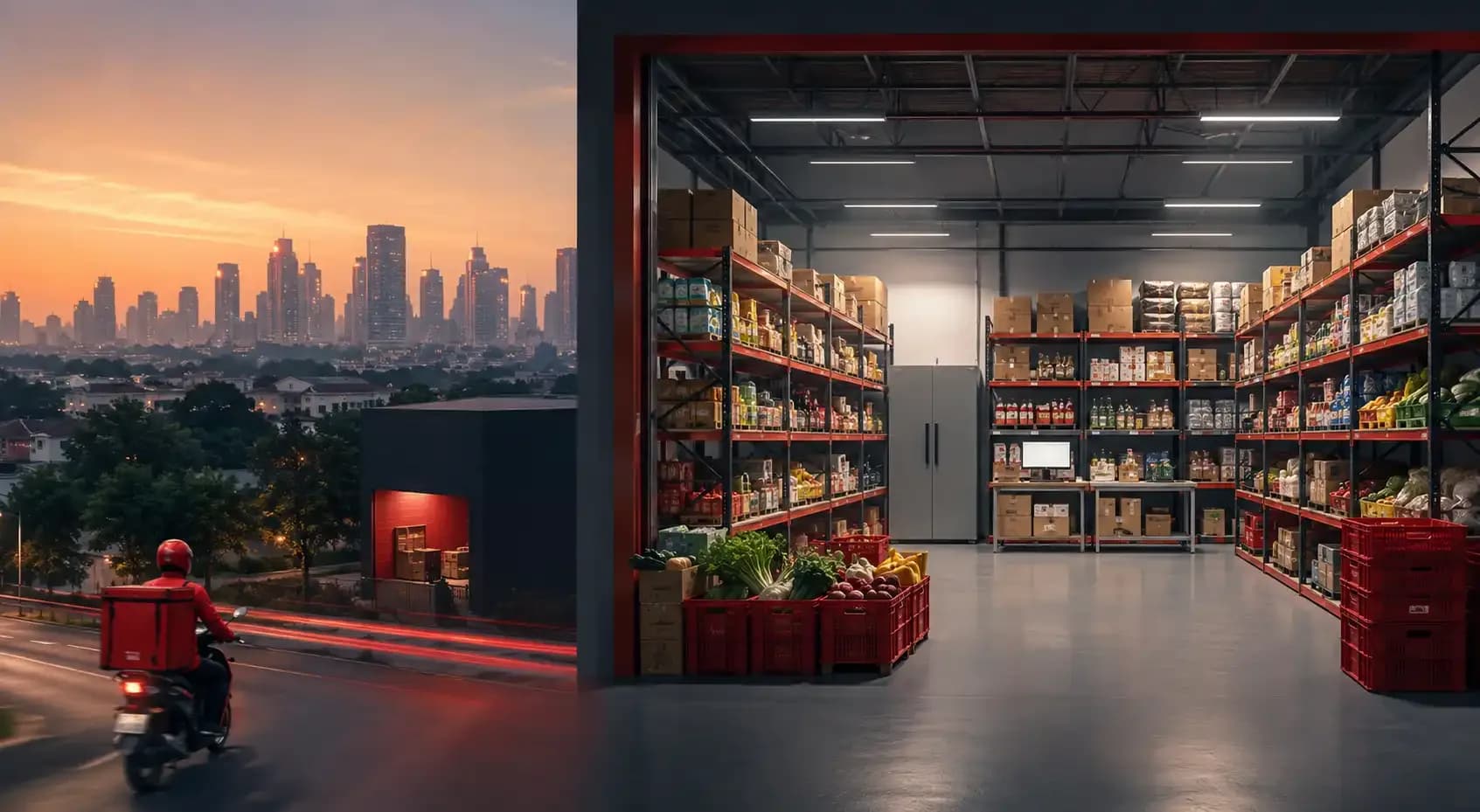
India’s quick-commerce boom is moving into its next phase — and the country’s neighbourhoods could soon have thousands more dark stores serving online orders.
A new report by research consultancy Infisum estimates that India’s e-commerce market could nearly triple from $125 billion in 2024 to $345 billion by 2030, growing at a compound annual growth rate of 18.4%.
At the centre of that expansion will be quick commerce.
The report, Smart Growth in a Fast Market, estimates that the quick-commerce market could reach $65–70 billion by 2030 and contribute around 45–50% of incremental e-retail growth over the next five years.
That growth is expected to translate directly into physical infrastructure. India’s dark-store network is projected to increase from around 2,525 facilities in 2025 to approximately 7,500 by 2030.
In other words, the infrastructure supporting India's 10- and 15-minute delivery economy could almost triple within five years.
Why dark stores are becoming central to quick commerce
Unlike conventional e-commerce warehouses, dark stores are small fulfilment centres located close to consumers. They are not designed for walk-in shopping. Instead, products are stored, picked and packed for online orders before being handed over to delivery partners.
The model allows quick-commerce companies to position inventory within a few kilometres of customers and reduce the time between order placement and delivery.
The scale of this network has already expanded considerably.
A separate Savills India assessment put the number of operational dark stores at 2,525 as of October 2025, spread across more than 100 cities and occupying approximately 13 million sq. ft. of space.
Tier-I cities accounted for around 68% of the network, while Tier-II and Tier-III cities together accounted for about 800 stores. Delhi-NCR led the major markets with approximately 400 dark stores, followed by Bengaluru with 360, Mumbai with 250 and Chennai with 190.
The expansion is also moving beyond the traditional metropolitan markets.
The new Infisum report says 66% of new D2C orders are now originating from Tier-II and Tier-III cities, highlighting how digital consumption is spreading into smaller markets. By 2030, online commerce is expected to account for 10–12% of India's total retail spending, with the number of online shoppers projected to reach 420–440 million.
Quick commerce is no longer just about groceries
The next phase of growth is also expected to broaden the role of dark stores.
Quick commerce initially built its proposition around groceries, packaged food and everyday essentials. However, platforms are increasingly adding categories such as personal care, lifestyle products and time-sensitive medical supplies.
Savills India has also pointed to the possibility of dark stores being combined with other formats, including cloud kitchens, as companies look for greater utilisation of their neighbourhood-level infrastructure.
That means the dark store of the future could potentially hold a much wider range of products — and managing that inventory safely could become considerably more complicated.
The food-safety question
This is where the rapid expansion of dark stores raises an important concern.
The number of facilities may nearly triple by 2030, but the question is whether the infrastructure, storage practices and regulatory framework governing these facilities can scale at the same pace.
The concern has already been raised by the All India Consumer Products Distributors Federation (AICPDF).
The distributors' body has asked the government to introduce mandatory infrastructure and storage standards for quick-commerce dark stores. It has argued that some facilities are storing 60,000–70,000 stock-keeping units (SKUs) in limited spaces.
According to the federation, overcrowded storage can result in unsafe stacking, restricted movement, inadequate ventilation, sanitation problems, ineffective pest control, difficulties during inspections and improper segregation of food and non-food products.
AICPDF has proposed that storage capacity should be scientifically linked to available floor space, with its suggested formula requiring around 0.35–0.40 sq. ft. per SKU. For a facility handling 65,000 SKUs, that would translate to approximately 23,000–26,000 sq. ft., subject to validation and adjustment based on the nature of the products being stored.
The federation has also sought standards covering ventilation, sanitation, pest management, temperature and humidity control, fire safety, aisle width, emergency access and segregation of different categories of products.
It has further called for approved storage capacity and maximum SKU limits to be reflected in FSSAI licences.
The concern is not theoretical
The regulatory debate comes at a time when quick-commerce facilities are already facing greater scrutiny.
In Maharashtra, food-safety authorities recently suspended the licence of a Blinkit quick-commerce hub in Akola following inspections that reportedly found serious hygiene and storage-related violations.
The action followed a wider enforcement drive against online food-storage facilities. Maharashtra FDA had earlier inspected dozens of establishments and suspended licences associated with Blinkit, Zepto and Swiggy Instamart after identifying issues including pest infestation, poor sanitation, storage problems and temperature-control concerns.
The scale of the inspections is significant because it shows that dark stores are increasingly being treated as an important part of the food-safety chain rather than simply as logistics facilities.
That distinction matters.
A dark store may look like a small warehouse from the outside, but when it stores milk, fresh produce, frozen products, packaged foods and other consumables that eventually reach consumers, the conditions inside can directly affect food safety.
India already has a regulatory framework — but the model is changing
FSSAI's existing hygiene requirements already place obligations on food businesses involved in activities such as storage and distribution. The regulator's Schedule 4 requirements cover hygienic and sanitary practices for manufacturing, processing, packaging, storage and distribution businesses.
FSSAI has also been updating its regulatory framework. In June 2026, the government notified amendments to the Food Safety and Standards (Licensing and Registration of Food Businesses) Regulations, 2011, aimed at rationalising certain compliance requirements while retaining key food-safety and traceability safeguards.
The challenge, therefore, may not simply be the absence of food-safety rules.
It is whether those rules are sufficiently specific and enforceable for a rapidly expanding business model in which large inventories are packed into relatively small, urban fulfilment facilities and moved at extremely high speeds.
The infrastructure challenge could become bigger by 2030
The Savills projection provides another indication of the scale of the coming expansion.
The dark-store footprint was estimated at around 13 million sq. ft. in 2025. Its research indicates that this could rise to roughly 38 million sq. ft. by 2030 as the number of facilities reaches around 7,500.
That means the discussion is no longer simply about how many dark stores India needs.
It is increasingly about what a compliant dark store should look like.
The industry will need facilities capable of handling different temperature requirements, adequate aisle and working space, proper pest-control access, product segregation, waste management, fire safety and reliable inventory tracking.
This could also push quick-commerce operators towards purpose-built facilities rather than relying heavily on converted shops, offices or other commercial spaces.
Savills has noted that many existing dark stores operate from repurposed spaces that were originally designed for conventional retail or commercial use. Such properties can have limitations related to structural design, automation, vertical storage, refrigeration, insulation and safety.
The economics of speed will face a new test
For years, the quick-commerce race has largely been about one metric: How fast can the order reach the customer?
The next phase could require another question:
How safely can that order be stored and delivered?
The answer will matter particularly for food products.
A 10-minute delivery promise has little value if milk is stored at the wrong temperature, fresh produce is exposed to poor conditions, packaged food is mixed with chemicals, or expired products are not removed from inventory efficiently.
As the number of dark stores moves towards 7,500, even a relatively small compliance gap at individual facilities could become significant when multiplied across thousands of locations.
What happens next?
The expansion of quick commerce appears unlikely to slow down.
The Infisum report expects the sector to become a major contributor to India's e-commerce growth, while Gen Z, rising digital adoption and increasing demand from smaller cities continue to expand the addressable consumer base.
For quick-commerce companies, this means more dark stores, deeper inventories and broader product categories.
For regulators, it could mean a much larger inspection and enforcement challenge.
And for consumers, the issue is straightforward: the speed promised by quick commerce should not come at the expense of the safety of what is being delivered.
India may be heading towards 7,500 dark stores by 2030.
The bigger question is whether the country can build 7,500 dark stores that are not only fast, but properly designed, adequately equipped and consistently compliant with food-safety requirements.
That is likely to become one of the defining challenges of India's next phase of quick-commerce growth.