
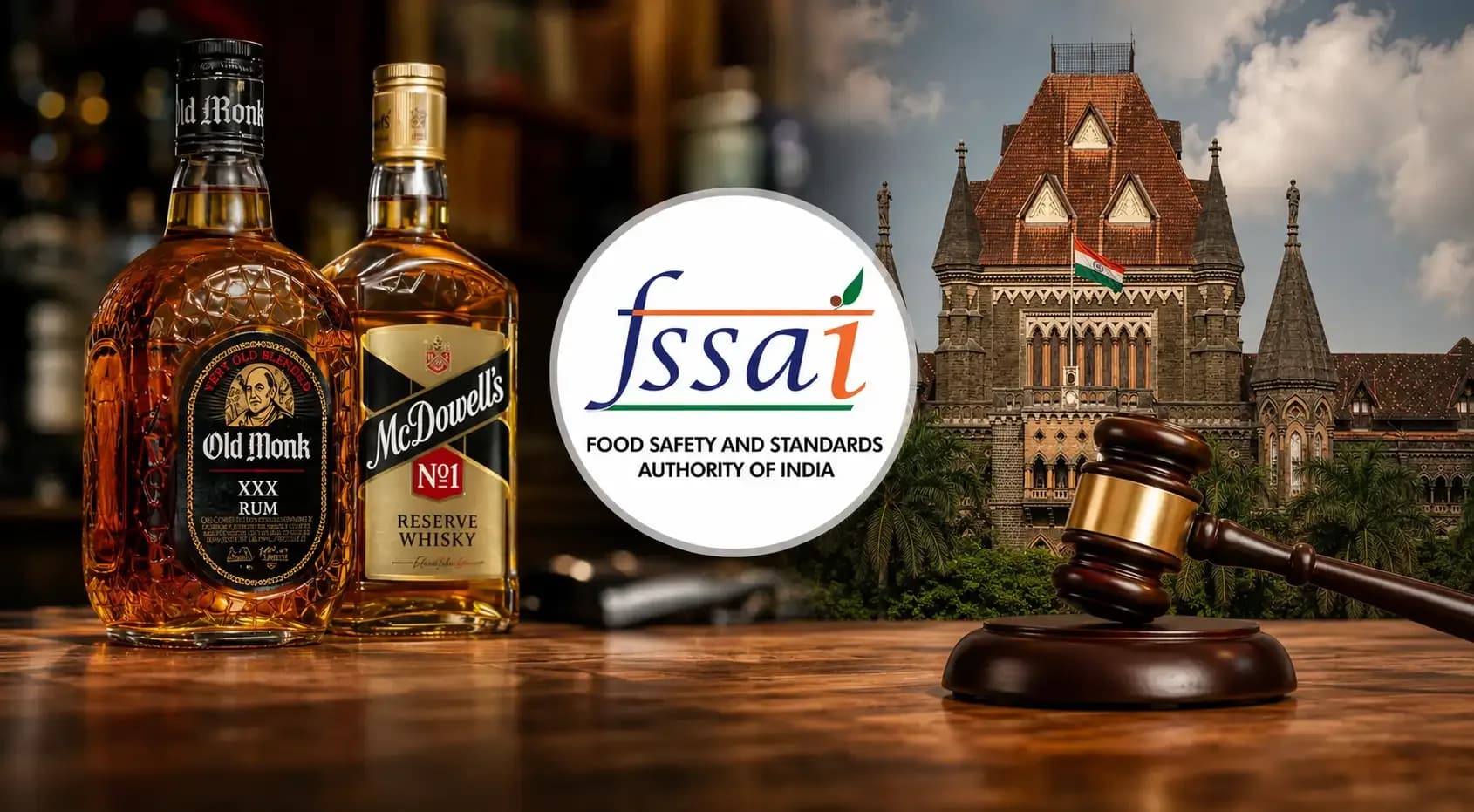
The battle over what can legally be called “rum” or “whisky” in India has reached the Bombay High Court, with some of the country’s biggest liquor manufacturers challenging regulatory action by the Food Safety and Standards Authority of India (FSSAI).
At the centre of the dispute are United Spirits, maker of McDowell’s No. 1, and Mohan Meakin, associated with Old Monk. The companies have approached the Bombay High Court after FSSAI took action against certain Indian-Made Foreign Liquor (IMFL) products over the use of added flavouring and claims relating to maturation.
The matter is being heard by a bench comprising Acting Chief Justice Ravindra V. Ghuge and Justice Gautam A. Ankhad. The court is now examining whether the affected products can continue to be sold and how FSSAI’s labelling requirements should be implemented.
The dispute in a bottle: What exactly is FSSAI objecting to?
FSSAI's objection centres on products that are marketed simply as “rum” or “whisky” despite the addition of artificial or nature-identical flavouring substances.
The regulator's position is that where flavouring is being used to impart or replicate the characteristic taste or aroma of rum or whisky, the product should not necessarily be presented to consumers simply as “rum” or “whisky”.
Instead, FSSAI has indicated that descriptions such as “rum-flavoured spirit” or “whisky-flavoured spirit”, or other wording that clearly communicates the product's nature, may be required.
The regulator's argument is essentially one of truthful labelling: consumers should be able to understand whether they are buying a standardised spirit or a spirit whose characteristics have been achieved, at least in part, through added flavouring.
FSSAI also questions “matured in cask” and age claims
The dispute goes beyond flavouring.
FSSAI has also raised questions over claims such as “matured in cask” and age statements on blended spirits where a significant portion of the final product consists of neutral spirit that has not itself undergone the claimed ageing process.
One of the issues highlighted by the regulator concerns Old Monk XXX Matured Rum, which carries an age-related claim. According to the latest reporting, FSSAI has questioned the composition of the blend and whether the age claim accurately represents the youngest spirit used in the final product.
The regulator's position is that an age declaration for a blended spirit should correspond to the youngest spirit in the blend, rather than allowing a smaller quantity of matured spirit to support an age representation for the entire product.
This could have consequences beyond a single brand because similar maturation and ageing claims are used across India's IMFL market.
United Spirits challenges FSSAI's action
United Spirits has pushed back strongly against the regulator's approach.
The company has argued that the production practices now under scrutiny have been followed across the industry for decades and that the sudden regulatory intervention could disrupt a significant portion of India's IMFL business.
During the court proceedings, senior advocate Birendra Saraf, appearing for United Spirits, argued that rum production can involve blending matured rum concentrate with neutral spirit, while flavouring may be used to maintain consistency in taste between batches.
The company has also questioned why certain flavouring practices are being treated differently from others and has argued that products that have been manufactured and sold for decades should not be abruptly taken off the market without an established health or safety risk.
That distinction is important.
The dispute is not simply about whether the products are safe to consume. It is also about how they are classified, described and presented to consumers under India's food and alcoholic beverage regulations.
The companies say relabelling cannot happen overnight
Another practical issue has emerged before the court: changing liquor labels is not as simple as changing a food-product sticker.
United Spirits has argued that revised liquor labels require approvals from the relevant state excise authorities.
As a result, even if manufacturers agree to change descriptions such as “rum” to “rum-flavoured spirit”, implementing such a change across production lines, packaging inventory and distribution channels could take time.
This has become particularly important because FSSAI's action has implications not only for manufacturers but also for distributors, retailers and existing supply chains.
FSSAI signals a possible way out
A significant development ahead of the August 10 hearing is that FSSAI has indicated that it is not necessarily seeking to permanently ban the affected products.
According to the latest reports, the regulator told the court that the restrictions could be withdrawn if manufacturers relabel affected products to clearly disclose the use of added rum flavouring.
Possible descriptions discussed include terms such as “rum-flavoured spirit” or “spirit flavoured with rum”, provided the description accurately communicates the nature of the beverage to consumers.
That could provide a potential route towards resolving the immediate supply disruption, although the manufacturers' objections to the regulatory orders themselves remain before the court.
Bombay High Court: “Everything can't be shut down overnight”
The Bombay High Court has already indicated that it is conscious of the potential impact of abruptly stopping sales.
During the previous hearing, the bench observed:
“We agree that everything can't be shut down overnight.”
The court also recognised that the dispute could have consequences extending beyond the manufacturers themselves, affecting distributors and consumers.
At the same time, the bench made clear that technical questions surrounding the manufacture, testing and marketing of spirits are matters on which the regulator's position needs to be properly placed before the court.
The court subsequently directed Additional Solicitor General Anil Singh to appear after obtaining instructions from FSSAI, setting the stage for the current hearing.
Which products have been caught in the regulatory action?
The action is not limited to one Old Monk or McDowell's product.
According to the latest reporting, FSSAI's action has covered selected variants manufactured by different companies, including products associated with:
McDowell's No. 1 Rum
Old Monk
Antiquity Blue Whisky
Royal Challenge Whisky
Bagpiper Deluxe Whisky
Old Cask Deluxe XXX Rum
The regulatory action is therefore broader than a dispute between FSSAI and a single manufacturer.
Importantly, reports of a “ban on Old Monk” or “ban on McDowell's” should be treated carefully. The action concerns specific products, variants and manufacturing circumstances, rather than necessarily amounting to a blanket prohibition on every product sold under those brand names.
Why this case could reshape India's IMFL market
The Bombay High Court proceedings could have implications far beyond the brands currently in the spotlight.
If FSSAI's interpretation is upheld, liquor manufacturers may have to reassess how they:
describe products containing added flavouring;
use terms such as “rum” and “whisky”;
make ageing and maturation claims;
formulate blended spirits;
design packaging and labels; and
obtain approvals for revised labels across different states.
The issue could also force a wider industry discussion around the distinction between a standardised spirit and a flavoured spirit marketed in the style of that category.
For manufacturers, the commercial stakes are significant. For regulators, the issue is about whether consumers are being given an accurate description of what is inside the bottle.
What happens next?
For now, the legal battle remains unresolved.
The Bombay High Court is examining the challenges brought by the liquor manufacturers, while FSSAI is defending its regulatory interpretation and has indicated that relabelling could provide a route for the restrictions to be withdrawn.
There is no final judgment in the matter as of the latest available update on August 10, 2026.
The immediate questions before the court include whether the affected products can continue to be sold under their existing labels, whether manufacturers will have to undertake relabelling, and how FSSAI's interpretation of the applicable alcoholic-beverage regulations should be applied.
The larger legal question could be even more consequential: how far can the food regulator go in restricting established alcoholic beverage products on the basis of labelling and formulation requirements, particularly where manufacturers dispute the regulator's interpretation?
For India's liquor industry, the answer could determine much more than what appears on a bottle.
This is a developing story. Indian Food Times will update this report as the Bombay High Court passes further orders or as FSSAI and the affected manufacturers issue new developments.