

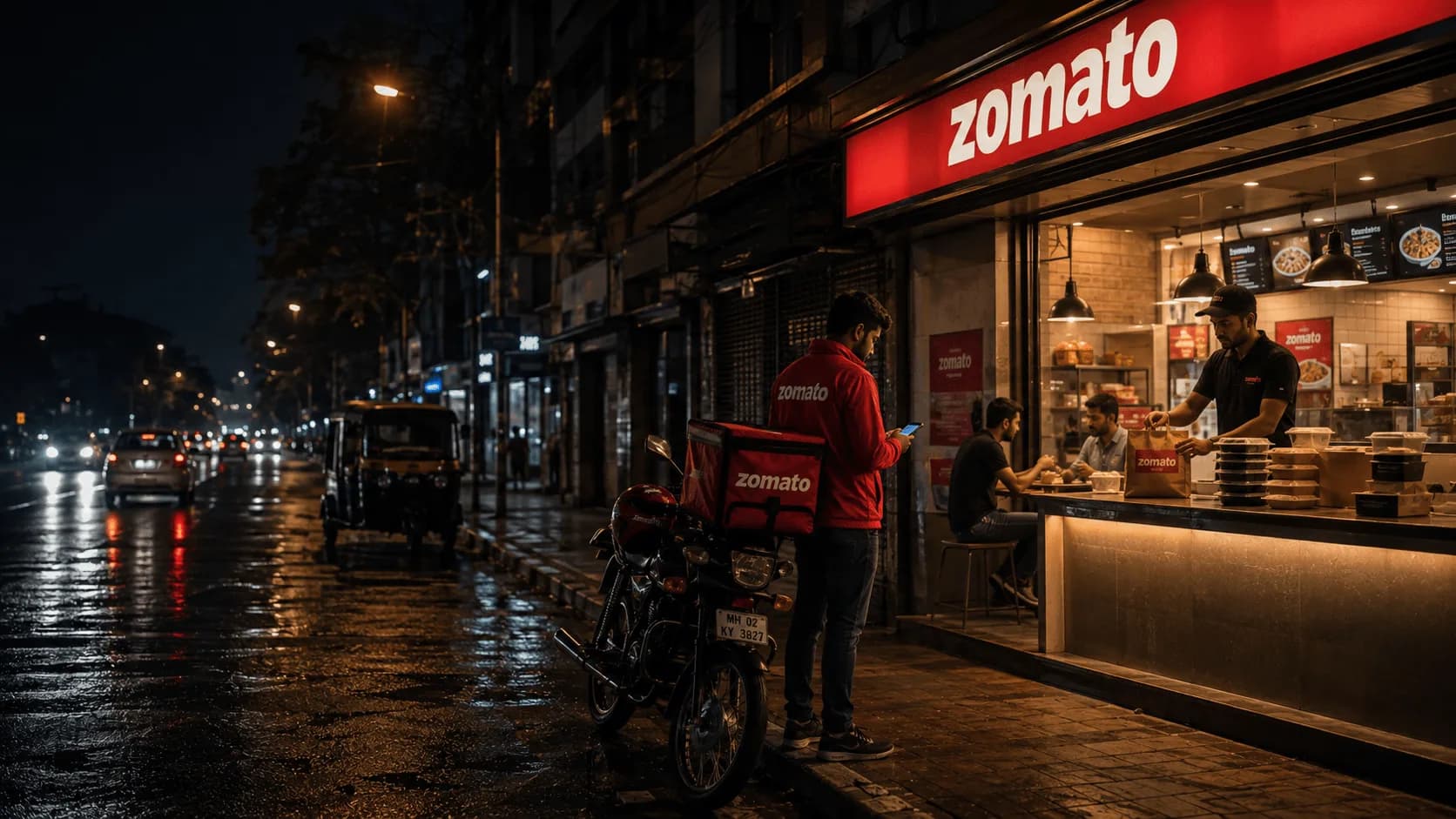
India's Midnight Food Economy Is Growing. Here's Who Is Paying for It.
It's 1 AM in a Bengaluru tech park, and nobody there thinks this is remarkable.
An analyst wrapping up a call with a client in New York orders a coffee and a grain bowl to her desk without looking up from her screen. Downstairs, a delivery rider idles at the gate, engine running, next drop already loaded on his app.
Nobody's partying. Nobody's out late. This is just Tuesday.
Let's kill a myth first
Every few months, someone writes the same lazy line: India is turning into a country that eats at midnight. It sounds true. It photographs well. It is also, mostly, wrong.
Zomato's own year-end numbers for 2025 put the platform's single biggest order spike of the entire year proudly labelled "India's national dinner time" at 8:25 PM in Delhi-NCR.
Eight twenty-five. That's not a midnight snack. That's dinner, on schedule, like your grandmother ate it.
So if the whole country hasn't shifted its clock, why is midnight suddenly worth a delivery platform's attention?
Because it isn't the whole country. It's a workforce.
In July, Swiggy quietly launched something called Late Night Eats and buried in the press release was the actual story. One in four corporate employees at the offices it covers are ordering food after 10 PM, while still sitting at their desks.
Not once in a while. Regularly enough that Swiggy built a product around it.
And this isn't a Bengaluru or Gurugram phenomenon anymore. The fastest growth is showing up in Bhubaneswar, Kochi, Lucknow, Visakhapatnam cities nobody associates with 2 AM biryani runs.
Ask who these people actually are and the answer stops being mysterious fast. India now has over 19 lakh people working in Global Capability Centres the offshore engine rooms multinational banks and tech firms run out of the country. These employees don't set their own hours. A bank in Manhattan does. A retailer in London does.
So no, India hasn't developed a taste for midnight. India has developed a night shift. And a night shift, inconveniently, still gets hungry.
Somebody noticed the money in that
Here's where it gets interesting. Once a platform sees a pattern like that in its own data, it stops treating it as a fluke and starts treating it as a business line.
Late Night Eats now covers 4,000-plus office locations and 30,000 restaurants in 30 cities, with menus specifically built for the 10 PM to 5 AM window. More than a third of the restaurants serving those offices stay open right through the night. There's even a "2 AM Club" - a curated list of places guaranteed to answer the phone at that hour.
Think about what that actually solves. One restaurant staying open till 2 AM on a hunch is dead weight on the books. Thirty thousand restaurants organised around a predictable, recurring demand pattern is something else entirely it's a line item.
Quick commerce got here years before anyone wrote a trend piece about it. Blinkit, Zepto and Instamart were quietly stretching their hours past midnight back when the only customers awake were call centre staff. What's changed isn't the idea. It's the size of the crowd it now serves, as India's GCC workforce has roughly doubled in five years.
Who's actually awake and ordering
It would be convenient and lazy, again to blame this on Gen Z and their biryani cravings. The data doesn't support it.
The people keeping this economy running are night shift GCC employees, hospital and hospitality staff on rosters nobody envies, and delivery workers themselves, grabbing a meal between drops. Students and post-party crowds are in the mix too. They're just not the engine. They're the garnish.
A word of caution, because someone has to say it
Eating at midnight isn't a punishable offence, but it isn't free either. Research on meal timing links late-night eating to circadian disruption, and one large international study found that a later last meal of the day carried a higher cardiovascular risk.
Nobody's midnight sandwich is a crisis. But turning it into a nightly habit, for people who didn't choose their own shift timing to begin with, is worth at least one uncomfortable sentence in an otherwise upbeat business story.
Where this probably goes
If GCC employment keeps climbing toward the 2.8 million mark projected for 2030, the customer base for midnight food climbs with it. Expect more menus built specifically for the graveyard shift, cloud kitchens designed to run lean at 3 AM rather than as an afterthought, and more cities loosening restaurant hours the way Delhi already has.
That's a reasonable bet on where this is heading. It is not a promise.
The actual headline here
For most of its history, India's food industry planned its entire day around three fixed appointments: breakfast, lunch, dinner. Everything outside those windows belonged to someone else a roadside dhaba, a lone biryani stall that never quite closed.
What's shifting isn't when India eats. It's who gets to decide when the eating day ends. Increasingly, that call is being made by a client's time zone on another continent and the country's biggest food platforms noticed long before the rest of us did.