

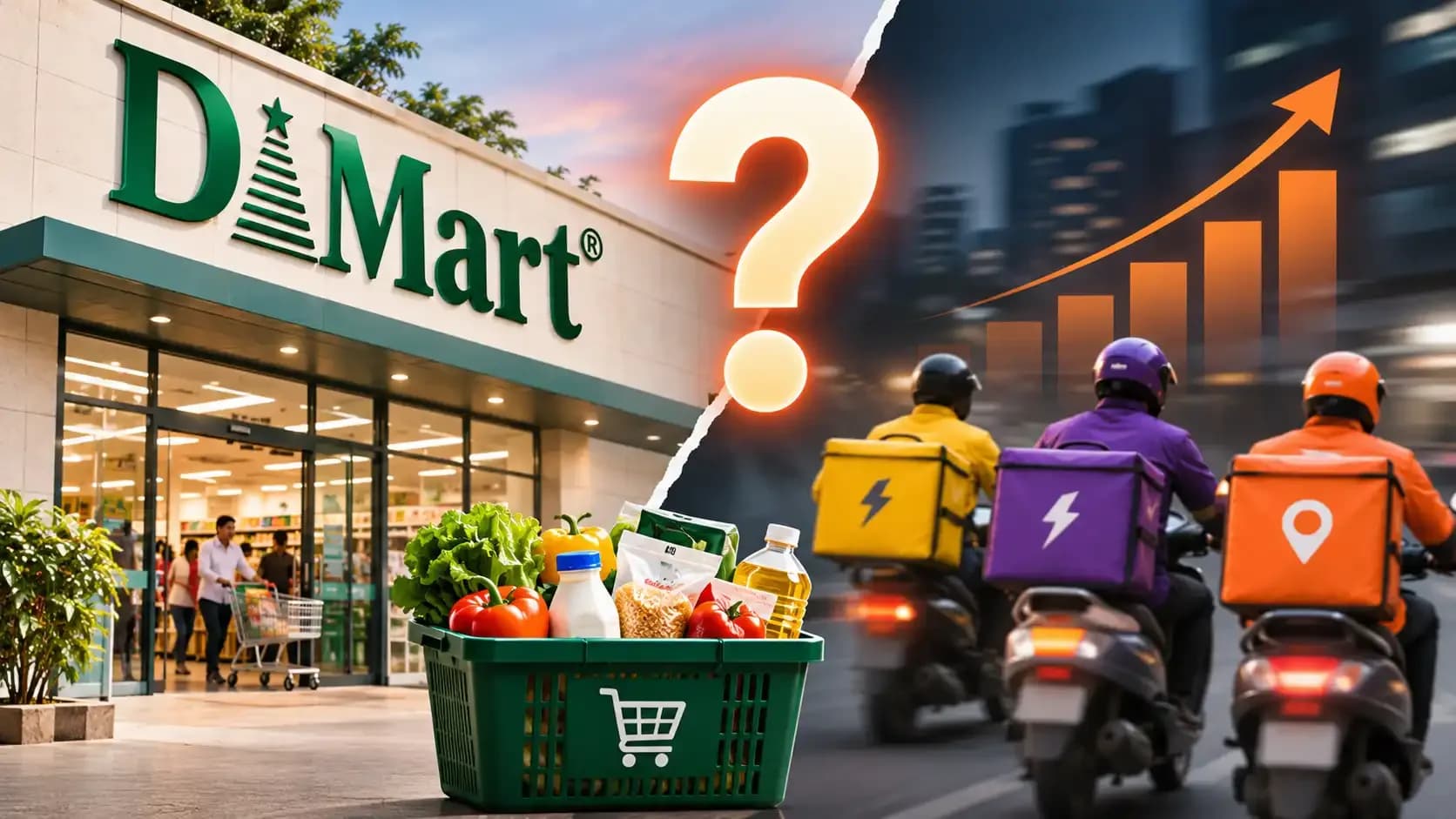
The story of DMart Ready is not just about mounting losses. It is about a retail giant struggling to turn its biggest competitive advantage into its next growth engine.
In business, having a competitive advantage is one thing. Knowing how to use it when the market changes is another.
For decades, DMart built its reputation on a simple but powerful formula: everyday low prices, efficient operations, strong procurement and a no-frills shopping experience.
It mastered physical retail in India.
But then came a market transformation that even the most successful retailers could not afford to ignore: online grocery shopping.
And DMart was not late to the opportunity.
In fact, it started DMart Ready back in 2017.
The business scaled rapidly during the COVID-19 pandemic. By 2020, DMart had reportedly activated its existing network of around 200 physical stores to fulfil online orders.
Think about that for a moment.
A retailer with an established store network, procurement capabilities, inventory and millions of potential customers already had much of the infrastructure required to build an omnichannel grocery business.
Yet, instead of making its physical stores the foundation of a long-term online fulfilment strategy, the company eventually moved towards a separate fulfilment model.
The reasoning was operational: online order picking and packing could disrupt the productivity of busy physical stores.
It may have made sense at the time.
But was it the right long-term strategic decision?
The numbers tell an uncomfortable story
DMart Ready operates through Avenue E-Commerce Limited, a subsidiary of Avenue Supermarts.
Its revenue growth looks impressive on paper.
FY18: ₹44 crore
FY20: ₹354 crore
FY22: ₹1,667 crore
FY24: ₹2,899 crore
FY25: ₹3,502 crore
FY26: ₹4,094 crore
Revenue has grown almost 93 times since FY18.
But there is another side to this growth.
Its annual net loss increased from approximately ₹247 crore in FY25 to ₹307 crore in FY26.
In other words, revenue grew approximately 17%, while losses increased approximately 24%.
And despite this expansion, DMart Ready's revenue remains approximately 5.9% of Avenue Supermarts' consolidated group sales.
This is the contradiction.
DMart Ready is getting bigger, but it has yet to demonstrate that it can become a consistently profitable digital business.
Importantly, this does not mean DMart's overall business is struggling. Its parent company remains profitable. The challenge is specifically around the economics and positioning of its online subsidiary.
The bigger problem: DMart may have underestimated how quickly customer behaviour would change
The original online grocery proposition was relatively simple.
Customers would use online platforms for additional purchases, urgent requirements or occasional convenience.
But that behaviour is changing.
Quick-commerce platforms are increasingly positioning themselves as complete household shopping destinations rather than merely places to order milk, bread or snacks.
Customers are beginning to purchase everyday groceries, personal-care products, household essentials and larger baskets through these applications.
This changes the competitive equation.
DMart's traditional advantage was built around low prices and a large assortment.
But competitors are working hard to replicate those advantages online.
Zepto Super Saver and Swiggy Instamart MaxxSaver are examples of how quick-commerce platforms are increasingly competing on value and assortment, not just delivery speed.
The competition is no longer simply about who delivers faster.
It is about who becomes the customer's default grocery-shopping destination.
And that is a much bigger battle.
Meanwhile, another retailer is demonstrating a different strategy
Here is where the story gets particularly interesting.
Vishal Mega Mart is using its existing physical-store network to expand its quick-commerce business.
According to its Q1 FY27 management disclosures, the company had enabled quick commerce in 767 of its 819 stores, covering approximately 520 cities.
Its quick-commerce business was contributing around 2–9% of store revenue, with stronger locations reaching approximately 9–10%.
Even more interestingly, management indicated that around 20% of quick-commerce customers were new to Vishal Mega Mart.
That last number deserves attention.
It suggests that online fulfilment can do more than shift existing customers from physical stores to digital channels. It can also bring entirely new customers into the business.
Vishal Mega Mart is effectively using its existing retail infrastructure to participate in the quick-commerce opportunity.
And this raises an uncomfortable question for DMart:
What if the physical stores that DMart once considered unsuitable for online fulfilment were actually one of its biggest untapped competitive advantages?
Of course, Vishal Mega Mart's model is not automatically superior. Its long-term profitability and fulfilment economics will need to prove themselves too.
But it demonstrates a strategy worth studying.
The decision that deserves a second look
In July 2025, DMart's management acknowledged that DMart Ready had become sufficiently significant to cannibalise some physical-store sales.
This is a fascinating statement.
Cannibalisation is often treated as a problem in traditional businesses.
But in a rapidly changing market, cannibalising your own business can sometimes be better than allowing a competitor to do it.
Netflix disrupted its DVD business with streaming.
Apple transformed its own product ecosystem repeatedly.
Amazon continuously expanded into categories that challenged its existing business.
The common lesson?
Successful companies cannot protect yesterday's business model at the expense of tomorrow's customer.
DMart's challenge is not necessarily that its physical stores are competing with its online business.
The challenge is figuring out how to make both channels work together.
There is no need to force online fulfilment through crowded supermarket aisles. A hybrid strategy could use separate picking areas, shared inventory, existing procurement networks and selected stores as hyperlocal fulfilment points.
The objective should be to integrate the supply chain without compromising the physical shopping experience.
The ₹1.5 lakh crore question
A recent LinkedIn analysis described DMart Ready as a missed ₹1.5 lakh crore opportunity.
That figure should be understood as an estimated opportunity-cost argument, not an actual financial loss or an amount disclosed by DMart.
But the underlying strategic question is worth discussing.
India's grocery market is enormous. Digital grocery adoption is expanding, and quick-commerce companies are trying to capture a larger share of everyday household spending.
DMart had several advantages that new-age platforms had to build from scratch:
Established procurement relationships.
A trusted retail brand.
Experience in operating high-volume grocery stores.
A large physical-store network.
Strong private-label capabilities.
An existing customer base.
These are not small advantages.
The real question is whether DMart could have converted them into a more competitive digital ecosystem earlier.
The auditor's warning is another reason to pay attention
Avenue Supermarts' FY26 annual report disclosed an investment of approximately ₹1,488 crore in Avenue E-Commerce.
The subsidiary's continued losses made impairment assessment an important audit matter.
To be clear, the auditor did not establish that the entire investment should be written off. The impairment assessment was identified as a Key Audit Matter, and the annual report records an unmodified audit opinion.
Nevertheless, the scale of capital committed to a business that continues to report substantial losses makes the next phase particularly important.
In August 2026, Avenue Supermarts also approved an additional investment of up to ₹500 crore in Avenue E-Commerce.
Management is clearly not abandoning the opportunity.
But the question investors should ask is increasingly straightforward:
How much more capital will it take before DMart Ready can demonstrate sustainable unit economics?
DMart's next battle is not against Blinkit. It is against its own business model.
DMart does not necessarily need to deliver groceries in 10 minutes.
That would be an expensive and potentially unnecessary competition.
Its strongest opportunity may be to build a different proposition:
Lower prices on everyday essentials.
Larger household grocery baskets.
Strong private-label assortment.
Scheduled and reliable deliveries.
Better availability.
More efficient fulfilment through its existing retail ecosystem.
It could own the monthly grocery basket instead of trying to win every urgent five-item order.
But to achieve that, the company needs to make its online business genuinely compelling.
And it needs to prove that growth can eventually translate into profitability.
The bigger lesson for Indian businesses
This story goes beyond DMart.
It highlights one of the biggest challenges faced by successful companies: the reluctance to disrupt a business model that has made them successful.
Sometimes, the biggest threat to an established company is not a competitor with more money, better technology or a bigger marketing budget.
It is the company's own attachment to the model that made it successful in the first place.
DMart built one of India's strongest physical retail businesses.
Now it must prove that it can build an equally competitive digital one.
Because in the next phase of Indian retail, having the stores, the inventory and the procurement advantage may not be enough.
The winner will be the retailer that knows how to make all of them work together.
And perhaps the biggest question of all is this:
Did DMart miss the opportunity to disrupt itself, or is it simply taking longer than the market expected to get its digital strategy right?
What do you think?