
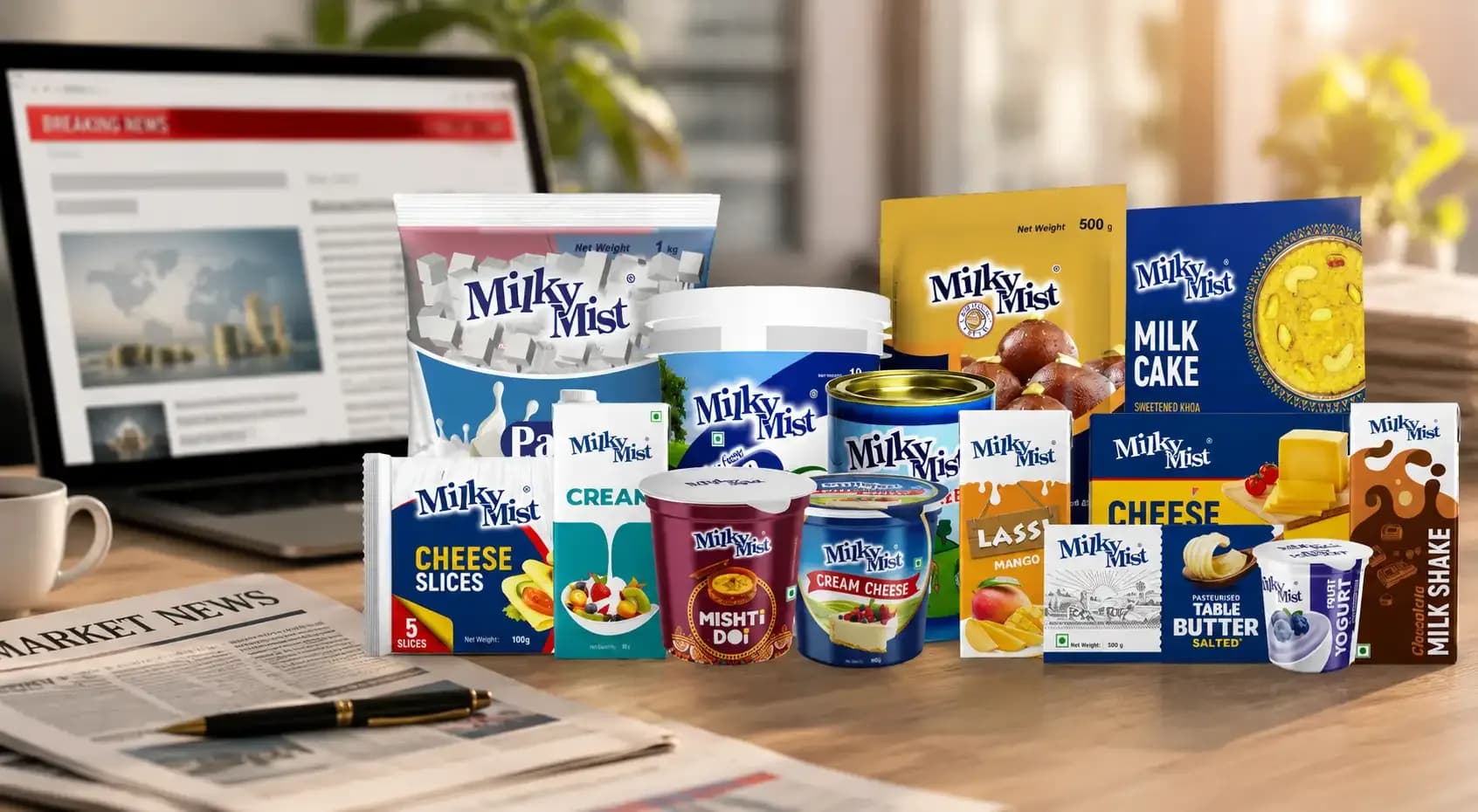
For decades, India's dairy story was largely about milk.
But the next phase of the industry is increasingly being built around what comes after the milk leaves the farm — paneer, cheese, yoghurt, ice cream, protein products, desserts and other value-added foods.
That shift is now at the centre of one of India's most closely watched food-sector public offerings.
Milky Mist Dairy Food is set to open its ₹1,553-crore initial public offering (IPO) on August 11, 2026, in what is expected to become the largest IPO by an Indian dairy company. The issue will remain open until August 13, with shares scheduled to list on the BSE and NSE on August 18.
The company has fixed a price band of ₹133 to ₹140 per share, giving it an implied valuation of approximately ₹10,778 crore at the upper end of the band.
But behind the headline number is a more interesting story: a regional dairy company that has built its business around value-added products is now asking public-market investors to place a substantial bet on its ability to scale nationally.
And that is where the Milky Mist IPO becomes more than just another primary-market event.
From a ₹2,035-Crore IPO to ₹1,553 Crore
Milky Mist's IPO journey began much earlier.
The company filed its Draft Red Herring Prospectus with SEBI in July 2025, proposing an issue of approximately ₹2,035 crore. The original structure comprised a fresh issue of up to ₹1,785 crore and an offer for sale of up to ₹250 crore by promoter shareholders.
SEBI subsequently cleared the issue in October 2025.
At that stage, the company planned to use the fresh issue proceeds for a combination of debt reduction and expansion, including investment in its Perundurai manufacturing facility in Tamil Nadu.
Then came a significant change.
In May 2026, Milky Mist raised approximately ₹482 crore in a pre-IPO transaction led by Jongsong Investments, an indirect wholly owned subsidiary of Temasek Holdings.
The transaction included approximately ₹357 crore of primary capital and ₹125 crore of secondary share sales by promoters Sathishkumar T and Anitha S. The investment was made at ₹139.76 per share, implying a valuation of roughly ₹9,300 crore at the time.
Following that transaction, the eventual IPO was reduced to ₹1,553 crore.
The revised issue consists of:
₹1,428 crore fresh issue
₹125 crore offer for sale
The reduction is significant because it shows how the company's capital-raising strategy evolved between the original DRHP and the eventual public offering.
The IPO at a Glance
Particular | Details |
|---|---|
IPO size | ₹1,553 crore |
Fresh issue | ₹1,428 crore |
Offer for Sale | ₹125 crore |
Price band | ₹133–₹140 |
Anchor bidding | August 10, 2026 |
IPO opens | August 11, 2026 |
IPO closes | August 13, 2026 |
Expected listing | August 18, 2026 |
Listing exchanges | NSE and BSE |
Upper-end implied valuation | ~₹10,778 crore |
The company is therefore entering the market at a valuation substantially higher than the approximately ₹9,300 crore valuation implied by the May pre-IPO investment.
At the upper end of the IPO band, the company is seeking a valuation of about ₹10,778 crore.
What Exactly Is Milky Mist Selling?
This is perhaps the most important part of the story.
Milky Mist is not primarily a liquid-milk company.
Its strategy has been built around value-added dairy products.
Its portfolio spans categories including:
Paneer
Cheese
Curd
Yoghurt
Greek yoghurt
Butter
Ghee
Ice cream
UHT products
Frozen products
Ready-to-eat and ready-to-cook products
Desserts and other dairy-based products
The company has increasingly moved towards premium and health-oriented products, including Greek yoghurt and protein-enriched dairy offerings.
That distinction matters.
Liquid milk is a highly competitive, relatively commoditised business. Value-added dairy gives companies greater opportunities to differentiate through branding, innovation, packaging, distribution and product mix.
Milky Mist is effectively betting that India's dairy consumption story is moving in this direction.
The Numbers Behind the IPO
Milky Mist's recent financial performance is one of the strongest arguments supporting the company's growth story.
For FY26, the company reported revenue of approximately ₹3,138 crore, up about 34% year-on-year.
More importantly, profit rose approximately 176% to ₹127 crore.
That means the company's profit growth has significantly outpaced its revenue growth.
Financial trajectory
Financial year | Revenue | PAT |
FY24 | ~₹1,827 crore | ~₹19 crore |
FY25 | ~₹2,355 crore | ~₹46 crore |
FY26 | ~₹3,138 crore | ~₹127 crore |
The progression is striking.
Revenue has expanded rapidly, while profitability has accelerated even faster.
However, investors need to look beyond the growth percentages.
At the upper IPO valuation of approximately ₹10,778 crore and FY26 PAT of about ₹127 crore, the implied trailing price-to-earnings multiple is roughly 85 times.
That is where the IPO becomes considerably more demanding.
The ₹10,778-Crore Question
The central question for investors is not whether Milky Mist is growing.
It clearly is.
The bigger question is:
How much future growth is already reflected in the ₹140 IPO price?
At approximately 85 times FY26 earnings, the market is not valuing Milky Mist like a conventional dairy business.
It is valuing it as a high-growth branded consumer company.
That distinction is crucial.
The company therefore needs to deliver sustained growth in:
Revenue + margins + distribution + premium products + geographic expansion
for the valuation to look increasingly comfortable.
The company's management has previously indicated an ambition of around 30% annual revenue growth, while expanding its retail footprint and increasing the contribution of quick-commerce channels.
If that growth continues for several years and translates into higher earnings, today's valuation could become easier to justify.
If growth slows materially, however, the valuation leaves less room for disappointment.
Why Temasek's Investment Matters
The involvement of Jongsong Investments, an indirect subsidiary of Temasek Holdings, is an important part of the IPO story.
In May, Jongsong participated in the ₹482-crore pre-IPO transaction at ₹139.76 per share.
That price is almost identical to the ₹140 upper end of the IPO price band.
For the market, the transaction provides an interesting institutional reference point.
It also suggests that a major global investment institution was willing to back the company's growth story immediately ahead of its public-market journey.
But investors should not confuse institutional participation with a guarantee of future stock performance.
The public-market valuation still has to be supported by earnings.
Where Does Milky Mist Want to Go Next?
The IPO is essentially funding the next stage of the company's expansion.
The original IPO plan included substantial allocations towards:
Repayment/prepayment of borrowings
Expansion and modernisation of the Perundurai facility
New capacity for products such as whey protein concentrate, yoghurt and cream cheese
Cold-chain infrastructure
Cooling equipment
Distribution expansion
The company has also been working on expanding its geographical footprint beyond its traditional southern stronghold.
There is another particularly interesting development.
In January 2026, Milky Mist announced plans for a ₹1,130-crore dairy processing facility in Maharashtra, with an initial processing capacity of 10 lakh litres per day and potential expansion to 25 lakh litres per day. The proposed project is expected to create around 800 direct jobs.
That expansion could become strategically important as Milky Mist attempts to build a genuinely pan-India dairy business.
The National Expansion Opportunity
Milky Mist already has a substantial retail footprint.
Reuters reported that its products are available in more than 375,000 retail outlets across India.
But the company still has significant room to expand outside its strongest markets.
This is simultaneously its biggest opportunity and one of its biggest risks.
India is a massive dairy market, but consumer preferences vary considerably between regions.
A product that works extremely well in Tamil Nadu or the broader South Indian market cannot automatically be assumed to have the same level of acceptance in North or East India.
Milky Mist therefore needs to replicate its brand, distribution and cold-chain economics across very different markets.
That will require capital.
And, perhaps more importantly, execution.
The Bigger Industry Story: India's Dairy Market Is Changing
The Milky Mist IPO comes at an important moment for the Indian dairy industry.
The opportunity is increasingly moving beyond basic milk.
Consumers are becoming more interested in:
Protein
Convenience
Premium yoghurt
Cheese
Functional dairy
Ready-to-eat products
Premium desserts
Health-focused foods
Milky Mist has positioned itself directly in many of these categories.
Its focus on Greek yoghurt and protein-enriched products is particularly relevant as India's urban consumers increasingly look at food through the lens of nutrition as well as taste.
This is why Milky Mist should not be viewed merely as another dairy company.
Its larger ambition appears to be becoming a branded value-added food company built around dairy.
Competition Will Be Tough
Milky Mist will enter the public market alongside established listed dairy companies such as:
Hatsun Agro Product
Heritage Foods
Dodla Dairy
Parag Milk Foods
And beyond listed competitors are much larger brands and cooperatives, including Amul and Mother Dairy.
The competitive challenge is therefore substantial.
The company must simultaneously protect its existing market share and spend aggressively enough to build awareness in new markets.
That creates a delicate balance between:
growth and profitability.
Our Market View: Strong Business, But a Valuation That Demands Execution
Indian Food Times' view: Milky Mist is one of the more interesting food-sector IPO stories in the current market because the underlying business is aligned with a genuine structural change in Indian consumption.
We like three things about the story.
First: The product strategy is right.
Milky Mist has avoided depending entirely on liquid milk and built its business around value-added categories.
That gives it exposure to premiumisation, convenience and protein-led consumption.
Second: The growth is real.
Revenue growth of roughly 34% in FY26 combined with a 176% increase in profit is difficult to ignore.
The company is demonstrating operating momentum rather than simply selling an aspirational growth story.
Third: The expansion runway is significant.
The company has a sizeable existing distribution network, plans for manufacturing expansion and an opportunity to grow beyond its traditional southern markets.
The Temasek-backed pre-IPO investment also provides additional credibility to the institutional story.
But there is a major "however."
The valuation is aggressive.
At the ₹140 upper band, the implied valuation of about ₹10,778 crore against FY26 profit of around ₹127 crore translates into an earnings multiple of roughly 85 times.
That is a premium valuation for a company operating in a competitive and input-cost-sensitive industry.
In our view, investors should therefore separate two questions:
Is Milky Mist a good business?
The answer appears to be yes, with strong growth potential.
Is ₹140 automatically a cheap price for that business?
That answer is much less straightforward.
The IPO appears more suitable for investors who are comfortable underwriting the company's future growth story, rather than simply buying based on its current earnings.
What Could Make the Valuation Work?
There are several potential catalysts.
If Milky Mist can sustain something close to its targeted high-growth trajectory, while improving margins, expanding its premium product mix and reducing debt, earnings could compound rapidly.
A larger contribution from:
Protein products
Greek yoghurt
Cheese
Cream cheese
Premium dairy
Quick commerce
North and East India
Exports
could also improve the overall product mix.
If earnings grow substantially faster than the company's valuation expands, today's high P/E could gradually moderate.
That is the bull case.
And What Could Go Wrong?
The risks are equally important.
Milk and input costs
Dairy margins are sensitive to milk procurement costs, packaging, energy and logistics.
Cold-chain complexity
Scaling dairy nationally requires significant investment in refrigeration and distribution.
Competition
Milky Mist will face established regional and national players with deep distribution networks.
Geographic expansion
Moving beyond the South requires considerable marketing and distribution expenditure.
Valuation risk
Perhaps the biggest risk for public-market investors is simply paying too much for future growth.
A high-growth company can still be a poor investment if the entry valuation assumes too much perfection.
The Milky Mist IPO Timeline
Date | What happened |
July 2025 | Milky Mist filed its DRHP with SEBI for a proposed ₹2,035-crore IPO. |
October 2025 | SEBI approval received for the ₹2,035-crore issue. |
February 2026 | CEO K. Rathnam reaffirmed the company's IPO plans and outlined ambitions for roughly 30% annual revenue growth. |
January 2026 | Company announced plans for a ₹1,130-crore dairy processing facility in Maharashtra. |
May 2026 | Jongsong Investments, a Temasek subsidiary, participated in a ₹482-crore pre-IPO transaction. |
July 2026 | Reports emerged that the IPO would launch in early August. |
August 4, 2026 | IPO size was revised down from ₹2,035 crore to ₹1,553 crore. |
August 5, 2026 | Price band fixed at ₹133–₹140 per share. |
August 10, 2026 | Anchor investor bidding. |
August 11, 2026 | Public subscription opens. |
August 13, 2026 | Public subscription closes. |
August 18, 2026 | Expected listing on NSE and BSE. |
The Bottom Line
Milky Mist's IPO is ultimately a bet on one of the most important shifts taking place in India's food economy.
Milk is becoming an ingredient. Value-added dairy is becoming the business.
Milky Mist has built its brand around that transition, and its recent financial performance suggests that the strategy is gaining traction.
But the stock-market story is different from the business story.
The business has attractive growth characteristics. The IPO valuation, however, leaves investors paying a significant premium for that expected growth.
For long-term investors, the key numbers to watch after listing will not simply be the share price or grey-market premium.
They will be:
Revenue growth → EBITDA margins → PAT growth → debt reduction → geographic expansion → premium-product contribution.
If Milky Mist delivers consistently on those metrics, the premium valuation can potentially be absorbed by earnings growth.
If it doesn't, the same valuation can become the company's biggest weakness.
Our view: Strong business proposition, attractive category positioning and substantial growth runway — but the IPO valuation calls for discipline rather than blind enthusiasm.
This is an editorial market assessment, not investment advice. Investors should read the company's final offer documents and assess the issue according to their own risk profile.