

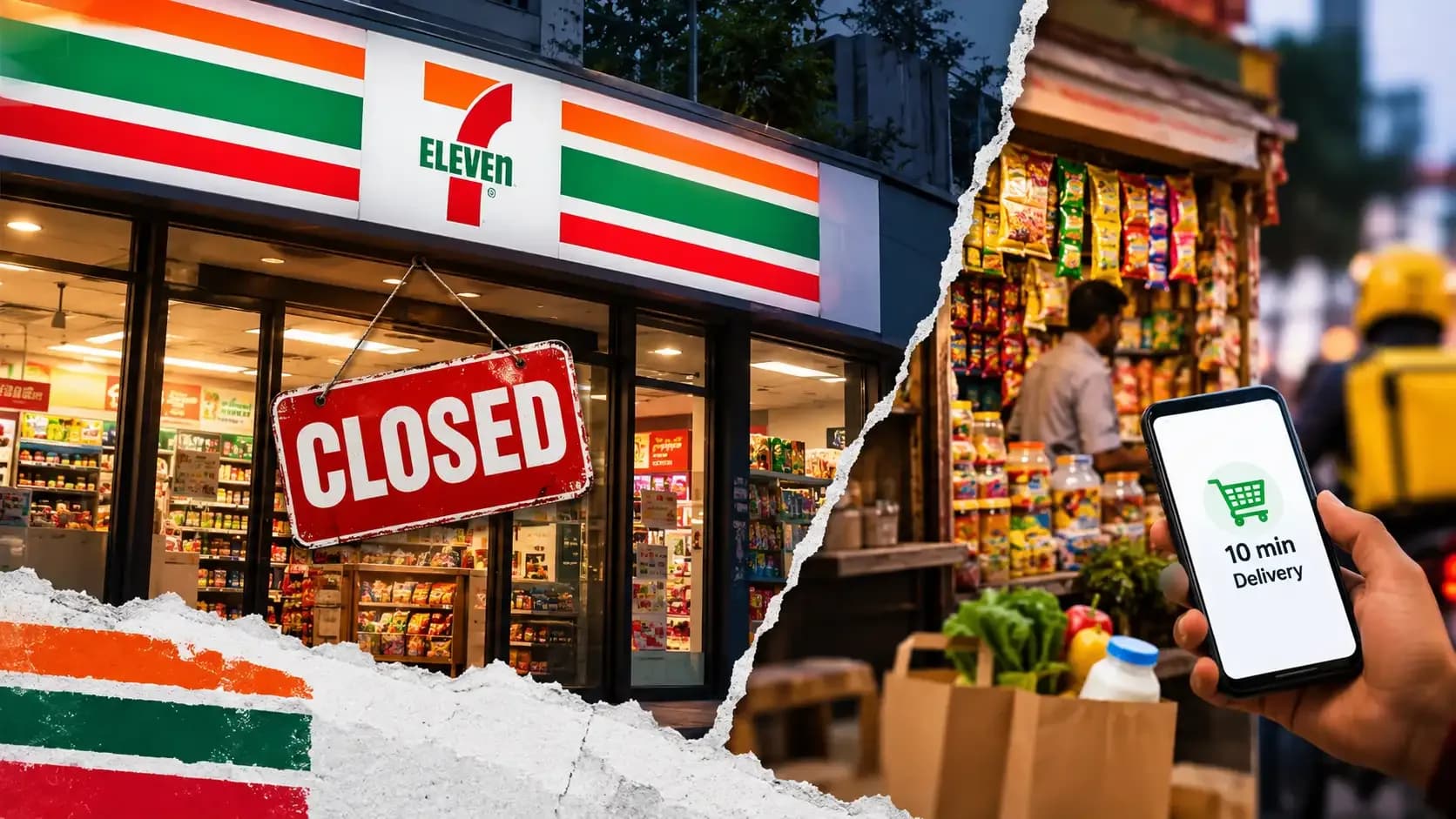
India has millions of small shops selling snacks, beverages, groceries and everyday essentials from neighbourhood corners.
Then came one of the world's biggest convenience-store brands.
7-Eleven.
Backed by one of India's biggest retail companies, Reliance Retail, the American convenience-store giant entered India with a promise that seemed almost obvious: bring the world's most successful convenience-store format to one of the world's fastest-growing consumer markets.
Five years later, the partnership is ending.
Most of 7-Eleven's nearly 60 Indian stores are expected to shut.
And that raises an uncomfortable question for India's organised retail industry:
Did India actually need 7-Eleven in the first place?
A global retail giant meets the Indian kirana
The Reliance–7-Eleven partnership began in 2021 after the convenience-store chain's earlier agreement with Future Retail collapsed.
Reliance Retail stepped in through its subsidiary 7-India Convenience Retail Limited, and the first 7-Eleven store opened in Mumbai's Andheri East in October 2021.
The proposition was straightforward.
Take a globally recognised convenience brand, combine it with Reliance's retail muscle and build a large network of stores across India.
But there was one problem.
India had already solved the convenience problem.
It was called the kirana store.
For generations, Indian consumers have been buying milk, biscuits, chips, cold drinks, bread, cigarettes, groceries and household essentials from shops located just minutes—or sometimes seconds—from their homes.
There was no need to teach Indians what convenience meant.
The industry was already doing it.
Then the economics became impossible to ignore
The latest financial numbers make the story considerably more uncomfortable.
7-India Convenience Retail reportedly recorded around ₹92 crore in revenue in FY2025-26, while its net loss was close to ₹90 crore.
Those figures don't simply tell us that the business was loss-making.
They highlight how difficult the economics of the format became.
A branded convenience store has to carry costs that many traditional retailers can avoid or minimise: rent, employees, electricity, inventory, logistics, store infrastructure and other operating expenses.
And the customer walking into the store is still comparing prices with the shop down the road.
That's a dangerous equation.
The customer didn't disappear. The definition of convenience changed.
This is where the story gets even more interesting.
India didn't suddenly stop buying convenience products.
Instead, convenience became digital.
A consumer who once walked to a nearby store can now open an app.
Blinkit.
Zepto.
Swiggy Instamart.
The product arrives at the doorstep.
That means a physical convenience store is no longer competing only with another physical store.
It is competing with a delivery network designed around the idea that the customer doesn't have to leave home at all.
And that's a very different battle.
Was quick commerce the killer?
It would be too simplistic to say that quick commerce alone killed 7-Eleven's India experiment.
The company faced multiple structural challenges, including store economics, scale and competition from India's established retail ecosystem.
But quick commerce has undoubtedly changed the consumer's expectations.
The old proposition was:
"We're five minutes away."
The new proposition is increasingly:
"Don't go anywhere. We'll come to you."
That difference could be enormous for a business built around physical convenience.
And then there is the ₹92 crore question
The most striking part of the story isn't the number of stores.
It's the economics.
Nearly 60 stores.
Around ₹92 crore in reported revenue.
Nearly ₹90 crore in net loss.
For a format that was supposed to scale across one of the world's largest consumer markets, those numbers are difficult to ignore.
They raise another question:
Was the problem the execution—or was India simply the wrong market for the traditional 7-Eleven model?
The answer may be somewhere in between.
7-Eleven had already tried once before
This wasn't even the brand's first difficult India partnership.
In 2019, 7-Eleven signed a master franchise agreement with Future Retail.
That partnership eventually collapsed, with the agreement terminated in October 2021 after Future Retail failed to meet agreed store-opening and financial commitments.
Reliance subsequently took over the opportunity.
Now, after five years, that partnership is also ending.
Two major Indian retail names.
One global convenience brand.
And still no large-scale 7-Eleven network.
That deserves attention.
India's retail market plays by different rules
A successful retail model in the US, Japan or other international markets cannot automatically be replicated in India.
India has:
A massive kirana ecosystem.
Extremely price-sensitive consumers.
High competition for prime retail locations.
Different shopping frequencies and basket sizes.
And increasingly:
A highly aggressive quick-commerce industry.
This combination creates an unusually difficult environment for a traditional convenience-store chain.
7-Eleven may have arrived with a global playbook.
But India already had its own.
The irony is almost perfect
7-Eleven's global proposition has always been built around one fundamental idea:
Convenience.
But India has taken that idea and pushed it much further.
The kirana brought convenience to the neighbourhood.
Modern retail brought organised convenience.
Quick commerce brought convenience to the doorstep.
So where exactly does a traditional convenience store fit?
That may be the question Reliance and 7-Eleven ultimately couldn't answer profitably.
Most of the nearly 60 7-Eleven stores are expected to close as the Reliance partnership ends.
However, this does not necessarily mean that 7-Eleven is permanently leaving India.
The global company could explore another local partnership in the future.
But if it does return, it may have to rethink the proposition completely.
Because opening more stores isn't necessarily the answer.
The bigger question is:
What can 7-Eleven offer that a ₹20 packet of chips from the local kirana or a 10-minute delivery from a quick-commerce platform cannot?
That is the battle.
The bigger lesson for India's food and FMCG industry
The Reliance–7-Eleven breakup is more than a retail partnership ending.
It is a warning for global consumer brands looking at India.
India isn't simply a giant market waiting for global formats to arrive.
It has its own deeply established consumer behaviour, distribution networks and retail economics.
Sometimes the biggest competitor isn't another multinational.
Sometimes it's the shop that's been operating downstairs for 20 years.
And sometimes, increasingly, it's an app.
7-Eleven came to India to sell convenience.
India may have responded by saying:
"We already have it."
And perhaps that is the most interesting part of this entire story.