


Mathura Destroyed 1,500 Kg of Paneer. The Harder Question Is What Happened to the Rest.
A raid in Kosikalan removed one batch of suspected adulterated paneer from the market. It didn't answer how much may have already reached restaurants and sweet shops or why, elsewhere in India, seized dairy rarely ends in a conviction.
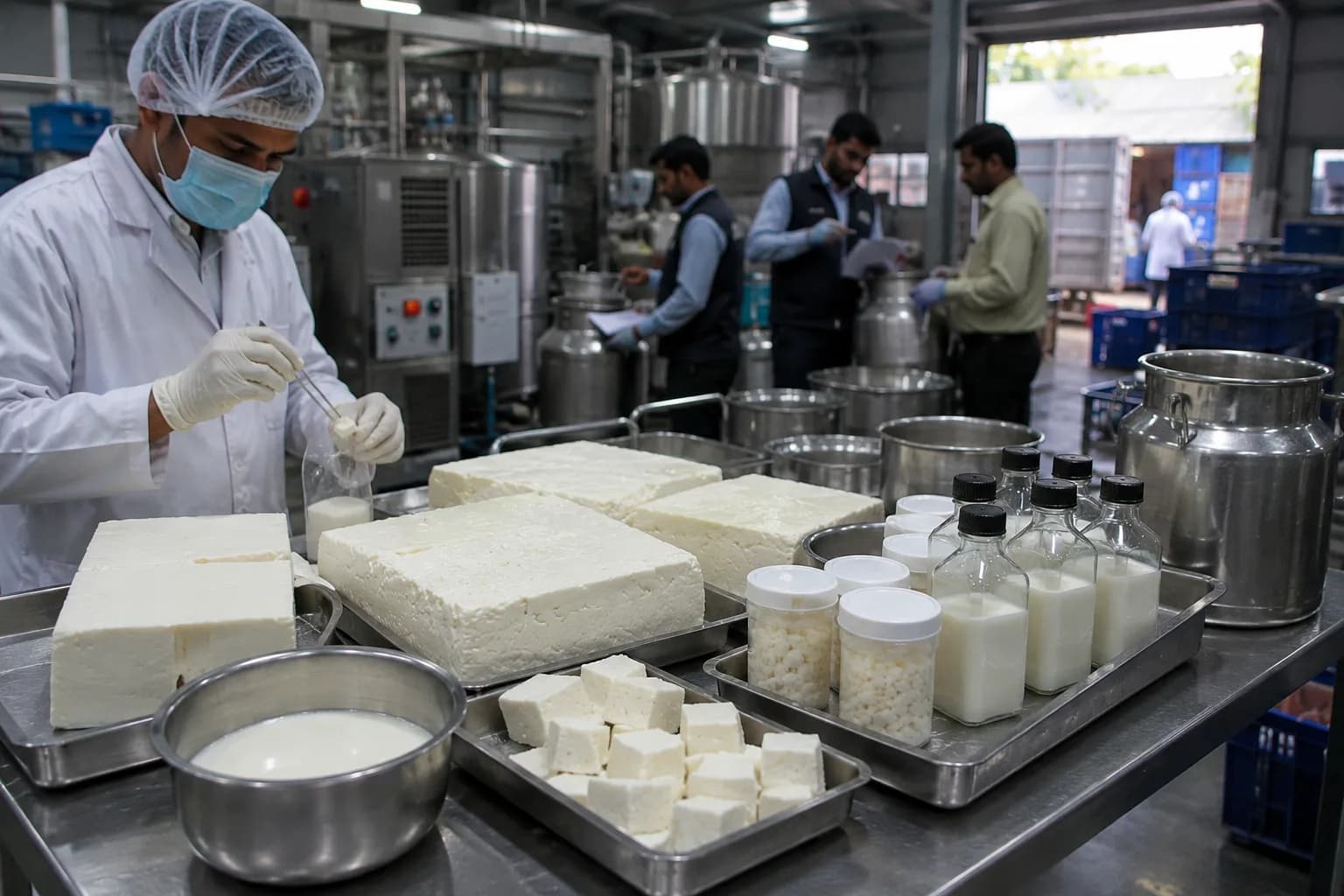
Fifteen hundred kilograms of paneer. Three thousand litres of milk. That is roughly what a small tanker truck carries, destroyed on the spot at a cheese-manufacturing unit in Kosikalan, on the outskirts of Mathura, earlier this month.
Uttar Pradesh's Food Safety and Drug Administration (FSDA) says the material was unfit for human consumption. Nine samples paneer, milk and cooking oil were collected and sent to a laboratory. As of this writing, the results are not public.
The raid tells us what officials found on one day, at one address. It does not tell us how much product may have already left that address before the door was opened or what happens to the nine samples now sitting in a queue at a government laboratory. That is where this investigation begins.
A six-district drive, not a single raid
The Mathura seizure was not an isolated action. It was one strand of a coordinated, week-long enforcement drive across three districts Ghaziabad, Mathura and Saharanpur run by 24 special FSDA teams under Commissioner Dr Roshan Jacob. The stated trigger was intelligence inputs about dairy and dairy-product manufacturing ahead of the festive season.
Across the three districts, officials inspected 25 manufacturing units; three were found shut. They destroyed 7,686 kg of food material on the spot, valued at roughly ₹10 lakh, and separately seized another 2,131 kg of material and suspected adulterants worth about ₹4.75 lakh a combined 9,817 kg moved out of circulation in one week. Seventy-two samples were collected across the drive.
Six FIRs followed: three in Ghaziabad, two in Mathura, and one for obstructing officials during the inspections. The Ghaziabad and Mathura cases cite the alleged use of industrial-grade chemicals and palmolein or refined vegetable oil in paneer production, and manufacturing carried out in unhygienic conditions. In the same window, a separate action in Ghaziabad destroyed or seized roughly 1,000 kg of paneer and khoya reported as contaminated. None of this constitutes a laboratory finding of adulteration that determination is still pending, and this article uses "suspected adulterated" for that reason.
It is worth being precise about what these numbers do not show. They are not evidence that most paneer in Uttar Pradesh, or in India, is adulterated. They are evidence that a targeted, intelligence-led operation across three districts found enough irregularity mislabelled fats, unhygienic conditions, unlicensed processing to justify seizure, destruction and prosecution at a meaningful number of sites. Scale matters here: 9,817 kg sounds enormous until it is set against a dairy economy that moves millions of tonnes of milk and milk products through Uttar Pradesh every month.
This wasn't only about paneer
The materials cited in the FIRs industrial-grade chemicals, palmolein and refined vegetable oil point to a specific and long-documented form of dairy fraud: substituting cheaper non-dairy fats or bulking agents for milk fat, then processing the result to mimic the taste and texture of paneer, khoya or ghee. Officials in earlier, similar cases elsewhere in India have described products made this way as designed to "pass" at first glance matching colour and mouthfeel closely enough that a shopkeeper, caterer or home cook cannot reliably tell the difference without testing.
That is precisely why this story cannot rest on a single raid. The economics that make substitution attractive palm oil and skimmed milk powder cost a fraction of fresh milk fat, and demand for paneer, khoya and sweets rises sharply around festivals do not disappear because one unit in Kosikalan was shut down. The relevant question is whether the system built to catch this kind of fraud can trace a product once it leaves a factory floor, not just seize what is still sitting inside one.
How adulterated dairy can move before anyone catches it
Legally, dairy in India passes through a chain: manufacturer, then wholesaler or a milk-collection/chilling centre, then distributor, then retailer or a restaurant, sweet shop or caterer, and finally the consumer. At almost every link in that chain, product can be intercepted or missed.
Reporting from enforcement drives across states shows both possibilities in the same week. In Punjab, food safety officers have intercepted vehicles carrying paneer and khoya mid-transit a truck stopped at a police post, a bus searched at a toll plaza, a car fleeing a checkpoint outside a sweet shop. Those interceptions work because someone was watching a specific route on a specific night. They also show, by implication, that plenty of other vehicles on plenty of other nights are not stopped.
There is also a legal safeguard built for exactly this scenario: under the Food Safety and Standards Act, once part of a batch is found unsafe, the law presumes the entire batch is unsafe. That presumption exists precisely because a food safety officer usually can't test every kilogram the point of the rule is to let a single positive sample justify pulling a whole consignment, not just the tested portion.
But a legal presumption is not the same as a functioning trace-back system. India does not have a single, unified, real-time batch-tracking mechanism linking a specific tanker of raw milk to a specific block of paneer to a specific sweet shop shelf, the way, for instance, pharmaceutical batch numbers are meant to work. Traceability in dairy enforcement today largely depends on paperwork at the point of seizure purchase invoices, transport records, the word of a driver or a shop owner and on officers physically finding the product before it disperses. When Maharashtra's Food and Drug Administration raided dairies in Vasai in 2019, it noted the seized paneer was already being supplied to hotels and restaurants meaning some of what that unit produced had, by definition, already left before the raid happened. Nothing in the reporting on Mathura confirms how much of the 1,500 kg had already been distributed versus how much was caught still on-site; that is one of the genuine unknowns of this story.
What happens after a sample fails
This is the part that gets skipped in most breaking-news coverage, and it is the part that actually determines whether a raid changes anything.
Once a Food Safety Officer collects a sample, it goes to an FSSAI-recognised state laboratory (with a referral laboratory available for disputed results) for chemical analysis. The result classifies the product into one of several categories defined under Section 3 of the Food Safety and Standards Act, 2006, and the category determines the entire legal path from there:
Substandard food fails to meet composition, quality or purity standards but is not necessarily dangerous diluted milk is the textbook example. This goes to a district Adjudicating Officer, is compoundable, and carries a penalty of up to ₹5 lakh.
Misbranded food involves false, misleading or deceptive labelling or claims for instance, cheese made with vegetable oil sold simply as "paneer." This also goes to the Adjudicating Officer, with a penalty of up to ₹3 lakh.
Unsafe food is injurious to health through contamination, harmful adulterants, or unhygienic processing that creates a genuine hazard. This is the only category that triggers criminal proceedings, heard before the designated FSS Act court (typically an Additional Chief Judicial or Metropolitan Magistrate), and can carry imprisonment ranging from six months up to a life term where a consumer's death is involved, alongside fines that can reach ₹10 lakh or more.
An adulterant itself is defined broadly under the Act as any material that could make food unsafe, substandard, misbranded, or containing extraneous matter which is why officials in Mathura and Ghaziabad have been careful, in official statements, to describe seized material as "suspected" pending the sample results, rather than asserting a specific legal category before a lab has spoken.
Two structural facts shape how long this takes. First, an accused party can request a re-test at the referral laboratory, which is a legitimate right under the Act but can add months to a case one Haryana food safety officer, describing a comparable batch of failed samples, said openly that "the legal procedure can take up to a year" once a repeat test is requested. Second, enforcement is split by design: FSSAI sets the science-based standards nationally, but implementation inspections, sampling, adjudication, prosecution sits with state governments, through Designated Officers, Food Safety Officers and district Commissioners of Food Safety. A national standard does not enforce itself; each state's capacity and political will to follow through determines whether a failed sample becomes a penalty, a court case, or nothing at all.
The gap between finding it and doing something about it
That last point is not hypothetical. Government data tabled in the Lok Sabha in August shows Telangana tested 3,576 food samples in 2025-26; 398, or 11.1%, failed. The state recorded not a single penalty or conviction that year. A five-year figure tabled separately tells the same story at scale: 20,965 samples tested between 2021-22 and 2025-26, 2,942 found non-conforming, 942 resolved with a penalty and zero criminal convictions across those five years.
Set beside neighbouring states, the gap is stark. Tamil Nadu tested more than twelve times as many samples as Telangana in the same period and still recorded 1,359 penalties and 857 convictions. Kerala, testing 16,746 samples, recorded 1,026 penalties and 330 convictions. The difference is not simply about sample volume it's about what happens after a sample fails, which is precisely the step this investigation set out to examine.
Nationally, the picture is similarly uneven. Of 2,23,808 food samples analysed across India in 2025-26, 40,023 nearly one in five were found non-conforming. Of those, 31,878 civil cases were decided with a penalty, and 1,918 criminal convictions were recorded. Put differently: a failed sample is common. A conviction, nationally, follows well under one in twenty failed samples, and in some states, essentially none.
None of this proves that Mathura's samples will meet the same fate the case is too recent, and results are still pending. But it is the honest context in which to read any promise of "strict action" following a raid: the raid is the easy part. The adjudication, the re-testing window, the court date, and the conviction are where enforcement systems around the country visibly slow down or stop.
Why dairy specifically
Milk and its derivatives are structurally easy to adulterate and hard to police at scale. Milk fat can be diluted with water or partially replaced with cheaper vegetable fats palm oil, in particular, recurs across enforcement cases nationwide because it can be processed to mimic the texture of milk fat at a fraction of the cost. Skimmed milk powder is used to bulk up volume. In more serious cases documented by food safety departments, urea, detergent-like compounds, or unauthorised colouring agents have been used to fake the appearance or thickening properties of dairy.
Two things make dairy specifically vulnerable, beyond the raw economics. First, paneer, khoya and similar products are frequently sold loose unpackaged, unbranded, weighed out at the counter which strips away the label and batch-code trail that FSSAI's traceability rules are built around. Second, demand spikes sharply and predictably around festivals, weddings and religious occasions, exactly when officials also report the heaviest enforcement drives a pattern several state food safety departments describe openly as a seasonal cat-and-mouse dynamic rather than a year-round baseline.
What consumers can and cannot do
FSSAI has, for several years, promoted a "Detect Adulteration with Rapid Test" (DART) booklet and Rapid Analytical Food Testing (RAPID) kits, alongside Mobile Food Testing Laboratories branded "Food Safety on Wheels," aimed at giving both officials and citizens simple screening tools. These have a real, if limited, role.
What they are not is a substitute for laboratory confirmation. Viral home tests boiling, smelling, rubbing a sample between fingers are not validated methods for reliably detecting the kind of processed, texture-matched fraud described in the Mathura and Ghaziabad FIRs; adulterated paneer, by design, is often made to pass exactly these casual checks. The more grounded, evidence-based precautions consumer advocates and food-safety officials point to are structural: buying from licensed, traceable sources rather than unbranded loose product where possible; treating unusually low prices as a signal to ask questions, not a bargain; and reporting suspected cases to the state helpline or FSSAI's FoSCoS portal so a Food Safety Officer not a home test makes the call. The responsibility for confirming adulteration sits with a laboratory and a legal process, not with a shopper standing at a counter.
The real gap isn't just adulteration. It's traceability.
Put the pieces together and a clearer picture emerges. Uttar Pradesh's drive shows that targeted, intelligence-led enforcement can and does find real irregularities chemicals, mislabelled fats, unlicensed and unhygienic units across multiple districts in a single week. Interstate interception cases from Punjab and elsewhere show that some adulterated product is caught mid-transit, which is only possible because officers happen to be watching that specific route. And the Telangana and national data show that finding a problem and resolving it through the legal system are two very different achievements, with the gap between them varying enormously by state.
What's largely missing from public view is the middle: a systematic account of how much product from a facility like the one in Kosikalan reaches consumers before enforcement catches up, and a genuinely trackable batch-to-shelf record for loose dairy products sold the way most paneer in India is actually sold. Until that middle is filled in with better batch documentation, faster laboratory turnaround, and enforcement outcomes that don't vary by more than an order of magnitude between neighbouring states a raid like Mathura's will keep answering the question of what was found, without answering the harder one: how much moved before anyone looked, and what happens to make sure it doesn't happen again at the same address.
What happens next
FSDA has said further legal action will follow if the nine Mathura samples fail laboratory testing, in line with standard procedure under the Act. IFT will update this story with the laboratory findings, any adjudication or court outcome, and confirmation of whether licences at the Kosikalan unit are suspended or cancelled, as that information becomes available.