

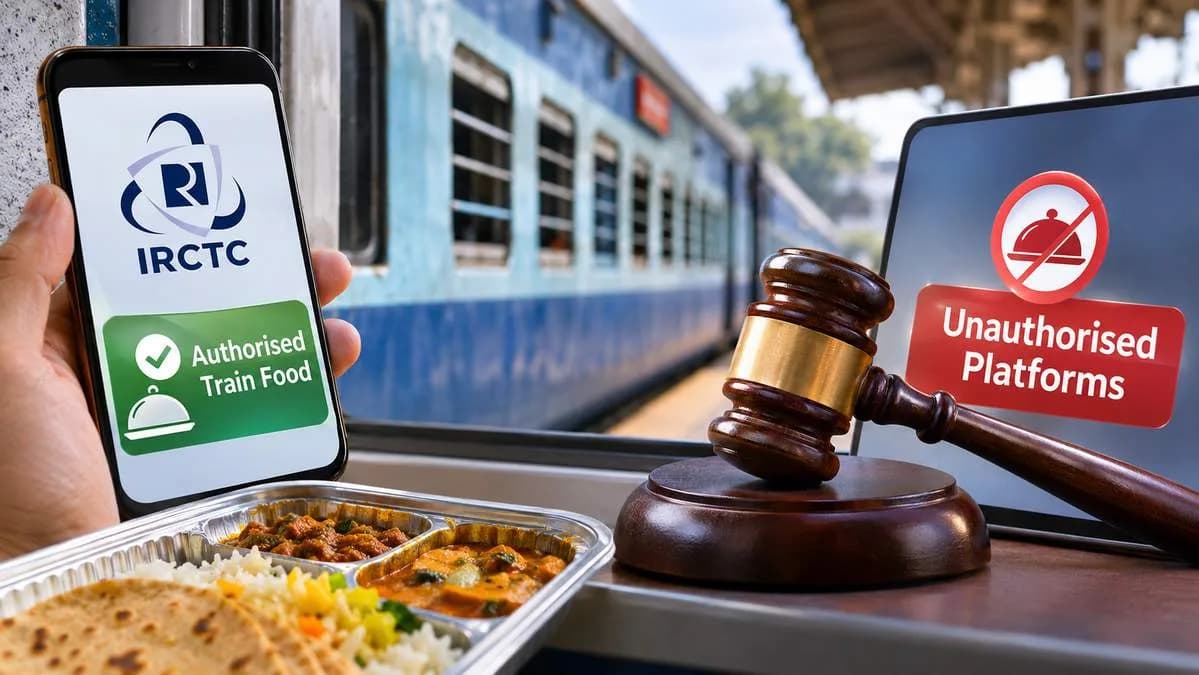
Ordering food during a train journey has become considerably easier over the years. Passengers no longer have to depend entirely on pantry car meals or rush to railway station platforms to purchase something to eat. With a few clicks, they can order everything from biryani and pizza to thalis and snacks, with delivery arranged directly at their seats.
But as online train food delivery has grown in popularity, so has the number of independent platforms offering these services. And now, the Indian Railway Catering and Tourism Corporation (IRCTC) is taking a much closer look at who is actually authorised to deliver food to passengers travelling across the country's railway network.
On November 7, IRCTC issued a fresh warning against unauthorised e-catering websites and mobile applications, urging passengers to avoid ordering meals through platforms that do not have its approval. The corporation has also intensified its enforcement drive against operators allegedly conducting train food delivery services outside its authorised ecosystem.
The concerns go beyond food quality. IRCTC has flagged potential risks involving food hygiene, passenger data, online payments, refunds and the misuse of its brand identity.
The latest warning follows legal proceedings initiated earlier this year against 14 non-compliant e-catering operators. For passengers who regularly order food online while travelling, the development raises an important question: how can they distinguish between an authorised train food delivery service and an unauthorised one?
IRCTC's legal action against unauthorised food delivery platforms
IRCTC's action is part of a wider effort to bring online food delivery services operating across the railway network under closer regulatory supervision.
According to information published by the corporation, a legal notice was issued to non-compliant operators on February 18, 2026. This was followed by criminal complaints on March 16 and April 11, as IRCTC moved towards formal legal action against operators allegedly continuing unauthorised activities.
The corporation has now reiterated its position through a fresh passenger advisory, warning that platforms operating outside its approved e-catering framework may expose travellers to several risks.
The action also targets the alleged misuse of IRCTC's brand and identity by businesses that could create the impression of being officially associated with Indian Railways.
Importantly, the legal proceedings should not be confused with final court judgments. The operators have been identified in connection with alleged unauthorised activities; the public information available does not establish that all have been convicted of any offence.
Which train food delivery websites have been identified by IRCTC?
IRCTC has published a list of websites associated with unauthorised e-catering operations.
The websites identified in the November 7 report include:
1. RailRestro.com
2. RailRestro.in
3. RailMitra.com
4. TravelKhana.com
5. TrainsCafe.com
6. DIBRail.com
7. RailFood.net
8. TravelerFood.com
9. FoodOnTrack.in
10. eCatering.app
11. KhanaOnline.in
12. TrainWay.in
13. RailMeal.com
14. TrainMenu.com
RailRestro appears with two separate domain addresses, which is why the number of website addresses and the number of operators are not necessarily the same.
The list is significant because several of these websites have names and services that closely resemble what passengers associate with official railway food delivery.
However, being named in IRCTC's unauthorised operator list does not, by itself, establish that every meal supplied through a particular business was unsafe or that the operator has been found guilty by a court.
Why is IRCTC concerned about these platforms?
IRCTC's objections are centred on five major areas: food safety, passenger information, financial security, customer accountability and regulatory compliance.
1. Food safety and hygiene concerns
Food delivered during a train journey has to meet the same basic safety expectations as food purchased elsewhere. But railway food delivery comes with an additional challenge: passengers often have little visibility into where their meals are prepared and how they reach the train.
IRCTC has expressed concerns that unauthorised platforms may source food from outlets that are not adequately regulated or may not comply with Food Safety and Standards Authority of India (FSSAI) requirements.
The corporation has specifically highlighted the possibility of food being prepared in unhygienic kitchens, inadequate food-handling practices, untrained workers and delivery personnel who may not have undergone mandatory medical examinations.
For passengers, the concern is straightforward. When ordering food online, they should have a reasonable level of confidence that the restaurant preparing their meal meets applicable food safety requirements.
IRCTC argues that its authorised ecosystem provides a more accountable framework for food sourcing and delivery.
2. Passenger data could be exposed to fraud
Ordering food on a train is not quite like placing a regular food delivery order.
Most railway food delivery services require passengers to provide their PNR number so that the platform can identify the train, journey details and delivery station.
Depending on the service, passengers may also share their mobile numbers, email addresses, coach and seat information, along with payment details.
IRCTC has warned that sharing such information with unverified platforms could expose passengers to phishing attempts, identity misuse and financial fraud.
For instance, a passenger who has shared their contact information with an unverified service could potentially receive fraudulent messages or payment requests disguised as order confirmations or delivery updates.
The warning does not establish that all the identified platforms have misused passenger data. It highlights the potential risks of providing sensitive information to businesses operating outside a recognised system.
3. Payment fraud and refund-related problems
Another concern raised by IRCTC involves financial transactions.
Passengers may pay for meals in advance, but what happens if the food never arrives?
IRCTC says unauthorised services may leave customers with limited options when orders are cancelled, delayed or not delivered. The absence of a reliable complaint-handling mechanism can make it difficult for passengers to obtain refunds or resolve disputes.
Potential problems include:
- Payment deducted without a confirmed order.
- Orders cancelled after successful payment.
- Food not delivered at the selected railway station.
- Additional or unclear charges.
- Unverified UPI payment requests.
- Delays in processing refunds.
- Difficulty reaching customer support.
For someone travelling on a long-distance train, a failed food order can be more than a minor inconvenience, particularly when the passenger has limited time to arrange an alternative meal.
4. Misuse of the IRCTC brand and identity
IRCTC has also raised concerns about unauthorised businesses using its brand identity or presenting their services in ways that could mislead passengers into believing they have official railway approval.
This is particularly important because the distinction between an official service, an authorised third-party aggregator and an independent food delivery website may not always be obvious to an ordinary traveller.
Passengers should therefore avoid assuming that a website is officially approved simply because it uses railway-related terminology, displays train images or asks for a PNR number.
5. GST and regulatory compliance
IRCTC has also highlighted the financial and regulatory implications of unauthorised e-catering operations.
The corporation says it contributes GST on its e-catering revenue and has expressed concerns that businesses operating outside the prescribed framework may not fulfil their applicable statutory tax obligations.
According to IRCTC, such activities could create an uneven competitive environment for authorised businesses and potentially affect government revenue.
These are concerns raised by the corporation and should not be interpreted as proof that every operator identified in the advisory has evaded GST.
Swiggy and Zomato are authorised: Here is what passengers should know
One important aspect of the crackdown is that IRCTC is not stopping third-party food delivery companies from participating in the railway catering market.
Instead, it operates an authorised aggregator model through which selected businesses can offer food delivery services to railway passengers.
Swiggy and Zomato are among the recognised food aggregators in this ecosystem.
Other names appearing in IRCTC's published authorised partner information include:
- Zoop
- RailYatri
- RailRecipe
- Yatribhojan
- YatriRestro
- Garg Rajdhani
- Homebytes
- OLF
- Relfood
- Gofoodieonline
- Rajbhog
- BrotherByte
- Happy Journey
- Swad Express
The authorised partner list can change, so passengers should verify a platform's current status through IRCTC's official e-catering website or application before placing an order.
The distinction is important: being an independent food delivery business is not automatically a violation. The question is whether the business has the required authorisation to provide services within the railway e-catering framework.
How passengers can order food safely during train journeys
IRCTC has advised passengers to use its official e-catering website, the Food on Track mobile application or its authorised food delivery partners.
The official e-catering service allows passengers to select meals from participating restaurants and arrange delivery at designated stations during their journey.
Here is how the process works:
Step 1: Visit the official website
Go to https://ecatering.irctc.co.in/ or use the official Food on Track application.
Step 2: Enter your PNR number
The system uses the PNR to identify the journey and display relevant delivery options.
Step 3: Select your delivery station
Choose a station along your route where the food can be delivered.
Step 4: Choose your restaurant and meal
Browse available restaurants, food items and prices before placing the order.
Step 5: Complete your payment
Use the available payment methods and retain the order confirmation.
Step 6: Receive your food
The restaurant or authorised delivery representative arranges delivery at the designated station and the passenger's coach or seat, subject to the service arrangements.
Passengers can also place orders through IRCTC's e-catering customer helpline, 1323.
What if a passenger has already ordered food from an unauthorised website?
Passengers who have previously used one of the identified websites should not automatically assume that their personal information or money has been compromised.
However, IRCTC's advisory is a good reason to be more careful with future bookings.
If an order has already been placed, passengers should retain their confirmation messages, payment receipts and transaction details. If food is not delivered or money is debited without a confirmed order, they should contact the service provider and their payment provider to raise a dispute.
In cases involving suspected online financial fraud, passengers can contact the national cybercrime helpline at 1930 or report the incident through the National Cyber Crime Reporting Portal.
For consumer-related complaints, the National Consumer Helpline is available at 1915.
Passengers who encounter unauthorised food vendors or illegal food delivery activities at railway stations or on trains can also report them to the Railway Protection Force through helpline 182.
A wider push to improve food safety across Indian Railways
IRCTC's action against unauthorised online food delivery services comes at a time when Indian Railways is also focusing on improving accountability across its onboard catering operations.
In a separate announcement published on March 19, 2026, the Ministry of Railways highlighted several measures intended to eliminate unauthorised vending and strengthen food safety.
These include QR-code-enabled identity cards for authorised vendors, digitally traceable food packets, mandatory FSSAI certification, CCTV monitoring of modern base kitchens, surprise inspections and third-party audits.
The QR-code-enabled identity cards are intended to help railway authorities verify the identity of vendors, helpers and staff deployed for onboard catering services.
The Ministry also highlighted that unauthorised hawking and vending in railway passenger areas is prohibited under Section 144 of the Railways Act, 1989.
While these measures address the broader railway catering ecosystem, the online e-catering crackdown is a separate but related effort to improve accountability in digital food ordering.
What does the crackdown mean for India's train food delivery market?
Beyond passenger safety, IRCTC's action could have wider implications for India's railway food delivery business.
Over the years, train food delivery has developed into a specialised segment of the country's food services industry. It connects restaurants, aggregators, railway stations and passengers through a delivery model that operates around train schedules rather than conventional delivery distances.
Unlike a regular food delivery order, a train meal must reach a particular station within a limited time window. The delivery partner also needs accurate journey information, coordination with restaurants and the ability to locate the passenger's coach and seat.
This makes railway food delivery a considerably different operational challenge from ordinary hyperlocal food delivery.
For companies operating in this segment, IRCTC's enforcement drive places greater importance on formal partnerships, regulatory compliance and reliable delivery infrastructure.
Authorised aggregators could also benefit from increased passenger awareness of official ordering channels.
However, the move raises questions about how independent food delivery businesses can participate in this market and what requirements they must fulfil to obtain the necessary approvals.
For the industry, the coming months could bring greater scrutiny of platform authorisation, restaurant sourcing, food safety and customer grievance mechanisms.
Train food delivery has made long-distance journeys more convenient for millions of passengers, but convenience should not come at the cost of food safety, financial security or personal information.
IRCTC's latest warning is a reminder that not every website offering food delivery on trains necessarily has official railway authorisation.
For passengers, the simplest precaution is to check whether a platform appears on IRCTC's current authorised partner list before sharing a PNR number or making a payment.
For the food delivery industry, the crackdown highlights an increasingly important reality: as digital food services expand into specialised markets such as railway catering, regulatory compliance and operational accountability will matter just as much as the convenience offered to customers.
The challenge now is to ensure that passengers continue to enjoy more food choices during their journeys while having confidence in the people preparing, handling and delivering their meals.