
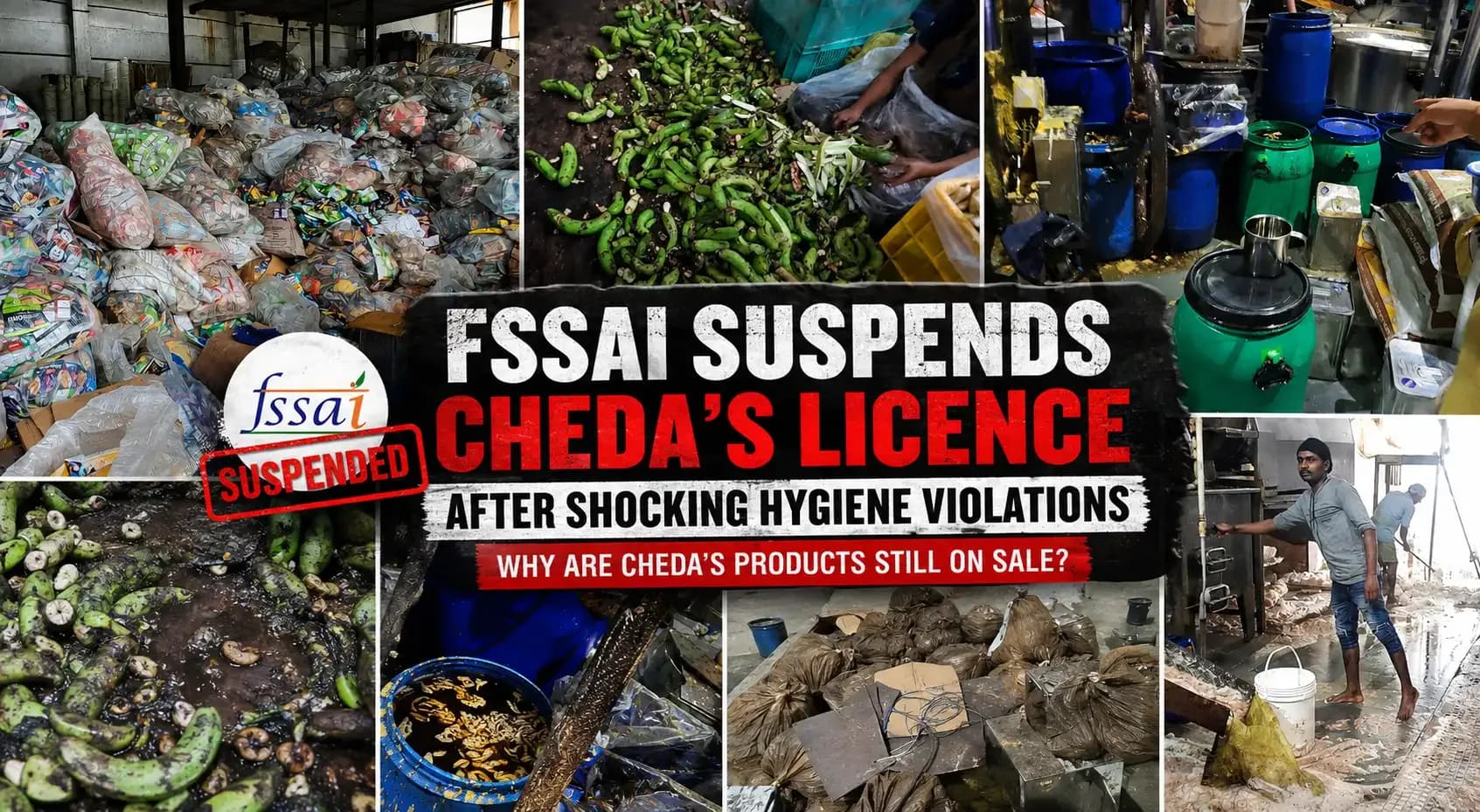
An FSSAI inspection has raised deeply disturbing questions about food safety at Chheda Specialties Foods. But an even bigger question now needs an answer: if the manufacturing licence has been suspended, why can consumers still order Chheda’s snacks from Instamart, Zepto and Blinkit — and buy them from local stores?
This is not just another food-safety inspection story.
It is a question about how India's food-safety enforcement actually works once a regulator finds serious violations inside a food manufacturing facility.
According to a communication posted by FSSAI West Region, Chheda Specialties Foods Pvt. Ltd., Maharashtra, faced suspension of its food manufacturing licence following an inspection conducted on August 6, 2026. The inspection reportedly recorded a critical non-compliance score of just 42% — 36 compliance points out of 86.
And the findings described in the communication are alarming.
Bare hands, decomposing waste and contaminated floors
According to the FSSAI West Region communication, food handlers were observed mixing besan dough with bare hands and peeling bananas while sitting on contaminated floors next to decomposing waste.
That is not a minor paperwork lapse.
It raises a basic question about hygiene at a facility manufacturing food that eventually reaches consumers.
The inspection also reportedly found extensive fungal growth around fresh and used edible-oil storage tanks.
Think about that for a moment.
This is an environment in which edible oil is part of the food-production process, yet the inspection reportedly found fungal growth around the storage infrastructure.
Expired and rejected products allegedly stored beside raw materials
The findings become even more troubling.
The FSSAI communication says market-returned, rejected and expired products were being stored near raw-material handling areas.
That creates an obvious cross-contamination concern.
A manufacturing facility handling food should have strict segregation between usable raw materials, finished products, rejected material, expired products and waste.
Instead, according to the inspection findings, these categories were allegedly being stored dangerously close to one another.
Leaking roofs. Stagnant water. Wastewater on the processing floor.
The inspection reportedly found roof leakages, damaged flooring with stagnant water, flaking walls above exposed food and wastewater being discharged directly onto the processing floor.
Again, these aren't cosmetic defects.
A food manufacturing facility is supposed to control precisely these kinds of environmental and hygiene risks.
Then came another disturbing list of observations:
Broken insect-proof mesh.
Dead houseflies reportedly found in the seasoning area.
Raw materials and packaging materials stored directly on wet and dusty floors.
Unlabelled food containers without batch information or date markings.
Serious traceability deficiencies.
And perhaps most concerning, according to the FSSAI West Region post, multiple food samples collected during previous inspections had reportedly been declared "Unsafe" or "Misbranded", with legal proceedings still ongoing.
If accurate, that raises a much larger question about whether this was simply one bad inspection — or evidence of a recurring compliance problem.
But here's where the story gets even more serious
The FSSAI communication says manufacturing operations were directed to be immediately suspended until comprehensive corrective measures are implemented and compliance with the Food Safety and Standards Act, 2006 is demonstrated.
FSSAI itself states that a Designated Officer can suspend a licence when a food business operator fails to comply with an improvement notice.
And India's food-safety framework doesn't stop at the factory gate.
FSSAI's own recall guidance says that food recalls can be used to remove food products from the market at any stage of the food chain, including products already with consumers, where they pose a public-health threat or violate applicable requirements.
In fact, FSSAI introduced a dedicated Food Recall functionality in FoSCoS in March 2026, allowing enforcement authorities to initiate recalls and making recall information accessible to consumers.
So now comes the question that FSSAI, the company and India's quick-commerce platforms need to answer.
If the manufacturing licence has been suspended, why are Chheda's products still available?
Our checks found Chheda products currently listed on multiple major quick-commerce platforms.
Swiggy Instamart
Instamart currently lists a dedicated Chheda's storefront in Mumbai with products including Golden Potato Chips, Long Masala Banana Chips, Yellow Banana Chips, Manglori Mix, Bhel Mix, Nylon Sev and several other products.
Zepto
Zepto currently lists products including Chheda's Yellow Banana Chips, Salt & Pepper Banana Chips and Farali Potato Chivda.
Blinkit
Blinkit currently lists Chheda's products including Golden Rock Salt Potato Wafers and Long Masala Banana Chips.
And this isn't merely an online-platform problem.
Chheda's products are also widely distributed through offline retail channels. The company's own website describes a broad retail network and says its products are sold through multiple offline and online partners.
So what exactly has been suspended?
This is the critical question that should not be casually answered with "all Chheda products are unsafe."
A suspension of a manufacturing licence does not automatically establish that every packet of every Chheda product currently sitting in a supermarket or consumer's kitchen is unsafe.
There can be existing inventory, different manufacturing premises, different licences, different batches and products manufactured before the enforcement action.
But that is precisely why consumers deserve clarity.
If the regulator has suspended the manufacturing operations because of serious hygiene and food-safety violations, authorities should clearly communicate:
Which licence was suspended?
Which manufacturing premises does it cover?
Which products and batches, if any, are affected?
Was a product recall ordered?
Were distributors instructed to stop selling affected stock?
Were quick-commerce companies informed?
Were retailers informed?
Has potentially affected inventory been quarantined?
Has any recall been entered into the FSSAI FoSCoS Food Recall system?
Those answers matter.
Because without them, consumers are left staring at a bizarre contradiction:
A regulator says manufacturing operations have been suspended — while the same brand's food can still be delivered to your doorstep in minutes.
The Quick-Commerce Question Cannot Be Ignored
This is where the responsibility extends beyond the manufacturer.
Instamart, Zepto and Blinkit are not merely technology companies connecting buyers and sellers. They are increasingly important parts of India's food distribution ecosystem.
FSSAI has itself been tightening regulatory oversight of e-commerce and quick-commerce food operations, including requirements around food-safety licensing and supply-chain compliance.
So if an FBO's manufacturing licence has been suspended, what mechanism do these platforms have to identify affected products and prevent their continued sale?
And if they have already received a regulatory communication, why are the products still visible to consumers?
There may be a perfectly legitimate explanation — for example, if the suspension applies only to a specific manufacturing premises while existing compliant inventory from an earlier production period remains legally saleable.
But that explanation needs to come from the authorities and the company, not from consumers guessing at checkout.
And then there is the local-store problem
Quick commerce is easy to check.
But what about the thousands of neighbourhood grocery shops, supermarkets, distributors and wholesalers carrying the same products?
If a recall or withdrawal is required, how quickly does that information travel down India's fragmented distribution chain?
One FSSAI guideline makes the purpose of recall clear: removing affected food from the marketplace and distribution chain and protecting consumers.
That means a serious enforcement action cannot end with a factory inspection report.
The real test begins after the inspection.
Can the regulator trace the affected products?
Can distributors identify them?
Can retailers remove them?
Can quick-commerce platforms block them?
Can consumers know whether the packet in their hands is affected?
That is what effective food-safety enforcement should look like.
Chheda's own quality claims make the situation even more uncomfortable
There is another element worth examining.
Chheda Specialities' own website describes its manufacturing operation as having a quality-control unit, advanced laboratory and FSSC 22000 certification, while stating that it "strictly abide[s] by hygiene norms."
Those are strong quality and safety claims.
Which makes the reported inspection findings even more difficult to ignore.
A company can have certifications, sophisticated machinery and quality-control infrastructure on paper.
But food safety ultimately comes down to what happens on the factory floor.
And if the regulator's reported observations are accurate, that is exactly where the uncomfortable questions now lie.
This is bigger than Chheda
Consumers should not have to become food-safety investigators.
They should not have to read an FSSAI social-media post, then open three different quick-commerce apps to determine whether the affected brand is still being sold.
They should not have to wonder whether the packet they are buying was manufactured before or after a regulatory violation.
And they certainly should not have to discover a food-safety action after placing an order.
India has invested heavily in building a modern food-safety regulatory framework.
FSSAI now has FoSCoS, inspection mechanisms and a dedicated digital food-recall system.
The question is whether these systems are actually fast enough to protect consumers when something goes seriously wrong.
Because a suspended licence sitting in a regulatory database means very little if potentially affected products continue moving through warehouses, delivery networks and neighbourhood shops without clear public instructions.
The questions FSSAI and Chheda must answer
1. What exact FSSAI licence number was suspended?
2. Does the suspension cover Chheda's Manor/Wada manufacturing facility or another premises?
3. Does the order prohibit only manufacturing, or does it also require withdrawal of specific products/batches already in the market?
4. Were any products recalled following the inspection?
5. If yes, which products, batch numbers and manufacturing dates are affected?
6. Were Swiggy Instamart, Zepto and Blinkit formally notified?
7. Were distributors, wholesalers and retailers instructed to stop selling any affected inventory?
8. Why were Chheda products still available on major quick-commerce platforms after the reported suspension?
9. Have previous "Unsafe" or "Misbranded" sample cases resulted in recalls or only legal proceedings?
10. Has FSSAI published the inspection/suspension order and corrective-action status for consumers to see?
And perhaps the most important question:
If regulators believe the situation was serious enough to suspend manufacturing, what is being done right now to ensure potentially affected food already sitting in India's retail supply chain does not reach consumers?
That is the answer consumers deserve.
Because food safety is not about protecting a brand's reputation.
It is about protecting the person who opens the packet and eats what is inside.
Editorial note
This article is based on the FSSAI West Region communication shown in the accompanying screenshots and independently verified information on current product listings. The continued availability of Chheda products on quick-commerce platforms does not, by itself, establish that those specific products are unsafe or covered by the suspension. The scope of the suspension, affected premises/batches and any recall action should be confirmed from the underlying regulatory order. Chheda Specialties Foods should be given an opportunity to respond to the inspection findings and the questions raised in this report.
Sources: FSSAI/FoSCoS materials, Chheda Specialities' own website, and current product listings on Instamart, Zepto and Blinkit.