

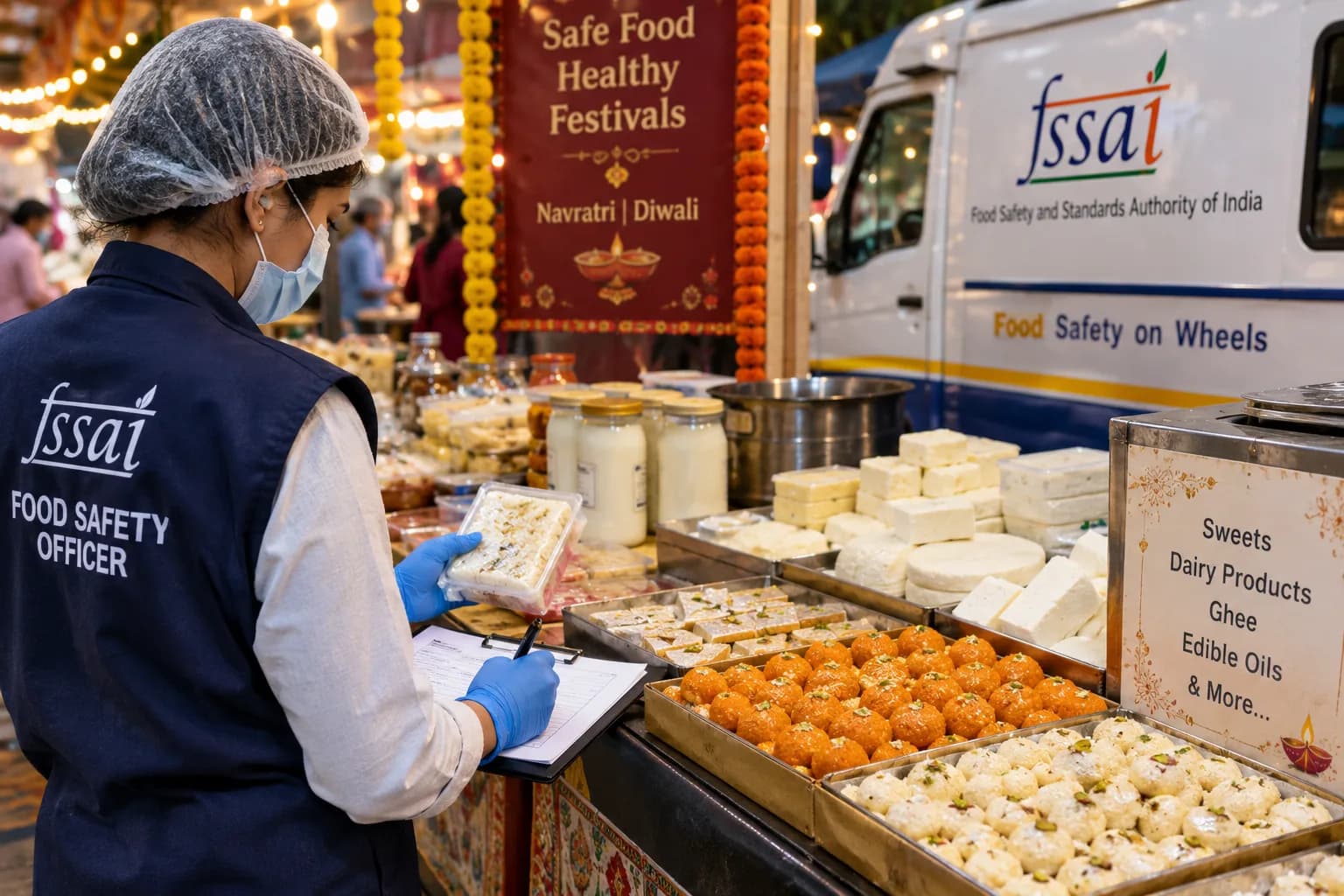
FSSAI’s 29 September letter asks states to inspect, sample and log results in real time before Navratri and Diwali. The big seizure figures in circulation mostly predate it, and no national count of samples tested has been reported.
FSSAI’s letter of 29 September is, at heart, three instructions to state food commissioners: inspect, take samples, and record everything on two government portals as it happens. What changes when that order reaches a khoya mandi or a roadside dairy?
What FSSAI has ordered
The letter, which FSSAI called “most important,” was addressed to the commissioners of food safety in all states and Union Territories and to FSSAI’s regional directors. It asks designated officers and food safety officers to carry out inspections and sampling, concentrating on hotspots and sensitive locations. Priority foods are milk products, sweets, snacks, edible oil, beverages and ghee, with states free to add items that suit local diets, such as the flours eaten during Navratri fasts. Mobile testing vans, “wherever available,” are to be stationed at major markets or sent on intelligence.
The letter also makes one requirement mandatory: data on inspections, sampling and their outcomes must be entered on the FoSCoS and FoSCoRIS portals in real time. The reports I reviewed mention no inspection targets, deadlines or penalties for states that fall short. Nor, as of 6 October, did the announcement name any business: it is a preventive drive, not a list of findings.
What the enforcement evidence shows
The headline numbers need sorting by date and status.
Delhi’s government said on 23 September that its teams had seized and destroyed over 4,100 kg of khoya, chhena and analogue paneer over a month, that 22 of 30 khoya samples from Mori Gate mandi were unsafe, and that prosecution had begun. Another report, from ANI, calls the destroyed stock “suspected” to be adulterated. Reports also differ on whether the second failure rate (12 of 19) covered paneer and chhena or khoya and chhena. All of this predates the national letter by six days. An aggregator’s headline on 3 October nonetheless credited the destruction to FSSAI.
In Mewat, Haryana, police and food safety officials seized and destroyed over 10,000 kg of fake paneer in a month across about 50 raids, reported on 27 September. That drive followed a district ban on paneer production and had not disclosed when laboratory findings would be released after an earlier 7,500 kg seizure. In Pune, 12,500 kg of paneer and 4,600 kg of khoya were seized on 11 September under Maharashtra’s own year-round plan, with action to follow once laboratory reports arrive.
The first clear post-letter case is Etah, Uttar Pradesh, reported on 9 October. Officials acting on a tip-off recovered about ten quintals of paneer and other ingredients from a dairy, sent samples for testing, buried the seized material the same night, and said an FIR was being initiated, with further action to depend on lab reports. The report does not say whether the raid was part of the national drive.
Where implementation gets difficult
The letter’s own wording builds in a limit: FSW vans only “where available.” FSSAI says each van tests about 80 parameters qualitatively across seven food categories, which makes them screening tools. The government told Parliament 305 vans are deployed across 35 states and UTs, against, by FSSAI’s count, 727 districts. FSSAI’s own testing page describes the number and spread of food labs as “grossly inadequate.”
Reports from this year show what that can mean, though they are not nationwide. Hyderabad’s state food lab was reported to have one analyst, with routine reports taking 20 days to a month. A new state lab in Visakhapatnam was reported idle for lack of trained staff. In Haryana’s 2024 festive season, 792 samples were taken and 371 lab results were reported. The consequences of a failed result are slower still: in Patna in July, operators whose samples failed were given five days to object, after which disputed samples go to a central referral lab. A festival can end before any of that concludes.
What this means for festive buyers
Nothing here suggests sweets, paneer, khoya or ghee are generally unsafe, and small sellers are not suspect by default. Sensible habits are modest: buy from sellers with a visible FSSAI licence or registration number, check dates and labels on packed products, keep the bill, and be wary of unusually cheap loose paneer or khoya. Appearance, smell and taste cannot rule adulteration out, and informal home tests, such as the iodine test for starch, can at most hint at one adulterant. Report suspected problems through your state food safety department or FSSAI’s official channels. Check the contact details on the official websites rather than on forwarded messages.
The accountability question
An order to inspect is not an inspection, an inspection is not a tested sample, a tested sample is not an established violation, and none of these is corrective action completed. The real-time data requirement means the figures that would show how far the drive has progressed should already be accumulating on FoSCoRIS. The public needs five of them, ideally by state: inspections conducted, samples collected, results received, failures by category and legal status, and follow-through, including re-inspection.
Until those are published, a seizure announcement tells readers about effort, not outcome. Whether the 2026 drive makes festive food safer cannot be judged from the evidence that exists in public.