

Unsafe, But on What Evidence? What the Nestlé Dairy Whitener Case Does and Doesn’t Prove
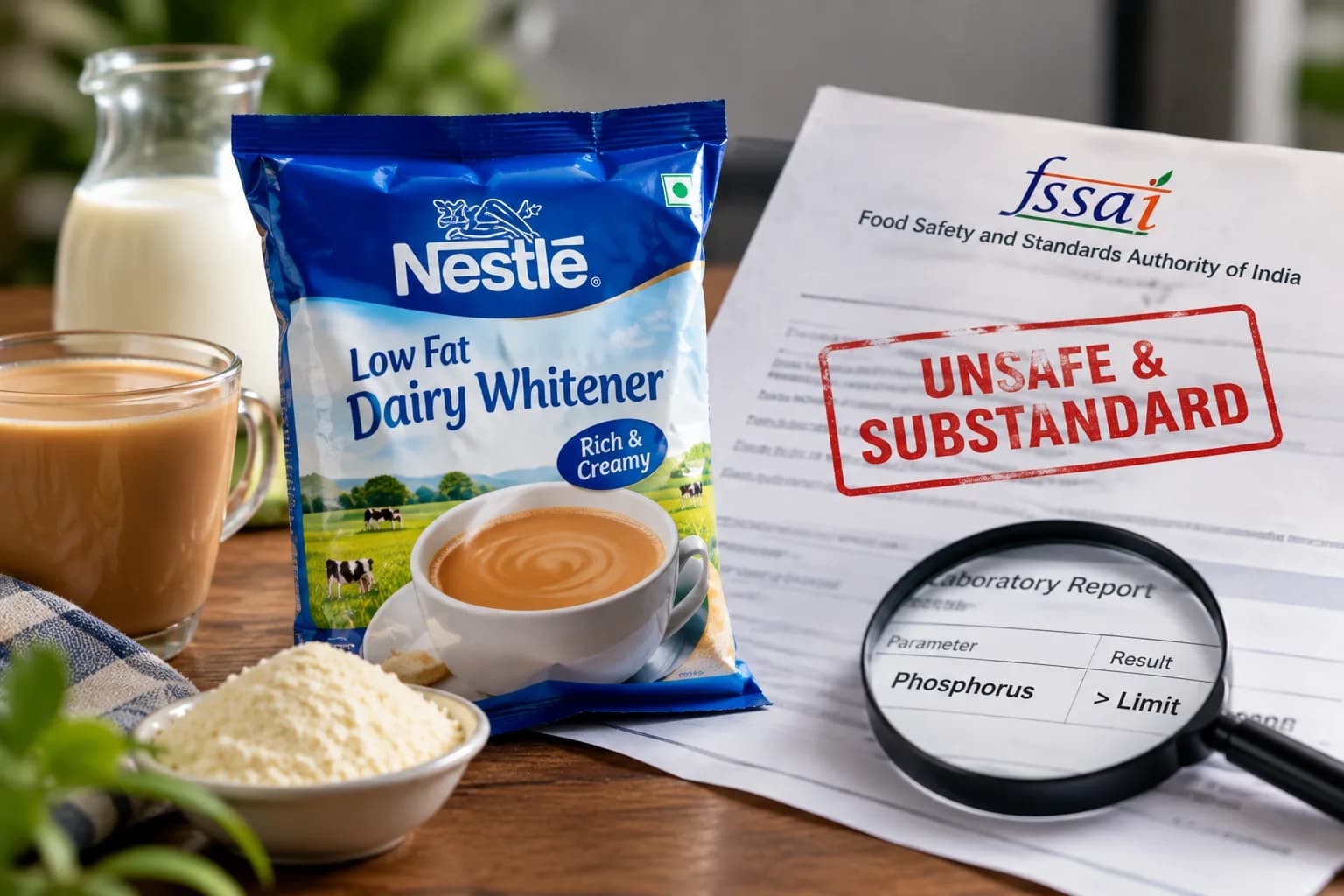
FSSAI says a Nestlé dairy whitener sample from a Delhi hotel was “unsafe” and “substandard.” Nestlé disputes how phosphorus was assessed. With the lab report unpublished, the public cannot yet test either side.
The regulator’s classification is the strongest the system offers: “unsafe.” The company’s reply is that the number behind it was read the wrong way. Between the two lies a laboratory report that readers have not seen.
On 3 October, FSSAI said a food analyst had found a sample of Nestlé’s Low Fat Dairy Whitener, drawn from Bharat Hotels Ltd, which runs The Lalit in Connaught Place, to be “substandard” and “unsafe,” indicating non-compliance under the Food Safety and Standards Act, 2006. The hotel was given the report and a notice, an opportunity to appeal within the prescribed period, and a direction to stop selling the identified product.
What FSSAI found
On 3 October 2026, FSSAI said a sample of Nestlé’s Low Fat Dairy Whitener, drawn from the premises of Bharat Hotels Ltd (The Lalit) in Connaught Place, New Delhi, had been classified by a food analyst’s laboratory as “substandard” and “unsafe” under the Food Safety and Standards Act, 2006. The regulator gave the hotel a copy of the report, issued it a notice, offered it a chance to appeal within the prescribed period, and directed it to stop selling the identified product.
What Nestlé says
Nestlé India responded the same day. Its spokesperson said the product is safe to consume and complies with all applicable regulatory requirements. The company’s explanation is about phosphorus. It says phosphorus occurs naturally in milk and so in milk-based products, and that FSSAI lab reports reflect total phosphorus against the additive limit, without accounting for the natural contribution from milk-based ingredients. It says the product complies on added phosphorus, including as consumed, and that it has been engaging with the authorities and has shared data on similar milk-based products.These are company statements. They are not independent verification, and FSSAI had not, per Reuters, responded to them when its report was filed.
The phosphorus question
Milk contains phosphorus, bound up in its proteins and minerals. Any product built substantially from milk ingredients will register phosphorus in a lab test. Separately, food regulations allow certain phosphate additives only in specified categories and within set limits. Dairy-whitener rules sit within the FSS (Food Products Standards and Food Additives) Regulations, 2011, and additives are permitted only within the limits specified in Appendix A.The dispute, as Nestlé frames it, is whether a total-phosphorus measurement was held against a limit that applies only to the added kind. A test cannot, on its own, tell natural from added phosphorus; that requires a stated method, a regulatory basis for the comparison, and knowledge of the formulation. Nestlé’s reference to an “as-consumed” basis adds another question: whether limits apply to the powder or to the product as prepared.
None of this means FSSAI erred, and none of it means Nestlé is right. It means the answer depends on documents that are not public.
What the public record shows, and what it doesn’t
Available: the date, the product name, the sample location, the classification, the direction to the hotel and the existence of an appeal window.
Not available: the measured value, the limit applied, the unit, the analytical method, any correction for natural phosphorus, a batch or lot number, manufacturing or expiry dates, and any indication of whether the sample was one pack or a larger quantity. The specific parameter is not named in FSSAI’s public post; phosphorus enters the story through Nestlé’s account. This article does not speculate about why these details are absent.
What ‘unsafe’ and ‘substandard’ mean here
These words are not interchangeable, and neither is the same as a recall.
A substandard finding generally means a product fails a prescribed standard or specification.
Unsafe is a stronger classification under the Act’s definitions of food that may be injurious to health. The two can be applied to the same sample.
A food analyst’s report is an initial finding. The food business operator can appeal it, and under the Act the appeal route leads to a referral laboratory. [Editor: confirm the section number and time limit, commonly cited as Section 46(4), against the Act’s text before publishing.]
A stop-sale direction tells a business to stop selling a product. A recall withdraws it from the market. FSSAI has reported the former here, not the latter.
A final determination, whether adjudication, prosecution or a court ruling, has not been reported.
No appeal, retest or FSSAI response to Nestlé’s explanation has been publicly reported. The hotel had not issued a statement in the coverage reviewed.
What consumers should know
Nothing in the public record supports pulling Nestlé dairy products, or even this one, off every shelf. The direction applies to an identified product at one operator, and no batch has been named.
Practical, proportionate steps: if you buy this product, keep the pack and note the batch and expiry in case FSSAI publishes details. Watch FSSAI’s own channels for any recall or advisory. Be careful with reports that go beyond the regulator’s wording; at least one outlet’s reference to “affected batches” is not supported by an official source I could find. If you have symptoms you attribute to a food, speak to a doctor. Nothing in the public record links any illness to this product.
What remains to be established
Whether the report will be published, what exactly was measured and compared, whether the hotel or Nestlé appeals, whether a referral lab retests the sample, and whether FSSAI reconciles its finding with Nestlé’s data. The September action against a Nestlé baby-food sample is a separate matter and should not be read into this one.
The broader issue is not which party wins. When a regulator’s strongest classification reaches the public without its supporting numbers, readers can’t judge it. When a company defends itself without releasing the same data, they can’t judge that either.