

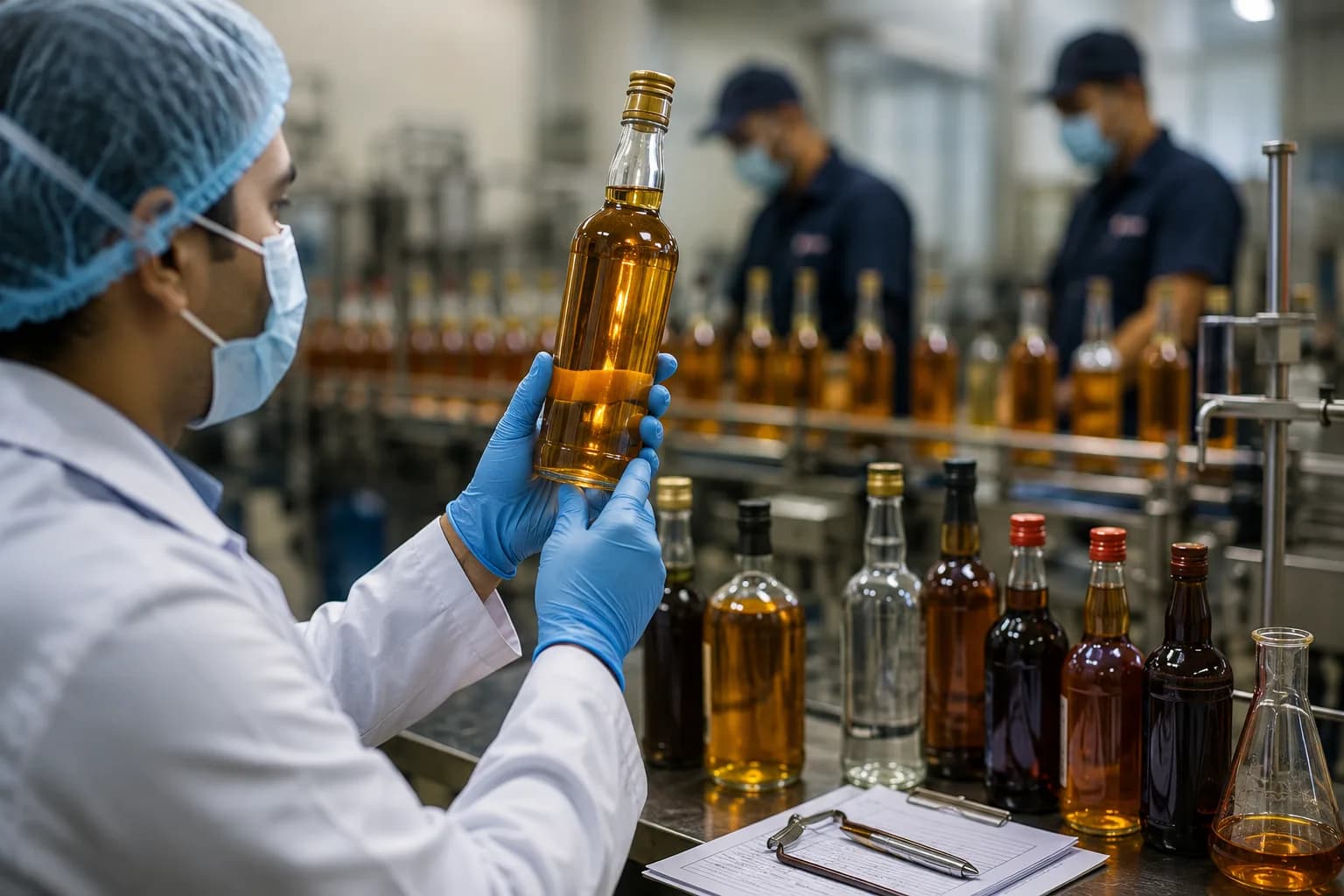
Eleven Enrica Enterprises brandies and a rum disappeared from TASMAC shelves on an FSSAI order and reappeared before most consumers noticed. The real story isn't the ban. It's what the reversal reveals about who regulates alcohol in India, and how thin the line is between "non-compliant" and "unsafe."
One week in August, 11 liquor brands sold through Tamil Nadu's state-run shops simply disappeared. Ten brandies and a dark rum, all made by a single manufacturer, were pulled from every TASMAC depot in the state on an order from India's food safety regulator. Three days later, they were back restocked, re-sold, as if nothing had happened.
For a government process, that is an extraordinarily fast reversal. A national food regulator doesn't typically flag a manufacturer, halt sales through the country's largest single liquor retail network, and then clear the same products for sale within 72 hours. So what actually changed between August 11 and August 14 the finding, or the manufacturer's paperwork? And more fundamentally: in a country where alcohol is simultaneously a food product, an excise commodity and a state monopoly, who is actually in charge of deciding what's fit to drink?
The Three-Day Reversal
The sequence is now fairly well documented across contemporaneous reporting and official communications routed through TASMAC. On August 11, 2026, FSSAI's Southern Regional Office inspected Enrica Enterprises' manufacturing facility in Poonamallee, Tiruvallur district. The inspection turned up three categories of issue: non-compliant product labelling, incorrect product nomenclature, and the presence of natural-identical and artificial flavouring substances in the products tested.
FSSAI issued an order the same day directing that sale of the 11 affected products VSOP Exshaw Gold Brandy, Louis Vernant XO Blended Premium Brandy, McDowells VSOP Brandy, No.1 McDowells Fine Brandy, Mensclub Deluxe Brandy, Honey Bee Fine Brandy, Enrica VSOP Select Brandy, Enrica Platinum Reserve XO Brandy, Enrica Premium French Brandy, Veeran Special Brandy, and Enrica Old Indie Classic Dark Rum — be stopped with immediate effect. The Tamil Nadu Prohibition and Excise Department relayed the order to TASMAC, and Managing Director K. Nandhakumar instructed regional, district and depot-level officials to stop the movement and sale of the products across the state's retail network.
On August 14, the Prohibition and Excise Department authorised TASMAC to resume sale of all 11 products. The stated basis: an appeal from Enrica Enterprises, accompanied by an assurance of full compliance with FSSAI's requirements.
That is the entire visible sequence and it is worth being precise about what it does and doesn't tell us. It does not say FSSAI "changed its mind" about what it found on August 11. Available records do not establish that the underlying laboratory or documentation findings were disputed or overturned. What the sequence establishes is narrower: a stop-sale order was issued, the manufacturer responded with a compliance commitment, and the order was lifted on the strength of that commitment a process the law is explicitly built to allow, and one this piece walks through below.
What FSSAI Actually Found
Three distinct problems were named in the communication that reached TASMAC: labelling that didn't meet regulatory requirements, product names that didn't accurately describe what was in the bottle, and the most technically significant issue the use of natural-identical and artificial flavouring substances.
None of the available official communications describe a toxicity finding, a contamination finding, or any laboratory result indicating the products were dangerous to consume. This is a meaningful distinction, and one that got flattened in a lot of the initial coverage. Regulatory non-compliance is not the same claim as proven health danger, and nothing in the record supports calling these products "unsafe" or "poisonous." What the record supports is a finding of standards non-compliance a real and enforceable category under Indian food law, just a different one from contamination or adulteration.
What the Flavouring Rules Actually Mean
To understand why "natural-identical and artificial flavouring" was enough to trigger a stop-sale order, it helps to understand what FSSAI has been saying loudly and specifically for the past several weeks, in a campaign that reaches well beyond Tamil Nadu.
Under the Food Safety and Standards (Alcoholic Beverages) Regulations, 2018, standardised spirits like rum, whisky and brandy are expected to derive their defining taste and aroma from the prescribed raw materials and process: molasses or grain fermentation, distillation, and maturation, for instance. FSSAI has clarified in recent public statements that it is not banning flavouring substances outright additives like vanilla or coffee flavour, used transparently, remain permitted. The specific practice it is targeting is different: manufacturers using a neutral, largely flavourless base spirit, then adding "rum flavour" to a rum, or "whisky flavour" to a whisky, to recreate a sensory profile that is supposed to emerge naturally from the manufacturing process while still labelling and selling the product as standard rum or whisky. FSSAI has stated that if a flavouring substance is added, the product must be declared as a flavoured or premix spirit, not marketed as if it were standard.
This is the same underlying issue that, in July and August 2026, led FSSAI to issue notices to and, in some cases, halt sale of variants from far larger national players United Spirits' Baramati plant (producer of McDowell's No.1 Rum), its Madhya Pradesh facility (Antiquity Blue Whisky, Royal Challenge Whisky), Mohan Rocky Springwater, INBREW Beverages and Associated Alcohol & Breweries, among others. In one of those cases, a laboratory report reportedly noted that "the addition of artificial flavours is masking its natural flavour and making the product substandard" language that maps closely onto the finding communicated in the Enrica case. Enrica, in other words, wasn't singled out. It was one manufacturer caught in a national compliance sweep that has been running in parallel across multiple states.
Why the Products Were Stopped
Given that framework, the mechanics of the August 11 order become straightforward. FSSAI's Designated Officers have authority under the Food Safety and Standards Act, 2006 to act quickly where non-compliance is identified including stopping sale of specific products without waiting through a longer licence-review cycle. The Act's Section 33 (prohibition orders) and Section 34 (emergency prohibition notices and orders) exist precisely for this: to allow an immediate, precautionary stop-sale where a Designated Officer has reasonable grounds to believe a business is failing to meet the applicable regulations, pending a fuller compliance process.
That is what appears to have happened here: an immediate, precautionary stop on products found non-compliant with labelling, nomenclature and flavouring rulesnot a final adjudicated conclusion, but an interim protective step available under the law the moment non-compliance is identified.
Why the Order Was Revoked
The revocation followed what the Prohibition and Excise Department described as an appeal from Enrica Enterprises, backed by an assurance of full compliance. This tracks closely with how the FSS Act's compliance architecture is meant to work more broadly even where, as here, the fastest-moving tool used was a prohibition order rather than the slower improvement-notice route.
Under Section 32 of the Act, when a Designated Officer identifies non-compliance, the standard instrument is an improvement notice: it must state the grounds for the finding, specify exactly what's wrong, set out the required corrective measures, and give the business at least 14 days to comply. Only sustained failure to act on that notice escalates to licence suspension or cancellation. A business that receives regulatory findings and responds with a credible compliance commitment updated labels, corrected nomenclature, reformulated or properly declared flavouring is doing exactly what the law contemplates a compliant business will do.
The available records do not establish precisely what documentation or verification the Prohibition and Excise Department relied on before authorising TASMAC to resume sales, beyond the appeal and compliance assurance. What can be said with confidence is that revocation, on its own, is not evidence that the August 11 findings were incorrect. It is evidence that the department accepted the manufacturer's response to those findings as sufficient to lift the immediate stop-sale.
What an Improvement Notice Really Means
It's worth pulling apart two things that sound similar but function very differently in food law.
A prohibition order is immediate and protective. It says: stop selling this, right now, because we have reasonable grounds to believe it doesn't meet the rules. It doesn't require a lengthy hearing first; that's the point it's meant to be fast.
An improvement notice is corrective and process-driven. It says: here's exactly what's wrong, here's what you need to do about it, and here's your window a minimum of 14 days to do it. Only real, sustained non-compliance with an improvement notice escalates toward suspension or cancellation of a licence, and even then the business gets a chance to be heard before a licence is cancelled.
The Enrica case moved fast enough three days from order to revocation that it more closely resembles the "quick stop, quick fix, quick clearance" pattern of a prohibition order being satisfied, rather than a full 14-day improvement-notice cycle playing out. Either way, the structural point holds: Indian food law is explicitly built to allow findings, corrective action and resumption of sale to happen in sequence, sometimes quite quickly, without that sequence meaning the regulator was wrong to act in the first place.
FSSAI vs TASMAC vs Excise: Who Does What?
This is the part of the story that gets consistently under-explained, and it's the actual reason a liquor bottle in Tamil Nadu answers to at least three different authorities.
FSSAI is the Union government's food safety regulator. Since the 2018 Alcoholic Beverages Regulations, its writ extends to alcohol as a food product: composition, standardisation, labelling, permitted additives, and as this case shows flavouring practices. FSSAI's Southern Regional Office conducted the inspection and issued the original order.
TASMAC is not a regulator at all it's the Tamil Nadu government's retail and wholesale monopoly for liquor sale in the state, set up in 1983. It doesn't test, inspect or approve products in the way FSSAI or excise authorities do. It executes: when told to stop selling something, or to resume, it issues that instruction to its roughly 5,400-odd retail outlets and depots. In this case, TASMAC was the enforcement channel, not the decision-maker.
The Tamil Nadu Prohibition and Excise Department sits closest to the actual decision point here. It received FSSAI's order, communicated the stop-sale to TASMAC, and after Enrica's appeal communicated the revocation as well. Excise authorities have long overseen production quantities, duty payment and alcohol-content verification (TASMAC has, since November 2003, relied heavily on a state laboratory in Guindy, Chennai, which primarily checks whether products meet standard alcohol-by-volume thresholds roughly 42.8% for spirits, with separate ranges for wine and beer). That's a narrower kind of testing than what FSSAI's flavouring and labelling findings involve.
Where this gets genuinely complicated is the overlap: excise law under the Tamil Nadu Prohibition Act, 1937 governs production, licensing and duty; food safety law under the 2006 Act and 2018 regulations governs composition, standards and labelling. A product can clear one system's checks correct ABV, duty paid, licensed distillery while still falling short on the other's requirements around flavouring and labelling, exactly as happened here. Nobody is lying or covering anything up in that scenario; two different regulatory questions are simply being asked by two different authorities, on two different timelines, using two different tools.
What This Means for Consumers
For someone standing in a TASMAC queue, the practical takeaway isn't that the products they were sold were dangerous there's no evidence for that. It's that "available for sale" and "fully compliant with every applicable rule at every moment" are not, and have arguably never been, the same guarantee. A product can be pulled for a labelling or flavouring issue, corrected, and legitimately returned to sale within days, without that meaning the system failed or that the correction was cosmetic.
The more useful consumer question, raised pointedly by TASMAC employees and consumer groups after this episode, is whether the type of testing routinely done largely alcohol-content verification is adequate on its own for a modern food-safety mandate that now explicitly includes flavouring authenticity and labelling accuracy. That's the gap the state government's post-Enrica order for intensified distillery-wide quality checks appears designed to address, even if it hasn't yet resolved the underlying question of how frequently, and how rigorously, flavouring compliance specifically gets tested outside of an FSSAI-triggered inspection.
Is This an Isolated Case?
No and treating it as a one-off Tamil Nadu story misses the more significant pattern. The Enrica action sits inside a broader FSSAI enforcement wave against artificial and nature-identical flavouring in standardised spirits that became public through July and August 2026, touching manufacturers and plants in Maharashtra, Madhya Pradesh, Goa and beyond, including brands owned by United Spirits (Diageo), Mohan Rocky Springwater, INBREW Beverages and Associated Alcohol & Breweries. FSSAI has publicly stated this is not industry-wide condemnation it has acknowledged that many manufacturers already produce compliant products but the timing makes clear that Enrica was caught in a nationally coordinated compliance push on a specific, technical issue, not a standalone Tamil Nadu controversy.
What Happens Next?
The Tamil Nadu government's order for intensified alcohol-content and quality testing across all TASMAC-supplying distilleries is the most concrete follow-on step so far. Whether that expanded testing regime will specifically incorporate flavouring-compliance checks as opposed to remaining focused on ABV verification is not yet established in available records, and is the detail worth watching. Nationally, further FSSAI action against other manufacturers flagged in the same flavouring sweep remains possible, given notices reportedly already issued to additional producers in Maharashtra.
Conclusion
The headline version of this story "11 liquor brands banned, then unbanned" is accurate but incomplete to the point of being misleading. What actually happened is that a food regulator used a fast, precautionary legal tool to stop sale of products it found non-compliant on labelling, nomenclature and flavouring grounds; a manufacturer responded with a compliance commitment within days; and a state excise authority, operating through its retail monopoly, accepted that commitment and resumed sales all inside a legal framework built to allow exactly that sequence. The reversal wasn't a cover-up, and it wasn't proof the original finding was wrong. It was the food-safety compliance system working roughly as designed, at a speed that looked, to most consumers watching from outside it, uncomfortably close to nothing happening at all.