

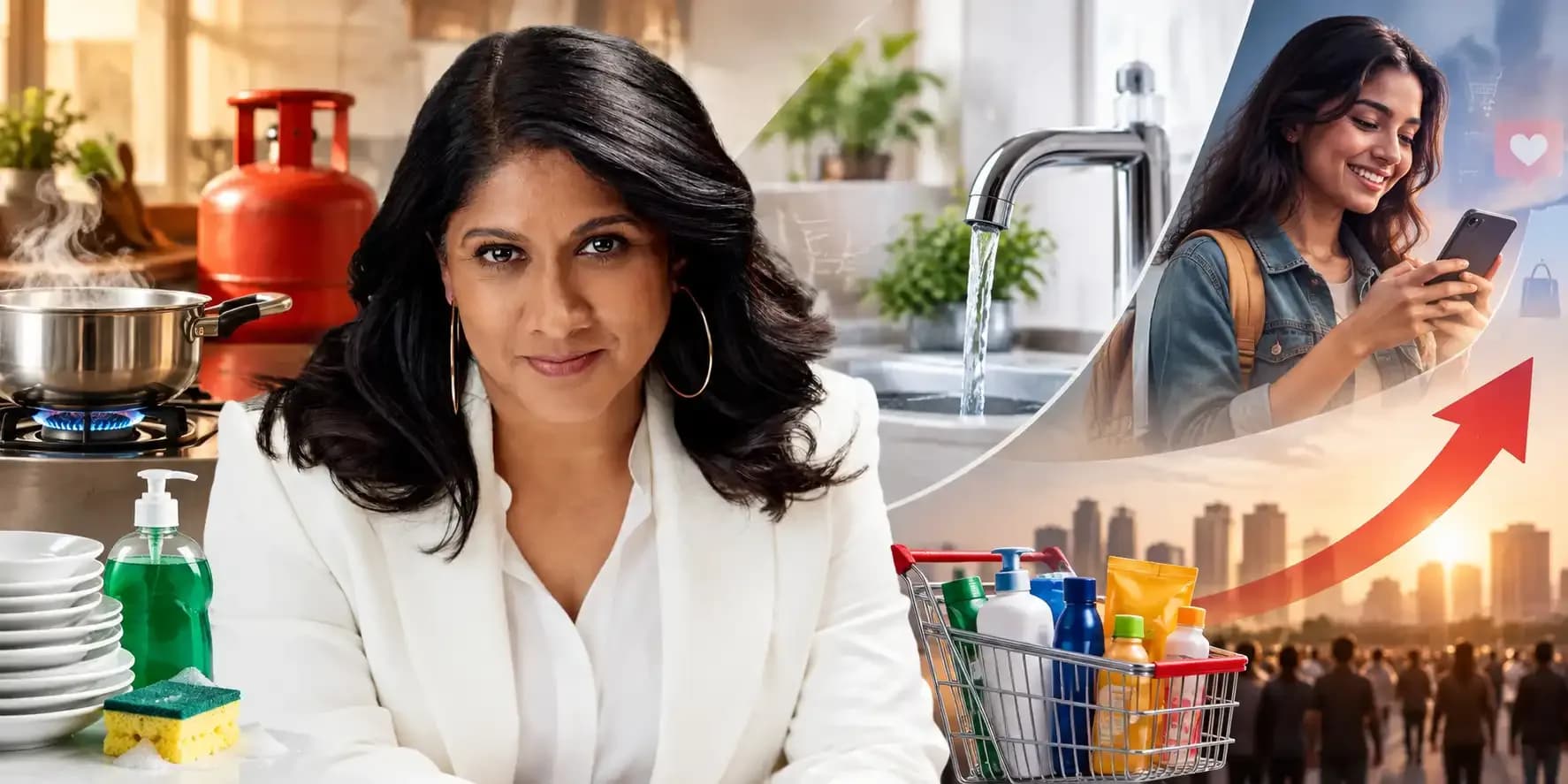
What does an LPG cylinder have to do with dishwashing? And how could a smartphone-wielding Gen-Z consumer influence the next growth cycle of India's largest FMCG company?
For Hindustan Unilever (HUL), the answer lies in changing everyday habits.
HUL Managing Director and CEO Priya Nair says the next wave of consumption in India could be shaped not only by rising incomes or broader economic growth, but by seemingly small changes in how households cook, clean, shop and discover brands.
Speaking during HUL's Capital Markets Day interaction with analysts, which was made public on Sunday, Nair pointed to increasing LPG adoption, wider access to tap water and the behaviour of India's large Gen-Z population as structural changes that are creating new consumption opportunities.
The comments come as HUL looks to reignite growth in a consumer packaged-goods market that Nair described as a “very subdued demand environment”, while acknowledging that the company still has work to do across some brands and segments.
How an LPG cylinder can create demand for dishwashing products
One of Nair's most striking examples was LPG adoption.
As more Indian households shift from traditional wood-fired cooking to LPG, the nature of household cleaning is also changing.
Wood-fired cooking can leave ash that has historically been used by some households for cleaning utensils. With LPG, that source of ash is no longer available in the same way.
That, combined with greater access to running tap water, can change how households clean their kitchens — potentially creating greater demand for dishwashing products and other home-care solutions, Nair explained.
For an FMCG company such as HUL, the implication is significant.
A change in household infrastructure can gradually create a change in consumer behaviour, which can then create an opportunity for an established product category.
In other words, India's consumption story may sometimes begin with something as basic as how a family cooks its food.
Tap water could reshape household cleaning
Nair also highlighted the growing reach of tap water as another structural change influencing consumption.
Greater access to running water can make certain cleaning routines easier and more frequent, opening opportunities for products designed around modern household cleaning habits.
The broader HUL thesis is that category penetration can increase as infrastructure and lifestyles evolve.
This is particularly important in a country where consumer behaviour varies significantly between income groups, geographies and levels of infrastructure.
Rather than assuming that all Indian households will consume in the same way, HUL is looking at how consumption changes as households move through different stages of development.
Gen Z is changing how Indians discover brands
The other major force identified by Priya Nair is India's enormous Gen-Z population.
HUL estimates India's Gen-Z population at around 377 million, making it a major consumer group with the potential to influence categories well beyond products specifically targeted at young people.
According to Nair, Gen Z is changing how categories are discovered, how consumers interact with brands and ultimately how purchase decisions are made.
That creates a very different challenge for traditional FMCG companies.
Consumers are no longer discovering products only through television advertising, physical stores or recommendations within the family.
Social media, digital platforms, quick commerce and online communities have created new routes through which consumers encounter brands.
For HUL, the opportunity is to ensure its established brands remain relevant while also identifying categories and consumer needs that are emerging through these new behaviours.
But investors are asking: where is the growth?
HUL's opportunity is large. But investors are looking for evidence that the company can convert that opportunity into sustained growth.
During the Capital Markets Day interaction, Mihir Shah of Nomura challenged Nair on the gap between the consumption opportunity HUL continues to highlight and the company's recent performance.
Shah questioned what factors were holding back growth and what HUL was doing to address those problem areas.
Nair acknowledged that the consumer environment had been subdued and that the company still needed to improve performance in certain segments and brands.
The exchange highlights the central challenge for HUL: India may have enormous consumption headroom, but identifying an opportunity is not the same as monetising it.
HUL wants to make consumers consume more
The company's response is a broader portfolio strategy that HUL calls “Winning in New India.”
The strategy focuses on four key areas: consumption, premiumisation, market making and entering new spaces.
The idea is not simply to wait for India's economy to grow and hope FMCG consumption follows.
HUL wants to actively increase consumption by encouraging consumers to use products more frequently, move towards higher-value products, bring new consumers into under-penetrated categories and enter new consumption spaces.
The company is also increasing its capital expenditure intensity from around 2% of turnover to approximately 3% over the next five years, with the additional investment aimed at growth and productivity.
Premiumisation is another major growth lever
Alongside changing consumption habits, HUL is betting heavily on premiumisation.
The company wants consumers to move towards products that offer additional benefits and higher perceived value.
Dove is one of the brands central to this strategy. HUL has identified it as a key premium growth engine, with the company expecting the brand to become its second-largest over time as it expands beyond its traditional strength in soap and shampoo.
This reflects a broader shift in India's FMCG market: growth is increasingly coming not just from getting more consumers to buy a category, but from getting existing consumers to trade up within that category.
New-age brands are making the market more complicated
HUL's strategy also comes against a rapidly changing competitive landscape.
Thousands of new consumer brands have emerged over the past few years, many of them built around specific consumer problems, digital-first distribution and rapidly changing preferences.
Industry estimates cited in the recent discussion suggest around 11,000 brands were launched between 2020 and 2025, with roughly 230 crossing ₹150 crore in revenue.
These brands may be smaller than HUL, but they can often move quickly and respond to emerging consumer trends.
Nair said the impact of these new brands needs to be assessed category by category. In categories such as home care, tea and soaps, she argued that scale remains important.
But scale itself is becoming harder.
“The barriers to scale...have never been higher”
Nair's comments also underline how fragmented India's consumer market has become.
India is not one homogeneous FMCG market.
Consumer economics differ across income groups. Consumption habits vary between urban centres, small towns and rural markets. Distribution channels are changing, while quick commerce and digital platforms are creating new routes to consumers.
Nair said:
“The barriers to scale in this country have never been higher because it is getting more complex.”
The challenge for HUL is therefore twofold: maintain the enormous scale advantages of an established FMCG company while becoming agile enough to respond to increasingly fragmented consumer needs.
HUL's India opportunity is changing
HUL's FY26 turnover stood at ₹63,763 crore, while its standalone EBITDA margin was 23.6%, underlining the scale of the business Nair is now attempting to reshape.
The company is also looking at newer geographies, channels and consumer spaces, including opportunities created by rural consumption, quick commerce, digital media and under-penetrated categories.
But the underlying thesis remains simple.
India's next consumption wave may not come from one big economic event. It could emerge from millions of small behavioural changes happening inside Indian homes.
A household switching to LPG.
A family gaining access to tap water.
A consumer moving from a basic product to a premium one.
A Gen-Z shopper discovering a category on a smartphone instead of through traditional advertising.
For Priya Nair and HUL, these shifts represent more than changes in lifestyle. They are potential new consumption occasions — and therefore potential new growth engines.
The bigger FMCG story
HUL's latest strategy offers a revealing view of how India's largest consumer companies are thinking about the next phase of growth.
The easy assumption is that India's rising incomes will automatically translate into higher FMCG consumption.
HUL's argument is more nuanced.
The next opportunity may lie in understanding exactly how Indians are changing — one kitchen, one tap, one smartphone and one shopping decision at a time.
And for a company selling products across millions of those households, those small changes could eventually add up to India's next big consumption wave.