

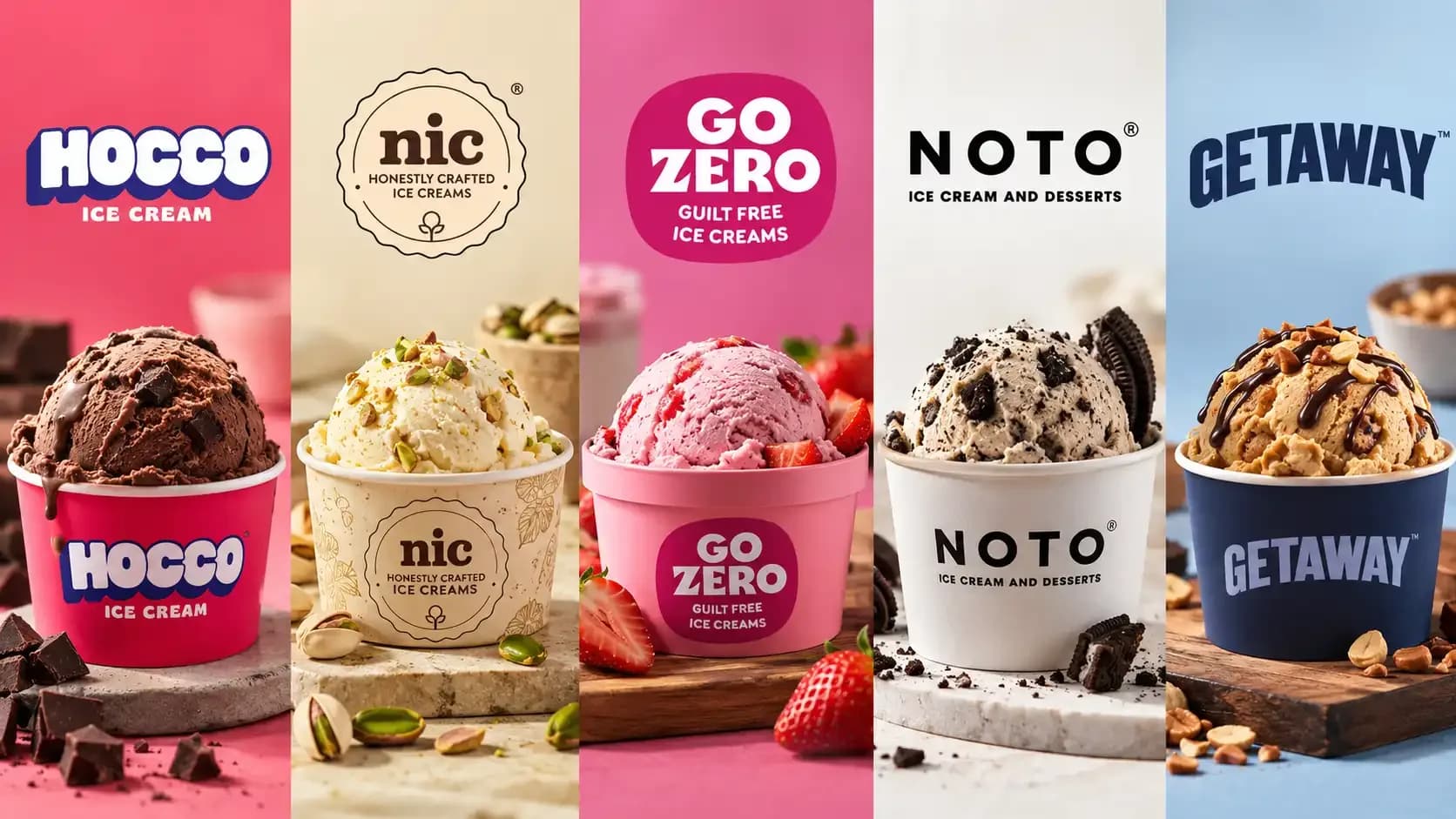
India’s ice-cream market is entering a new phase, and the next generation of brands is betting on scale, premiumisation, health, quick commerce and sharper consumer positioning. Here are five homegrown brands worth watching.
For decades, India's ice-cream market was largely a battle between established names such as Amul, Vadilal, Mother Dairy, Kwality Wall's and Havmor.
The rules were relatively simple: build a strong distribution network, put freezers in as many stores as possible, win on price and flavours, and own the summer season.
Those rules are changing.
A new generation of Indian ice-cream companies is approaching the category very differently. Some are building national distribution at remarkable speed. Others are selling the idea of indulgence without the guilt. Some are using quick commerce as their primary growth engine, while others are attracting institutional capital to build premium, natural and differentiated portfolios.
The opportunity is substantial.
According to IMARC, India's ice-cream market was worth ₹24,350 crore in 2025 and is estimated to reach ₹27,170 crore in 2026. The market is projected to reach ₹63,941 crore by 2034, representing an estimated CAGR of 11.29% between 2026 and 2034. Per-capita consumption has also increased from around 400 ml in 2011 to nearly 1.6 litres in 2023.
That growth is attracting a new breed of companies.
Here are five Indian ice-cream brands that stand out—not because they are already the biggest, but because they are building businesses that could reshape the category.
1. Hocco: The ₹500-Crore Ice-Cream Startup That Got There Much Faster Than Planned
If there is one company that best represents the aggressive scaling of India's new-age ice-cream market, it is Hocco.
Founded in 2023 by Ankit Chona, Hocco came from the family behind Havmor. But rather than simply recreating the legacy business, the new company has attempted to combine the distribution instincts of a traditional FMCG business with the speed and branding of a modern consumer startup.
And the numbers show just how quickly that strategy is working.
Hocco reported more than ₹530 crore in net sales in FY26, according to founder Ankit Chona. Inc42 reported the figure at approximately ₹532 crore. The company had earlier expected to reach around ₹450 crore.
That is particularly striking considering Hocco was founded only around two and a half years before the FY26 result.
The company has also raised approximately ₹481 crore in total funding, following a ₹100 crore Series C round led by Sauce VC at a reported valuation of approximately ₹2,500 crore.
Building an FMCG machine
Hocco's strategy is not purely digital.
The company is investing heavily in the infrastructure that has traditionally separated large ice-cream companies from D2C brands: manufacturing, distribution, cold storage and general trade.
Hocco's production capacity was expected to reach approximately 2.5 lakh litres per day, with the company targeting more than 4 lakh litres per day by the following summer. A new Panipat facility, being developed with Hindustan Foods, is part of that expansion.
The company has also expanded into markets including Telangana, Chhattisgarh, Punjab and parts of Uttar Pradesh, while strengthening its distribution infrastructure.
Interestingly, technology is also becoming part of its cold-chain strategy. Hocco says its crates use RFID tracking, allowing the company to monitor products across cold rooms and distribution networks.
Quick commerce is becoming important—but not everything
Quick commerce contributed around 15–16% of Hocco's sales, with the company expecting that share to cross 20%. But unlike many new-age consumer brands, Hocco continues to place significant emphasis on general trade.
That could become one of its biggest advantages.
Ice cream is ultimately a cold-chain business. Winning on Instagram is useful; winning the freezer at the neighbourhood store is what creates scale.
Hocco's internal target for FY27 is around ₹900 crore in revenue, with the company aiming to cross ₹1,000 crore if growth momentum continues. It is also working towards EBITDA breakeven.
Why Hocco matters: It is arguably the clearest example of an Indian ice-cream startup attempting to become a full-fledged FMCG company.
2. NIC Ice Creams: The Premium Brand Building a National Frozen-Dessert Platform
If Hocco is the scale story, NIC Ice Creams represents the premiumisation story.
NIC is operated by Walko Food Company, founded in 2012. The company has built a portfolio around ice creams, kulfis and frozen desserts, with NIC becoming its best-known brand.
The company's proposition is built around premium ingredients, natural positioning and a broad flavour portfolio.
NIC currently offers 40+ flavours and says its products contain milk, sugar and other ingredients without added artificial colours, flavouring agents or preservatives. It also offers no-added-sugar variants.
Institutional investors have taken notice
Walko raised $20 million from Jungle Ventures in February 2024, following an earlier $11 million investment in 2023.
The 2024 round reportedly valued the company at approximately ₹1,300 crore, or $150 million.
The company said at the time that NIC had achieved approximately 90% CAGR over the previous five years and expanded into more than 100 cities.
Walko's latest available financial data gives another indication of the scale of the business.
The company reported ₹288.9 crore in revenue in FY25, up from ₹212.8 crore in FY24—a growth of approximately 35.8%. However, this is Walko Food Company's consolidated revenue and should not be treated as NIC's standalone revenue, because Walko operates multiple brands.
That distinction is important when evaluating the company.
120+ cities and 25+ parlours
Walko says NIC is now available across 120+ cities, with 25+ parlours.
Its distribution spans food-delivery platforms, quick-commerce companies and modern retail, including Blinkit, Zepto, Swiggy Instamart, Flipkart Minutes, BigBasket, Amazon Fresh and major retail chains.
That gives NIC something many premium D2C brands struggle to build: physical availability.
The larger ambition is even more interesting.
Walko is not building only one ice-cream brand. Its portfolio includes NIC Ice Creams, Grameen Kulfi, Mimo, Cream Pot and Café Chokolade, allowing it to address different price points and consumer occasions.
Why NIC matters: It is attempting to create a multi-brand frozen-dessert company rather than relying on one premium ice-cream label.
3. Go Zero: The Brand Betting That Indians Want Ice Cream Without the Guilt
The most disruptive idea in India's ice-cream market may not be premium flavour at all.
It could be "healthier indulgence."
That is the territory Go Zero is aggressively pursuing.
Founded by Kiran Shah in 2022, Go Zero has positioned itself around zero-sugar, low-calorie, high-protein and vegan ice creams.
Its growth has been striking.
Go Zero reported ₹42.7 crore in revenue in FY25, compared with ₹11.5 crore in FY24—a jump of approximately 273%.
The company's momentum appears to have accelerated further in 2026.
In May 2026, founder Kiran Shah said Go Zero generated approximately ₹35 crore in net revenue in a single month, excluding GST and platform commissions. He also reported approximately 350% year-on-year growth for the month.
For a young ice-cream company, that is a remarkable number.
Quick commerce is the engine
Go Zero has been particularly aggressive in using quick commerce as its distribution engine.
Earlier company commentary indicated that approximately 70–80% of sales were coming from quick-commerce platforms, while Swiggy and Zomato contributed another 20–25%.
That is a very different playbook from the traditional ice-cream industry.
Instead of spending years building a huge network of physical freezers first, Go Zero has used dark stores and digital distribution to put its products closer to consumers.
The strategy is particularly suited to a category like ice cream, where the consumer's purchase decision can be almost entirely impulse-driven.
Open a delivery app.
Search "ice cream."
See Go Zero.
Order.
The distance between discovery and consumption has effectively collapsed.
The challenge: can growth become scale?
Go Zero's biggest opportunity is also its biggest challenge.
Health-focused ice cream remains a premium proposition. The company has to convince consumers that a higher-priced product is worth buying repeatedly—not simply trying once.
It also needs manufacturing and supply-chain capacity to keep up with demand.
But if it can turn its rapid digital growth into repeat purchasing and broader distribution, Go Zero could become one of India's most recognisable health-focused dessert brands.
Why Go Zero matters: It is trying to create an entirely new consumer equation—ice cream as an indulgence that can fit into a health-conscious lifestyle.
4. NOTO: The Early Mover That Helped Create India's "Guilt-Free" Ice-Cream Category
Before "zero sugar" became a mainstream consumer conversation, brands like NOTO were already trying to convince Indians that ice cream could be indulgent without being excessively heavy.
Founded in 2019 by Ashni Shah and Varun Sheth, NOTO built its proposition around low-sugar and low-calorie products.
Its product range has since expanded beyond conventional tubs to include popsicles, cups, tacos, minis, bars and vegan products.
The company reported ₹27.5 crore in revenue in FY25, compared with ₹23.1 crore in FY24—a growth of approximately 19.2%.
That growth is nowhere near Hocco's or Go Zero's current trajectory.
But judging NOTO only on topline growth misses an important part of the story.
The company helped establish the consumer proposition that newer brands are now aggressively pursuing.
From niche idea to mainstream category
NOTO's founders initially invested close to ₹1 crore of their own capital and developed the product around the idea of "indulgence without the guilt."
The company initially relied heavily on sampling, influencer marketing and food-delivery platforms before expanding its digital distribution.
The pandemic accelerated the shift toward quick commerce and home delivery, allowing NOTO to expand without relying entirely on traditional modern retail.
The brand is now available across markets including Mumbai, Pune, NCR, Bengaluru, Hyderabad and Chennai.
Funding behind the expansion
NOTO has raised institutional capital over several rounds.
In April 2025, the company raised ₹21 crore, led by Equentis Angel Fund, with participation from Inflection Point Ventures, JITO and others. The capital was earmarked for product expansion, offline store launches and deeper market penetration.
The company has also attracted high-profile backing, including actor John Abraham.
More recently, NOTO's founders told Mint that the company had reached approximately ₹35 crore in annual revenue in FY26, had turned profitable on a monthly basis and was targeting expansion into tier-2 cities.
That makes the latest trajectory more encouraging than the FY25 statutory number alone suggests.
Why NOTO matters: It was an early mover in India's better-for-you ice-cream category and is now trying to turn that positioning into a profitable, broader consumer brand.
5. Get-A-Way: The Protein Ice-Cream Brand That Attracted a Dairy Giant
The smallest company on this list may have one of the most strategically significant developments.
Get-A-Way, founded in 2018, focuses on high-protein, no-added-sugar ice creams and desserts.
Its proposition is aimed squarely at consumers who want dessert but increasingly think about protein, sugar and calories.
The company's parent, Peanutbutter and Jelly Pvt Ltd, reported revenue of:
₹7.89 crore in FY23
₹14.80 crore in FY24
₹18.08 crore in FY25.
The numbers are modest compared with Hocco or NIC.
But then came the strategic validation.
Heritage Foods buys 51%
In October 2025, Heritage Foods acquired a 51% stake in Get-A-Way for ₹9 crore.
The remaining 49% stayed with the existing promoters, while Heritage also agreed to acquire an additional 20% after March 2026 at the prevailing valuation.
For Heritage, the transaction represents more than an investment in an ice-cream brand.
It is a bet on the broader functional-food opportunity.
Get-A-Way uses whey protein in its formulations and natural sugar alternatives instead of traditional sweeteners.
Heritage brings something a startup cannot easily build overnight:
manufacturing capability, dairy expertise and distribution.
Get-A-Way brings the opposite:
a young brand, product innovation and access to health-conscious consumers.
The combination could become considerably more interesting over the next few years.
Why Get-A-Way matters: Its acquisition shows that established dairy companies are beginning to see functional and health-oriented frozen desserts as a strategic category rather than a niche startup experiment.
The Numbers: How the Five Compare
Brand | Founded | Latest revenue figure | Growth / milestone | Funding / strategic investment | Core positioning |
|---|---|---|---|---|---|
Hocco | 2023 | ₹530+ Cr FY26 | ~₹532 Cr FY26 revenue | ~₹481 Cr raised; ₹2,500 Cr valuation | Mass + premium |
NIC / Walko | 2012 | ₹288.9 Cr FY25* | ~35.8% YoY | $35M+ funding | Natural / premium |
Go Zero | 2022 | ₹42.7 Cr FY25 | ~273% YoY; ₹35 Cr net revenue in May 2026 | ~$5.96M+ | Zero-sugar / healthy |
NOTO | 2019 | ₹27.5 Cr FY25 | ~19.2% YoY; ₹35 Cr FY26 reported | ~$4.94M+ disclosed | Low-sugar / low-calorie |
Get-A-Way | 2018 | ₹18.08 Cr FY25 | Up from ₹7.89 Cr FY23 | Heritage acquired 51% for ₹9 Cr | Protein / no-added-sugar |
*Walko's company-level revenue, not NIC standalone revenue.
What Is Really Changing in India's Ice-Cream Market?
The most important story here isn't actually about five companies.
It is about how Indians are beginning to consume ice cream.
For years, ice cream was primarily an impulse purchase.
You saw a freezer.
You bought a cone.
You ate it.
The new generation of brands is turning ice cream into something much broader.
1. Ice cream is becoming a year-round category
The industry's growth is increasingly supported by urbanisation, rising disposable incomes, wider cold-chain infrastructure and changing consumption habits.
IMARC estimates that impulse products accounted for 60.6% of India's ice-cream market in 2025, while cones represented 27.3% of the market by format.
But the opportunity is moving beyond traditional summer consumption.
2. Quick commerce is changing the freezer
This may be one of the biggest structural changes in the category.
A consumer no longer has to walk to the neighbourhood store to buy ice cream.
The freezer has effectively moved into the consumer's phone.
Blinkit, Zepto, Swiggy Instamart and other platforms allow consumers to discover and order frozen desserts almost instantly.
For brands such as Go Zero and NOTO, this has significantly reduced the physical distribution barrier that traditionally made the ice-cream business difficult for startups.
For larger players such as Hocco and NIC, quick commerce becomes another distribution layer rather than the entire strategy.
3. Health is becoming a serious ice-cream proposition
The rise of Go Zero, NOTO and Get-A-Way reveals another structural change.
Consumers are not necessarily giving up desserts.
They are asking for different desserts.
That means:
less sugar.
fewer calories.
more protein.
plant-based options.
better ingredients.
The interesting part is that this does not necessarily mean consumers want "diet food."
They still want indulgence.
The winning brands are therefore attempting to solve a difficult product problem:
How do you make an ice cream healthier without making it taste healthy?
That distinction could determine which brands survive.
4. Premiumisation is happening at the same time
At the other end of the market, consumers are also willing to pay more for premium flavours, better ingredients and differentiated experiences.
NIC's growth demonstrates this opportunity.
Its 40+ flavour portfolio, premium positioning and expansion across 120+ cities show how the category is moving beyond basic vanilla, chocolate and strawberry.
In other words, the Indian consumer is simultaneously looking for:
affordable indulgence
and
premium indulgence.
That creates space for several different winners.
And Now Reliance Has Entered the Game
Just as these emerging brands are scaling, the competitive environment is getting even more intense.
In September 2026, Reliance Consumer Products launched Bombay Creamery, entering India's ice-cream market with products starting at ₹10.
The initial rollout is in western India, with a national expansion planned.
The brand's portfolio includes cones, cups, tubs, bars and sticks.
The significance goes far beyond another brand entering the freezer.
Reliance brings something that most startups cannot easily replicate:
distribution scale.
And the company's history in categories such as telecom and beverages means the possibility of aggressive pricing and rapid distribution expansion cannot be ignored.
For emerging ice-cream companies, the competitive battlefield could therefore become much tougher.
The Battle Ahead: Scale vs Differentiation
The next phase of India's ice-cream market is unlikely to be won by one company alone.
Instead, different brands may own different consumer occasions.
Hocco
Scale + distribution + mass-premium
NIC
Natural + premium + flavour innovation
Go Zero
Zero sugar + health + quick commerce
NOTO
Low-calorie + better-for-you indulgence
Get-A-Way
Protein + functional nutrition
And that is what makes the category so interesting.
The old ice-cream market was largely about who could put the most freezers in the most stores.
The new market is increasingly about who understands the consumer best.
The Final Scoop
India's ice-cream industry is no longer simply a summer story.
It is becoming an FMCG, technology, health and premiumisation story at the same time.
The market is projected to grow from ₹24,350 crore in 2025 to ₹63,941 crore by 2034, according to IMARC.
That creates enough room for multiple challengers—but it also raises the stakes.
Hocco has already crossed the ₹500-crore mark far earlier than its founders expected. NIC is building a national premium frozen-dessert platform. Go Zero is showing how quickly a health-focused proposition can scale through quick commerce. NOTO is attempting to turn an early category advantage into a profitable business. And Get-A-Way's acquisition by Heritage Foods shows that established dairy companies are beginning to place strategic bets on functional desserts.
The next question is no longer whether India's new-age ice-cream brands can grow.
They clearly can.
The real question is:
Which of them can build the manufacturing, distribution, repeat purchase and brand loyalty needed to survive when India's biggest FMCG and dairy companies decide to fight back?
The freezer wars have only just begun.