


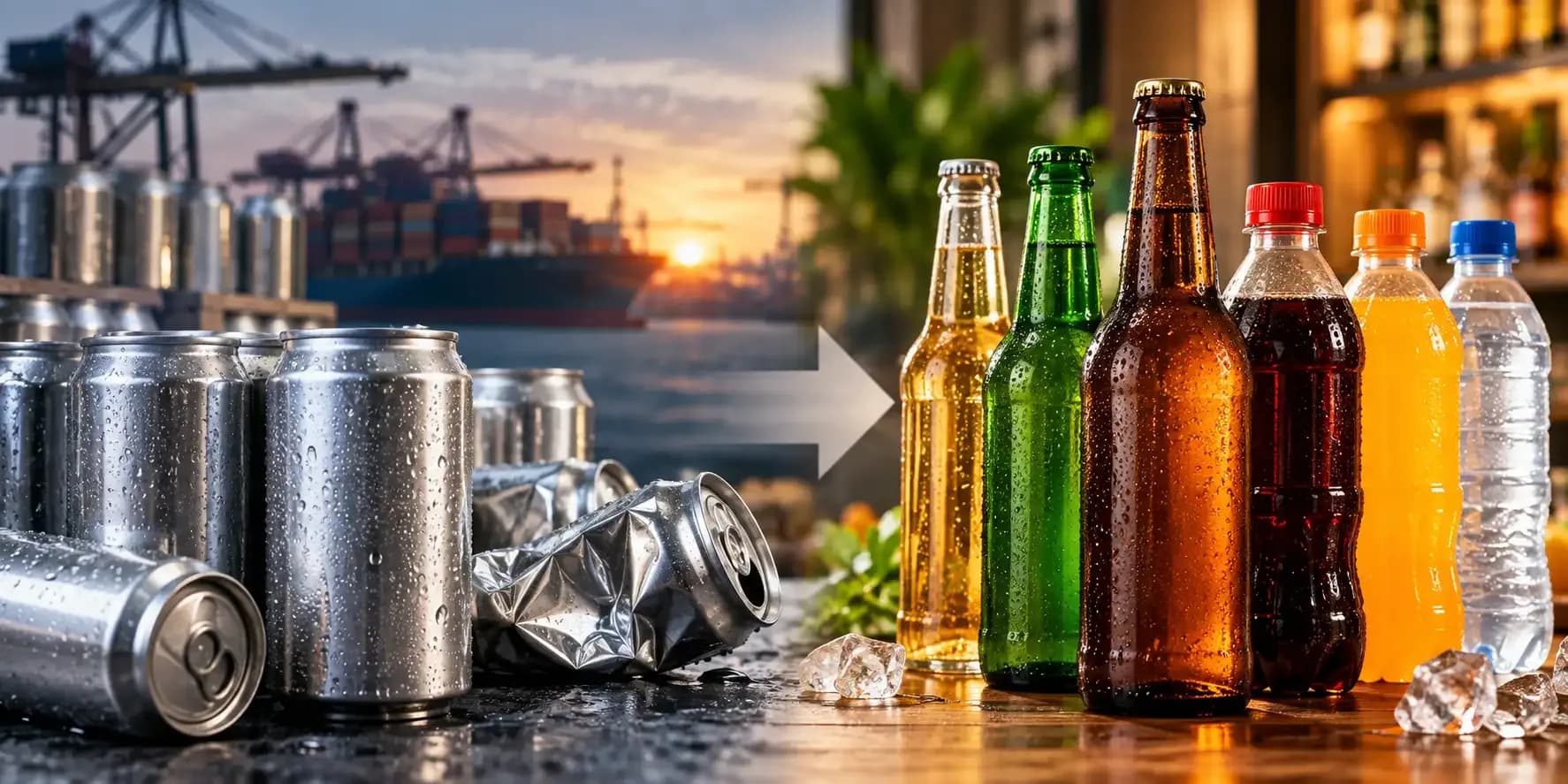
Indian beverage companies are increasingly turning to glass and PET bottles as disruptions linked to the West Asia conflict tighten supplies of aluminium cans and push up packaging costs, industry executives said.
The shift comes at a critical time for the beverage industry, with companies preparing for the upcoming festive season, when demand for soft drinks, beer and other packaged beverages typically rises.
The cost of empty aluminium can shells has increased by as much as 20%, according to the Brewers Association of India (BAI), adding pressure on beverage and beer manufacturers that rely on cans for a growing share of their products.
With imports and supply chains affected by the conflict, companies are now looking at alternative packaging formats to maintain product availability and limit their exposure to further disruptions.
Aluminium supply disruption puts pressure on can availability
The current pressure on beverage cans is linked to disruptions across the aluminium and packaging supply chain following the escalation of the West Asia conflict.
Industry executives have reported higher aluminium prices as well as disruptions in the movement of aluminium can sheet and finished cans.
Aluminium prices have reached around $3,500-$3,600 per tonne, with industry sources reporting increases ranging from approximately 14% to 50% at different points, depending on the period and benchmark being considered.
For beverage manufacturers, higher aluminium costs are being compounded by availability concerns.
India has expanded its domestic beverage-can manufacturing capacity in recent years, but the industry continues to depend partly on imports to meet demand.
According to industry executives, companies such as Ball Beverage Packaging and Canpack have domestic manufacturing operations, but existing capacity has not been sufficient to completely eliminate the supply gap.
Glass bottles see stronger demand
As cans become more expensive and difficult to secure, glass packaging is emerging as one of the principal alternatives, particularly for beer.
Glass manufacturers have reported increased enquiries and orders from beverage companies as producers look to secure packaging ahead of the festive season.
The increased demand comes earlier than the industry's usual seasonal build-up, reflecting concerns about the availability of cans.
For beverage companies, shifting selected products or SKUs from cans to glass or PET provides a way to maintain production even when aluminium packaging is constrained.
The strategy also reduces the risk of relying on a single packaging format.
Beer industry faces particular pressure
The beer industry is among the segments most exposed to the shortage because cans have become an increasingly important packaging format.
The Brewers Association of India has warned that the West Asia conflict has disrupted global supply chains and pushed empty can-shell costs higher.
According to the association, the conflict has also delayed the commissioning of additional can-shell manufacturing capacity in India, increasing the industry's dependence on imports.
BAI represents major brewing companies including United Breweries, AB InBev and Carlsberg.
With beer demand expected to remain strong during the festive and winter consumption periods, manufacturers are increasingly looking towards glass bottles to ensure adequate packaging supplies.
Glass is not without its own cost pressures
The move towards glass, however, does not mean manufacturers are shifting from an expensive packaging material to a cheaper one.
Glass manufacturing is highly energy-intensive and therefore sensitive to fuel and natural-gas prices.
Glass bottle prices have already come under pressure this year following disruptions to energy supplies linked to the West Asia conflict.
Reuters reported in March that one major Indian glass bottle manufacturer had increased prices by around 17%-18%, while the Brewers Association of India also flagged rising glass bottle costs.
PET packaging faces a different set of cost pressures because its raw materials are linked to the petrochemical industry and, ultimately, crude-oil and energy prices.
As a result, beverage companies are effectively balancing cost, availability and supply-chain reliability across different packaging formats.
Packaging diversification becomes a priority
The current disruption is also highlighting a structural issue for India's beverage industry: dependence on a limited number of packaging suppliers and formats.
Products that are available in multiple formats — cans, PET and glass — have greater flexibility when one packaging supply chain is disrupted.
Products that depend heavily on a single format face greater risks.
Diet Coke is one example.
The beverage's availability in India's retail market has historically been more heavily associated with cans than several other carbonated soft drinks that are sold in PET and glass formats.
When can inventories tightened earlier this year, products with fewer packaging alternatives were more exposed to supply constraints.
The situation has prompted beverage companies to reassess the importance of packaging flexibility as part of their broader supply-chain planning.
Can demand remains strong
Despite the current disruption, the shift towards glass and PET should not be interpreted as a decline in consumer demand for aluminium cans.
India's beverage-can market has been growing.
Data cited by the Economic Times from Persistence Market Research showed that the country's beverage-can segment grew 8.5% between 2019 and 2023.
The growth reflects rising consumption of packaged beverages, urbanisation and increasing demand for convenient, portable packaging formats.
The current challenge is therefore largely one of supply and cost rather than consumer demand.
Festive season adds urgency
The timing of the disruption is particularly important for beverage manufacturers.
India's festive consumption season, which gains momentum from October and peaks around Diwali, is a key period for beverage sales.
Companies need to secure packaging supplies well before the increase in consumer demand.
Industry executives have indicated that manufacturers are already planning their requirements for glass, PET and aluminium cans alongside concentrate orders, production schedules and distributor forecasts.
The availability of packaging could therefore become an important factor in determining how smoothly companies meet demand during the coming festive period.
What consumers can expect
For consumers, the immediate impact is likely to be a change in packaging mix rather than an across-the-board disappearance of cans.
Some beverages could increasingly be offered in glass or PET bottles, while certain can-dependent products could face tighter availability.
Higher packaging and logistics costs could also eventually put pressure on retail prices if manufacturers are unable to absorb the increase.
The extent of the shift will depend on how long aluminium-can supplies remain constrained and how quickly additional domestic can-making capacity becomes available.
A supply-chain issue with wider implications
The latest disruption underscores how closely India's beverage industry is connected to global commodity and logistics markets.
A conflict in West Asia can affect aluminium prices, shipping routes, energy costs and packaging availability — ultimately influencing what packaging format consumers see on Indian retail shelves.
For beverage companies, the immediate priority is ensuring uninterrupted supply during a critical consumption period.
That could mean more glass bottles for beer, greater use of PET for soft drinks and a more diversified packaging strategy across the industry.
The aluminium can is unlikely to disappear from India's beverage market. But the current supply disruption is making one thing increasingly clear: for beverage companies, having a drink ready to sell is only half the equation — they also need the right package to put it in.