

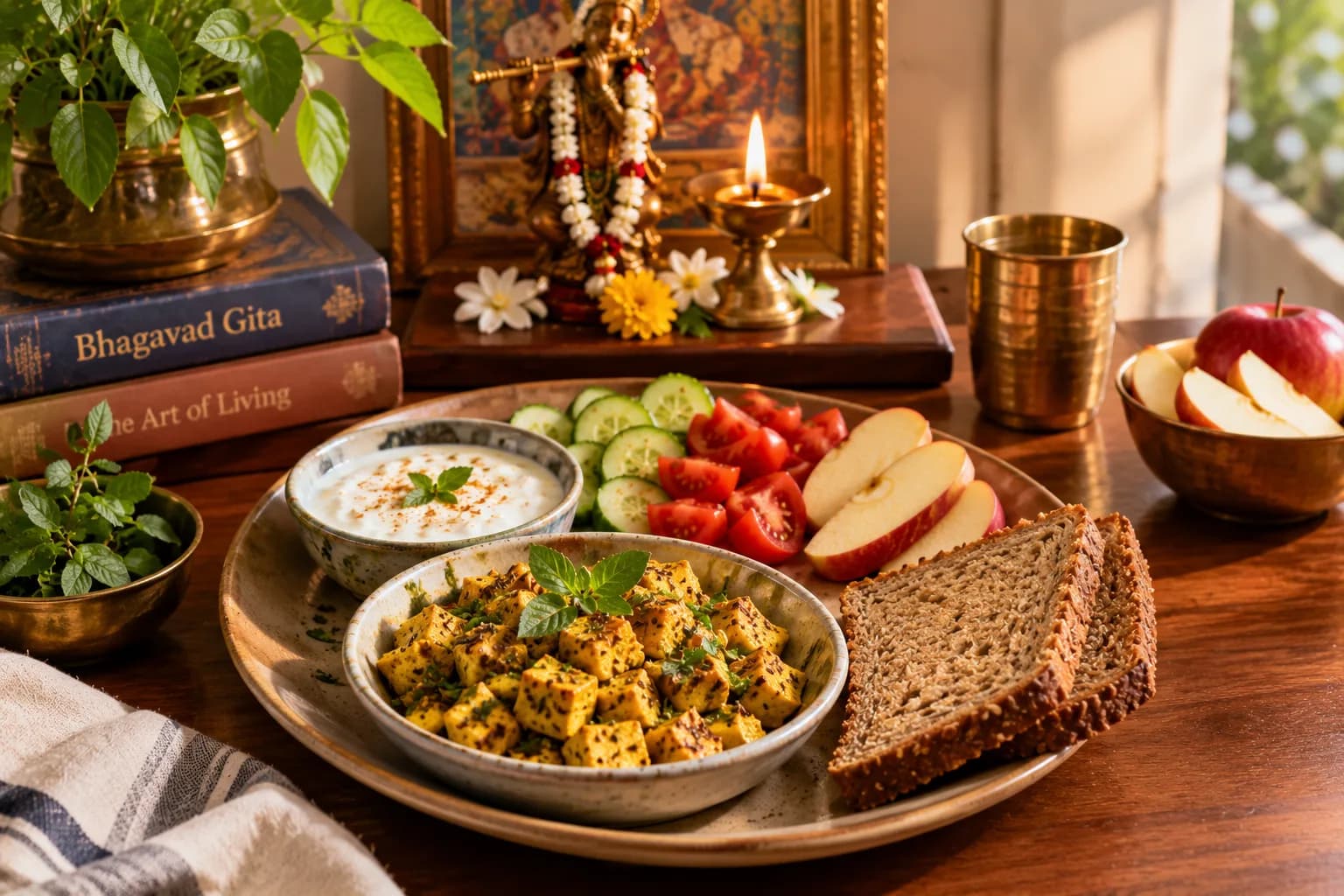
A plate of tofu, curd, cucumber, tomatoes, an apple and some bread does not look like the start of an internet conversation. There is no towering stack, no powder, no shaker bottle. Yet this breakfast, posted by content creator Tamal (@mantra_saadhana) as his "Sanatani protein breakfast", has been travelling widely since early October. The Instagram clip embedded in the Times of India's 4 October report showed more than 1.7 lakh likes when we viewed it.
The food explains some of that. The rest comes from what Tamal does before he eats. According to his video, as reported, he adds tulsi leaves to the plate, carries it to a home altar and offers it. Afterwards, he considers the food prasad.
That mix is the real story. It is not a verdict on tofu or a rule for anyone's kitchen. It is a small, specific example of three conversations meeting on one plate: Indian vegetarian cooking, modern protein culture, and personal devotion.
What is actually on the plate
The Times of India reports that Tamal is originally from Israel and moved to India with his family in 2009. It says he later spent 12 years at a traditional gurukul in Mayapur, West Bengal, where he says he studied Sanskrit, Vedic mantras, puja rituals and havan. He graduated in 2021. The same report says he describes himself as a vegetarian bodybuilder and a follower of Sanatana Dharma. We have not independently verified these biographical details, so they are attributed to that report.
The method, as reported, is plain. Tofu is cut into small cubes and cooked in a little ghee with jeera, hing and haldi. Salt and black pepper go in, and the tofu is lightly mashed as it finishes. It is served with yoghurt, fresh vegetables, an apple and bread. Tamal describes the meal as high in protein, with tofu at the centre.
In the video, a tofu pack, a cup of curd, apples, tomatoes and a cucumber sit in a steel bowl. A later shot shows the cooked tofu on a plate. Nothing on screen needs a specialist ingredient. If you have eaten paneer bhurji, you already know the logic: cubes in a tadka, mashed slightly in the pan.
The protein sum
"High protein" is easy to say and harder to measure. Tamal has not given quantities in the material we have seen, so any figure here is our estimate, built on assumed servings.
On those assumptions the plate lands at roughly 25 to 33 g of protein. The spread is wide because tofu varies so much by brand, firmness and water content. Silken tofu sits well below the firm blocks. A heavier curd, a different loaf or a bigger portion would shift the total in either direction. Treat these as estimates to check against food composition tables, not as label values.
What does that number mean? For perspective, ICMR-NIN's Dietary Guidelines for Indians, 2024, put the recommended allowance for a healthy adult at 0.83 g per kg of body weight a day. For a 75 kg adult, that works out to about 62 g across the whole day. That is a general reference for healthy adults, not a target for any individual. People who train with weights may need more, and the same guidelines note that intakes above roughly 1.6 g/kg a day add nothing further to gains from resistance training. Where one person should sit between those lines depends on body size, training, overall diet and health, and that is a conversation for a registered dietitian or doctor.
One breakfast also cannot tell us whether someone's day adds up. We don't know what else Tamal eats or how he trains, so this article makes no claim about whether his diet suits his goals. A 30 g breakfast is a good start for a day, not proof of anything about the rest of it.
Tadka was always here, tofu is the newcomer
What makes the plate feel Indian is not the protein source. It is the grammar. Cumin in hot ghee, a pinch of hing, haldi, and curd with cucumber and tomato on the side are as familiar as home cooking gets.
Tofu is the newer element. It has long histories elsewhere in Asia, but it is not a staple across most Indian kitchens. It does, however, slot easily into recipes built for paneer. In Manipuri cooking, firm tofu can stand in for paneer in sana thongba, which shows how readily it takes to Indian spicing. Tamal's plate is one visible example of an old movement: a newer ingredient adopted into a familiar technique.
It is also worth saying plainly that "vegetarian" does not mean "automatically high in protein". A thin dal with rice, or poha with chutney, can be modest in protein. Where a vegetarian plate gets its protein is usually a matter of choices: pulses with grains, curd or paneer, soy, nuts and seeds, and portions that match what the person needs. Dal, chana, rajma, peas, sprouts and dairy already do much of this work in many homes. Tofu simply adds another option.
How protein became the way we talk about food
Step back from the plate and a bigger pattern appears. A few years ago, most people described a meal as light, heavy, filling or fried. Today a good number describe it in grams.
The numbers behind that shift are worth a look. ICMR-NIN has put India's estimated average protein intake at about 0.66 g/kg a day against the recommended 0.83 g/kg. That gap gives the protein conversation real weight, because plenty of people may not be getting as much as they need. At the same time, it has opened a large market. Aisles now carry protein bars, shakes, flour and ice cream. A 2024 study by the Citizens Protein Project reported that close to 70 per cent of 36 supplements it tested were mislabelled for protein content. FSSAI's claims rules say a packaged food can be called "high in protein" only if it provides at least 20 per cent of the RDA per 100 g, and ICMR-NIN's 2024 guidelines advise against protein supplements for muscle building by healthy people.
Against that backdrop, a home-cooked plate has an appeal that a packaged product cannot easily copy. It is visible, it is familiar, and nobody needs to read a label to understand it. That is our interpretation, not a measured finding, but it fits the way food content is travelling. Traditional ingredients are being renamed in the language of the gym, and audiences seem to like the result.
Why Tamal calls it "Sanatani"
The word is Tamal's. In the report we reviewed, it is attached to the ritual, not to the nutrients.
Offering food before eating is a long-standing practice in many Hindu households and traditions, often with a short prayer. The food that has been offered is then received as prasad. Tulsi is closely linked with Vaishnava worship, which is why it often appears in offerings. Practices vary widely by family, region and sect, so no single household's way should be read as the standard.
For Tamal, the sequence is personal. In his video, he explains that the ritual helps "purify your consciousness". He cooks, adds tulsi, offers the plate and then eats. In that order, nutrition and devotion are not competing. The protein explains how the plate is built, and the offering explains what the plate means to him. Neither idea tells other people what they ought to eat, and a religious identity is not a dietary prescription.
Why it travels
We can say what is visible. The breakfast is easy to recognise, quick to cook and simple to film. Its ingredients come from any neighbourhood store. Nothing about it feels foreign to an Indian viewer.
What follows is interpretation. A creator from outside India presenting a devotional routine in Indian terms may feel fresh to some and reassuring to others. A fitness frame draws one audience, a vegetarian frame another, and a faith frame a third. One short video can reach all three. We cannot say which viewers responded for which reason, and it would be unfair to guess.
It is equally worth noting what the story does not show. It does not show that this breakfast is healthier than any other, and it does not show that tofu is replacing older foods. It shows that an ordinary plate can carry a lot when people are ready to read it that way.
Back to the plate
Strip away the hashtags and what is left is spiced tofu, some curd, vegetables, an apple and bread. The tofu supplies much of the protein. The curd and bread add their share. The tulsi and the altar add something no label measures.
The interesting part is not that tofu has become a religious food. Nobody involved is claiming it has. It is that one breakfast can now be read in several ways at once, as a protein meal, a vegetarian meal, an Indian meal and an act of devotion, depending on what the person eating it values. The plate stays the same. What changes is what we are ready to see in it.