


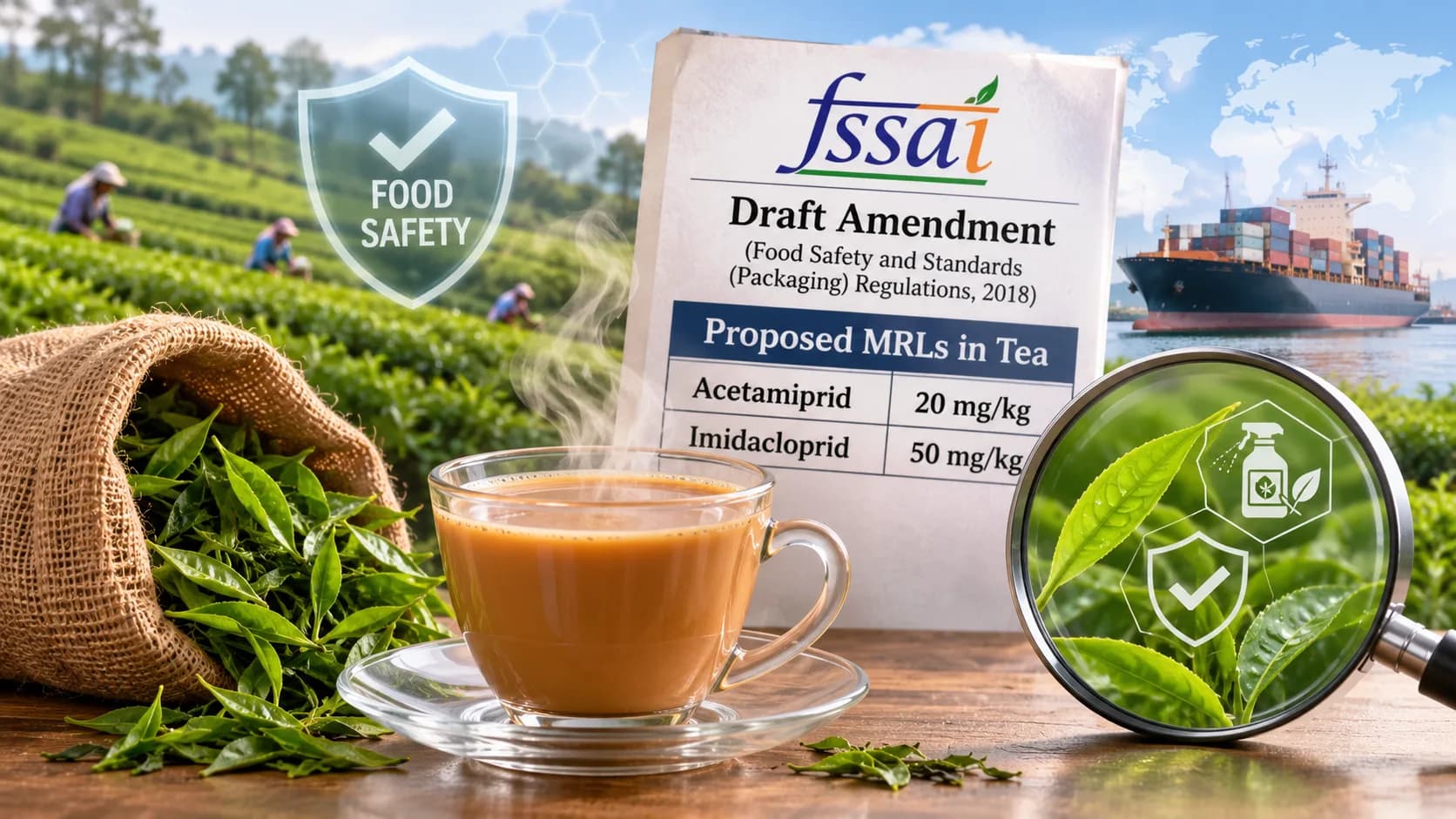
In most Indian homes, chai is the first thing made in the morning. Behind that cup sits a quieter rule question: how much insecticide may legally remain in the tea leaf?
FSSAI has now proposed an answer for two insecticides, acetamiprid and imidacloprid. The figures look large: 20 mg/kg for acetamiprid and 50 mg/kg for imidacloprid. Beside the 0.01 mg/kg that labs have been told to apply since 2024, they look larger still. The numbers do not mean what they first appear to, and the story is in the gap between them.
What exactly has FSSAI proposed?
The draft Food Safety and Standards (Contaminants, Toxins and Residues) Amendment Regulations, 2026 adds a "Tea" entry to Regulation 2.3.1 for each pesticide, TaxGuru's summary of the notification shows. The notification is dated 15 October 2026 and, according to that summary, the PIB release and ANI, appeared in the Gazette on 16 October. Transclew gives 17 October. IFT could not open the Gazette itself, and could not confirm the 3 November WTO/TBT notification date.
This is a draft. Comments are due after 60 days from the date Gazette copies are made available, which points to mid-December 2026. Nothing is enforceable until a final notification.
An MRL is a legal ceiling on what may remain in a food. It is not a dose farmers apply, and it is not a health threshold. Whether a pesticide may be sprayed on tea at all is a separate approval, decided by the Central Insecticides Board and Registration Committee (CIB&RC).
The earlier 0.01 mg/kg rule
On 4 March 2024, FSSAI directed all notified laboratories to test tea for six substances: cypermethrin, acephate, imidacloprid, acetamiprid, dinotefuran and fipronil. It said a tolerance limit of 0.01 mg/kg "shall be applicable". The direction does not cite a legal basis for that figure.
Transclew's reading is that 0.01 mg/kg is the default ceiling that applies where no MRL has been fixed, so it is a placeholder, not a safety finding. IFT could not verify the provision it relies on. The same report says neither pesticide was on the Tea Board's approved list in early 2024, and that the draft replaces the default with chemical-specific limits 2,000 to 5,000 times higher.
That does not make the draft a simple relaxation. A default and a considered limit are different kinds of number. But the case is not closed either. The notification, as summarised, does not publish the residue data behind 20 and 50 mg/kg. It also does not mention the 2024 direction, and covers only two of its six substances. Whether the direction lapses for those two on finalisation, and what labs should apply meanwhile, is a legal question IFT could not settle. Until finalised, the 2024 direction presumably still governs, though that is our inference, not FSSAI's statement. IFT has not yet put these questions to FSSAI.
Why now? Two developments are on the record. Small-grower body CISTA wrote to the health minister in July asking for a limit, saying the CIB&RC extended both pesticides to tea in January 2026 and the Tea Board listed them in April. Those are the association's claims; Transclew says the Tea Board's April plant-protection code marks each "MRL yet to be notified". In other words, approval to use and a legal residue limit arrived out of step.
What does an MRL actually tell us?
Regulators typically set MRLs from supervised field trials run under Good Agricultural Practice, which show what residues remain when the product is used as labelled. A dietary-exposure assessment then checks that realistic consumption stays below health-based reference values, the Acceptable Daily Intake (ADI) for lifelong exposure and the Acute Reference Dose (ARfD) for a single day. The MRL is meant to be a ceiling that is safely below those values, not equal to them.
Four things get confused:
A pesticide is approved for use.
A residue is detected in a sample.
The residue exceeds the MRL.
A person is actually exposed.
An analogy: a speed limit is not the speed at which a car crashes. A detection is not a violation, and a violation is not an illness.
Tea adds a wrinkle. Limits apply to dry leaf, but nobody drinks dry leaf. A study of black tea found that imidacloprid and acetamiprid move into the infusion, with brewing transfer of 37–39% for imidacloprid and 45–49% for acetamiprid, higher with longer brewing. That is one study, of one tea type, under its own conditions. It suggests residue in the cup is lower than in the leaf, not zero. IFT did not find a source for how milk or boiling time in Indian chai changes this, so we do not estimate it.
On the science of the two chemicals: both are neonicotinoids, insecticides that act on insects' nervous systems and are used against sucking pests such as the tea mosquito bug, CISTA says. Both also raise ecological concerns, including for pollinators, which is a separate question from human food safety. On health, the European Food Safety Authority in 2024 proposed lowering acetamiprid's ADI and ARfD from 0.025 to 0.005 mg/kg body weight, citing uncertainty about developmental neurotoxicity. That was guidance to risk managers; IFT did not find that it had been adopted. IFT also did not retrieve imidacloprid's reference values. Neither point shows that tea at or under the draft limits makes anyone ill.
India's exports under scrutiny
FSSAI says 20 mg/kg for acetamiprid is below Japan's 30 and the US's 50, and that 50 mg/kg for imidacloprid follows Codex. Those are government claims relayed in the announcement. Transclew reports that FSSAI's data portal shows a Codex tea limit of 50 mg/kg for imidacloprid and none listed for acetamiprid. IFT did not check Japan's or US databases directly, so those two comparisons stay attributed.
The key export number is the EU's: 0.05 mg/kg for both pesticides in tea, per Transclew and the Sentinel, which adds that Assam supplies a large share of tea exported to the EU and UK. Tea that meets India's proposed limit could still fail in Europe. A limit in India's rulebook does not travel with the consignment. Buyers apply their own.
Is there evidence of export rejections over these two pesticides? IFT found none. Older rejection stories involve other chemicals, such as a 1995 German rejection over tetradifon. The Sentinel says the central government expects little effect on EU exports; that is an official expectation, not evidence. The draft does not by itself prevent rejections, and this reporting does not establish that any are happening.
What changes for growers?
The practical gain is clarity. The North Eastern Tea Association told Assam's agriculture minister in June 2024, as Transclew reports, that the six chemicals had sometimes exceeded the limit, that small growers were using pesticides sold for other crops, and that once MRLs were fixed it was confident 90% of Assam's teas would comply. That is an association claim.
The obligations do not vanish. Growers still need approved products, correct doses, and waiting periods before plucking, because residues depend on timing. The Sentinel describes the harder problem: Assam has over 1.5 lakh small growers producing nearly half its tea, and too few laboratories. Green leaf spoils, so waiting for a certificate is costly. Bought-leaf factories pool leaf from many growers, so one grower's batch can put the whole lot at risk. A legal number only helps if labs, sampling and traceability can apply it.
IFT did not obtain comments from the Tea Board, Tea Research Association, planters' groups or exporters. They remain to be sought.
What the consumer needs to know
The draft is not evidence that tea is unsafe, and it does not show all tea contains these pesticides. What a reader can fairly infer from an MRL is limited: tea within it is legal. What cannot be inferred is a personal exposure figure, because that depends on how much tea you drink and how it is made. Whether leading brands publish residue results, and how often routine surveillance catches problems, is not something IFT found documented.
What happens next
FSSAI will review comments, then decide whether to finalise, change or drop the limits. Questions for the comment window: what field-trial and dietary-exposure data support 20 and 50 mg/kg; what happens to the 2024 direction; whether EFSA's revised acetamiprid values were considered; and how small growers will be tested.
Pesticide regulation is not only about setting a number. It is about how the number is derived, whether it can be enforced across a fragmented supply chain, and how it is read by buyers abroad. India is about to learn how much weight 20 and 50 can carry.