


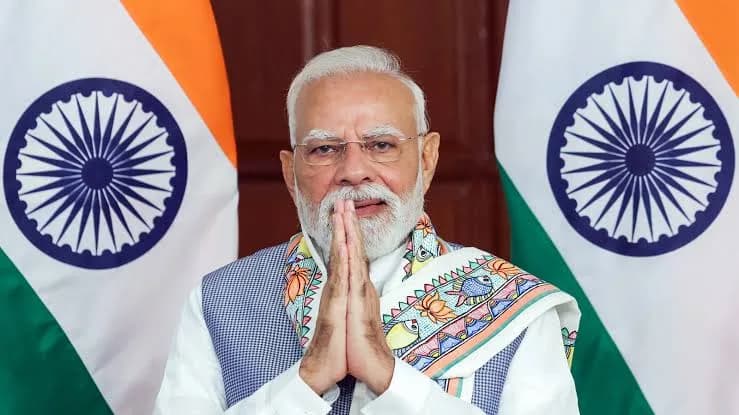
A widely shared list credits Prime Minister Narendra Modi with a fixed "daily diet" of 12 dishes. His own on-record answer to a student's question tells a more specific story and it's worth examining what he has actually said, and when.
A list has been circulating that credits Prime Minister Narendra Modi, at 76, with a daily diet built around twelve dishes upma, sabudana khichdi, pongal, moringa paratha, khichdi, dhokla, makhana, kheer, jhal muri, and a neem-mishri, hot water and fasting-linked cluster of habits. It's a tidy, shareable list. It's also not quite what the public record supports.
Because Prime Minister Modi has, on the record, already answered this exact question not in a food feature, but during Pariksha Pe Charcha 2026, his annual interaction with students, when one of them asked him directly what "magical diet" he follows. His answer, as transcribed on the official PMIndia.gov.in site: "The truth is that I don't have any fixed diet system, because earlier I used to eat in different families homes. The only thing was that since I am vegetarian, I would eat vegetarian food. Whatever was available in that house, I ate. Sometimes I had to cook for myself. Sometimes I cooked khichdi."
That's about as direct a primary-source answer as exists on this subject, and it sits uneasily next to a "12 dishes, daily" framing. What follows is an attempt to separate what he has actually, verifiably said about food and eating from what has simply accumulated around his name in secondary coverage.
What PM Modi Has Actually Said About His Diet
Beyond the "no fixed diet" answer, three other primary-source moments carry real weight, from three different years and three different contexts.
2019 : khichdi and poha. In an interview that year, Modi named khichdi and poha as dishes he loves, and described a self-cooked morning routine waking at 4:30 am, making tea, cleaning, cooking breakfast that he explicitly called "my daily routine for two and a half years." That phrasing matters: it's a description of a specific earlier period of his life, in his own words, not a claim about his present-day routine at 76.
February 2025 : makhana, quantified. At an election rally in Bhagalpur, Bihar, while promoting the region's makhana (foxnut) industry and the newly announced Makhana Board, Modi said, in Hindi: "I eat makhana 300 out of 365 days a year." This is a specific, quotable, self-reported figure worth taking seriously as his own claim, while also noting the setting: a political rally built around promoting a local product, which is a reasonable context for a leader to volunteer a personal habit, but a different kind of statement than an offhand aside in a casual interview.
March 2025: hot water and long-running fasts. In a conversation with podcaster Lex Fridman, also carried on PMIndia.gov.in, Modi described hot water as a settled personal habit ("that's my routine I always drink hot water") and gave a detailed account of decades-long fasting practices: eating only once in 24 hours through the four-to-four-and-a-half-month Chaturmas period tied to the monsoon; consuming only hot water for nine days during Sharad Navratri (roughly September–October); and eating only a single fruit once a day for nine days during Chaitra Navratri (roughly March–April) citing papaya as an example. He described having followed some version of this pattern for "50 to 55 years."
Sabudana Khichdi, Upma and Pongal
These three, along with moringa paratha, dhokla, kheer, jhal muri, and the neem-mishri pairing, are where the "12 dishes" list runs into trouble. This research could not trace any of these specifically to a direct statement from Modi no interview transcript, no official PMIndia posting, no reputable original reporting quoting him naming these particular dishes as personal habits. They appear to circulate through secondary listicles and aggregator content, some of it unsourced (one widely-copied "wellness" piece describes his day beginning with "warm water, sometimes infused with herbs" and breakfasts of "poha, upma, or khichdi" without citing where any of this comes from).
That doesn't mean he has never eaten these dishes sabudana khichdi and khichdi generally are common during Hindu fasting periods, and upma and pongal are widely eaten South Indian breakfast staples he may well have encountered on his many travels across India. But "widely eaten Indian dish, plausible for anyone" and "verified personal daily habit of this specific individual" are different claims, and the available public record only supports the former for these particular items.
Makhana, Khichdi and the Fasting Cluster
What the record does support, clearly: khichdi (self-described, though as occasional rather than daily, in his most direct on-record answer), makhana (a specific self-quantified claim), hot water (an explicit stated routine), and a genuinely elaborate, decades-long structure of periodic fasting tied to the Hindu calendar. These aren't part of a rotating daily menu they're closer to a set of long-standing personal disciplines, some constant (hot water) and some strictly periodic (the three fasting windows).
Does He Follow a Fixed Diet?
Based on the primary sources located in this research, no not in the sense the viral list implies. His own most direct statement on the subject explicitly rules out a fixed system, tying his eating instead to circumstance (what was available), preference, and a set of separately-described fasting periods. The strongest counter-evidence to "no fixed diet" is really the fasting structure itself, which is fixed but it's fixed as a schedule of restriction tied to religious/seasonal periods, not as a rotating list of dishes eaten day to day.
What the Public Record Actually Shows
Put together, the honestly documented picture is narrower and more specific than "12 dishes, daily": a stated preference for simple vegetarian food eaten according to circumstance rather than a fixed plan; khichdi as a dish he has cooked himself, at least occasionally; a self-quantified, high-frequency habit around makhana; a consistent hot water routine; and a genuinely long-running, detailed personal practice of periodic fasting. Several of the other dishes commonly attached to his name in circulating lists simply aren't traceable to anything he has said, at least not within the sources available for this research which is itself the more interesting finding than the list would suggest on its own.