
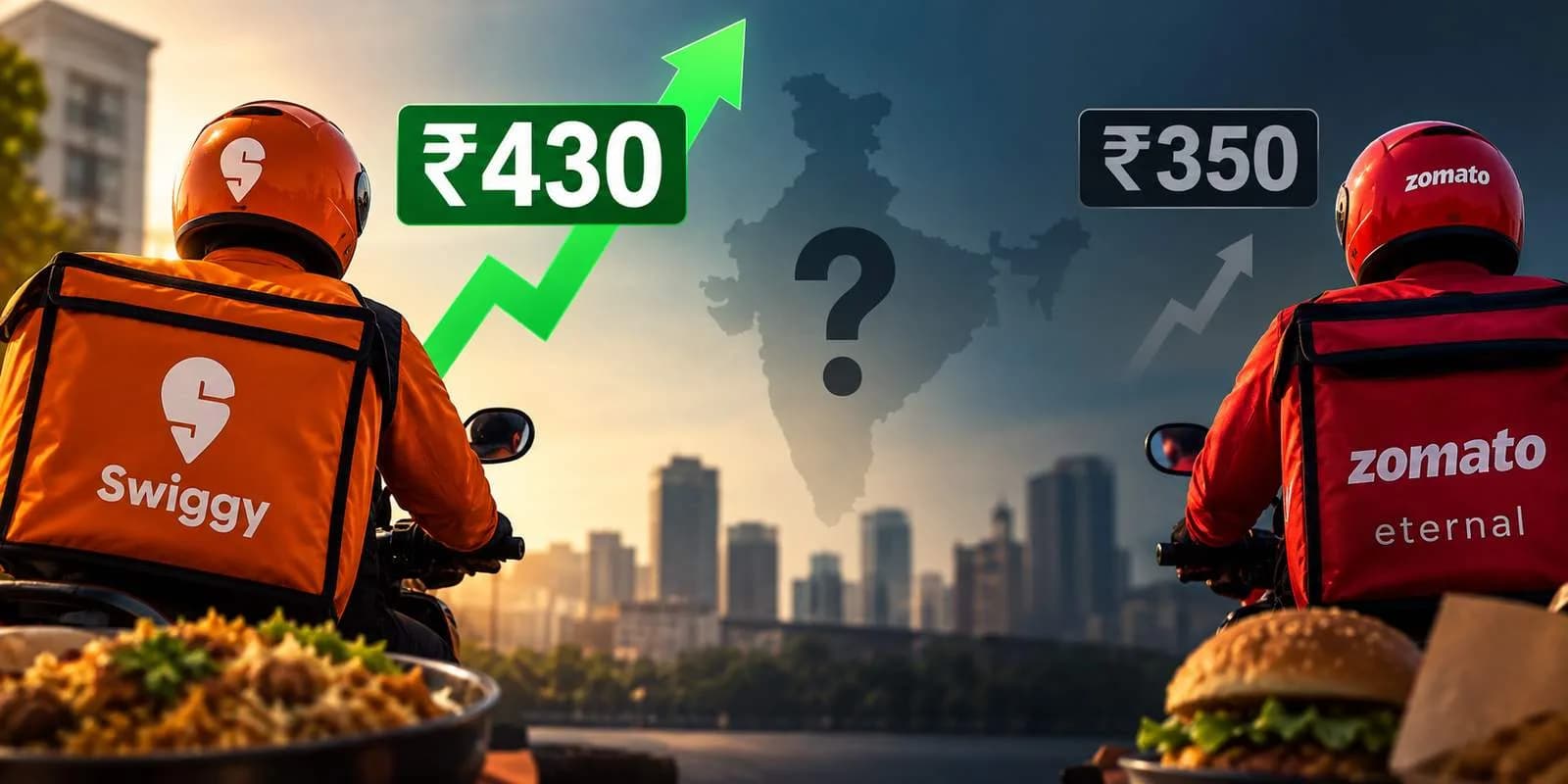
Swiggy at ₹430. Eternal at ₹350. Both rated ‘Outperform’.
At first glance, Bernstein’s latest call on India’s two biggest listed food-delivery platforms looks like another bullish brokerage report.
But there is a much bigger story hiding underneath those numbers.
Bernstein believes Swiggy could have around 52% upside, with a target price of ₹430, while it has retained an ‘Outperform’ rating on Eternal, with a ₹350 target.
The interesting part isn't simply the gap between the two targets.
It is Bernstein’s warning about what happens when India’s food-delivery platforms go after the next 100 million customers.
Because the biggest growth opportunity for Indian food delivery could also become its biggest profitability challenge.
Swiggy gets the bigger upside call
Bernstein has retained its Outperform rating on Swiggy and assigned a ₹430 price target.
The brokerage's target implies roughly 52% upside based on the reference price used in its research.
That comes at an interesting time for Swiggy.
The stock has been trading significantly below its 52-week high, leaving investors questioning whether the company's long-term growth story can eventually translate into stronger shareholder returns.
Bernstein's answer is essentially yes — but its reasoning goes well beyond food delivery.
Swiggy is increasingly operating across food delivery, quick commerce and other consumer-facing businesses, creating a larger ecosystem around its customer base and delivery infrastructure.
And that could become increasingly important as India's digital-consumption market matures.
Eternal gets ₹350 — but the real battle isn't just Swiggy vs Zomato
Bernstein has also retained its Outperform rating on Eternal, the parent company of Zomato, with a ₹350 target price.
The brokerage's target represents roughly 9% upside based on the reference price in its report.
So why is Bernstein seeing such a dramatically different implied upside between the two stocks?
That is where the story gets interesting.
The brokerage isn't simply betting on one company defeating the other.
Instead, it believes both Swiggy and Eternal are in a fundamentally stronger position because they are already the incumbents.
They have the users.
They have the restaurant networks.
They have the delivery infrastructure.
And increasingly, they have businesses beyond traditional food delivery.
But the next battle could be much harder.
India's biggest food-delivery opportunity may not be its easiest
India's food-delivery market is still tiny compared with China's.
Bernstein estimates India's overall food-services market is around one-twelfth the size of China's, while India's food-delivery market is approximately one-twenty-second the size of China's.
That sounds like an enormous opportunity.
And it is.
But there is a catch.
India's existing food-delivery customer base is disproportionately made up of relatively affluent consumers.
These customers tend to support higher-value orders, making the economics of food delivery more attractive.
The problem begins when platforms attempt to move beyond this audience.
What happens when the next 100 million customers don't order ₹500 meals?
That is the uncomfortable question at the heart of Bernstein's analysis.
India has hundreds of millions of potential digital consumers who have yet to become regular food-delivery users.
Bringing them online could massively expand the market.
But many of these customers are likely to be more price-sensitive.
Their average order values could be lower.
And delivery still costs money.
That creates a difficult equation:
Lower order value + delivery costs + customer acquisition = potentially tighter margins.
So the industry's next growth phase could produce something unusual:
more orders, more customers and a bigger market — but not necessarily proportionately higher profits.
And then there is China
If there is one country Indian food-delivery companies cannot ignore, it is China.
China provides a fascinating — and expensive — warning.
Bernstein points to nearly $30 billion spent during China's food-delivery competitive battle involving major players such as Meituan, Alibaba and JD.
Think about that number.
$30 billion.
The competition was no longer simply about delivering restaurant meals.
Food delivery became intertwined with e-commerce, quick commerce and consumer acquisition.
Platforms began competing for the same customer through increasingly fast delivery and aggressive spending.
And that changed the economics of the entire industry.
Could India see its own ₹-billion-dollar food-delivery war?
This is where Bernstein's analysis becomes particularly relevant for India.
The obvious question is:
Could Swiggy and Eternal eventually face the kind of competition that China experienced?
Bernstein appears more cautious about that possibility.
India's market is substantially smaller.
The overall food-delivery opportunity is still developing.
And the economics of reaching India's next wave of customers are different.
That doesn't mean competition won't intensify.
It means replicating China's enormous spending war could be considerably harder to justify economically.
But quick commerce changes the game
There is another factor that makes today's market very different from the food-delivery industry of five years ago.
Quick commerce.
Swiggy has Instamart.
Eternal has Blinkit.
And both companies are now competing in a world where consumers increasingly expect products to arrive extremely quickly.
The distinction between:
“I want dinner delivered”
and
“I need something delivered right now”
is becoming increasingly blurred.
This matters because the same underlying infrastructure — customers, technology, logistics and delivery partners — can potentially support multiple businesses.
That makes the competition much bigger than restaurant food.
It becomes a battle for consumer time, frequency and wallet share.
The real fight may be over the next 100 million users
For years, India's food-delivery story was largely about convincing urban consumers to order restaurant food online.
The next chapter could be completely different.
The opportunity is to take food delivery deeper into India's mass market.
Smaller cities.
More price-sensitive consumers.
Lower ticket sizes.
Higher frequency.
More competition.
And potentially much greater pressure to make every delivery profitable.
That is where the industry's biggest contradiction emerges.
Growth is easy to celebrate. Profitable growth is much harder.
A platform can report millions of additional orders.
But if acquiring and delivering those orders becomes increasingly expensive, revenue growth alone doesn't tell the full story.
That is precisely why Bernstein's China comparison deserves attention.
Why Swiggy and Eternal still matter
Despite these concerns, Bernstein continues to see Swiggy and Eternal as the incumbents best positioned to defend their businesses.
And that makes sense from a market-structure perspective.
A new challenger doesn't simply have to launch an app.
It needs to build:
A large restaurant network
A reliable delivery fleet
A substantial customer base
High order frequency
Sophisticated logistics
Technology infrastructure
Consumer trust
Enough capital to compete
And then it needs to make the economics work.
That is a much bigger challenge than simply offering cheaper delivery charges.
What could go wrong?
Bernstein's thesis also highlights several risks investors and the industry will need to watch.
1. The mass market could be less profitable
The next wave of customers may have lower average order values and greater price sensitivity.
2. Competition could increase spending
If platforms start aggressively subsidising consumers or restaurants, margins could come under pressure.
3. Quick commerce could intensify the battle
Food delivery and quick commerce increasingly compete for consumer attention and delivery capacity.
4. China's experience remains a warning
The nearly $30 billion competitive spending in China's food-delivery market demonstrates how quickly the industry can expand beyond traditional restaurant delivery.
5. Bigger doesn't automatically mean more profitable
A much larger customer base doesn't necessarily translate into proportionately higher profits if unit economics deteriorate.
So, Swiggy or Eternal?
That is perhaps the wrong question to ask from Bernstein's report.
The bigger question is:
Can India's food-delivery industry become dramatically larger without repeating the margin pressures seen in other markets?
Bernstein believes the existing leaders — Swiggy and Eternal — are positioned to defend their businesses.
But the path ahead is unlikely to be completely straightforward.
India still has a huge untapped food-delivery opportunity.
At the same time, the easiest customers may already be on the platforms.
The next phase will require convincing consumers who are more price-sensitive, potentially order less per transaction and live farther away from the dense urban markets that helped establish today's delivery economics.
The ₹430 question
Bernstein's ₹430 target for Swiggy has grabbed attention because of the roughly 52% upside attached to the brokerage's reference price.
But the more interesting part of the report may not be the ₹430 number at all.
It is the underlying question:
Can India's food-delivery companies turn the country's enormous untapped consumer base into profitable growth?
China shows what can happen when food delivery becomes a battlefield for the entire digital-consumer economy.
India may take a different path.
For Swiggy, Eternal and the wider food industry, the next few years could determine whether food delivery becomes a genuinely mass-market habit — or remains concentrated among consumers for whom the current economics work best.
The battle isn't over who delivers food faster anymore.
It may ultimately be about who can deliver growth without delivering away the margins.