
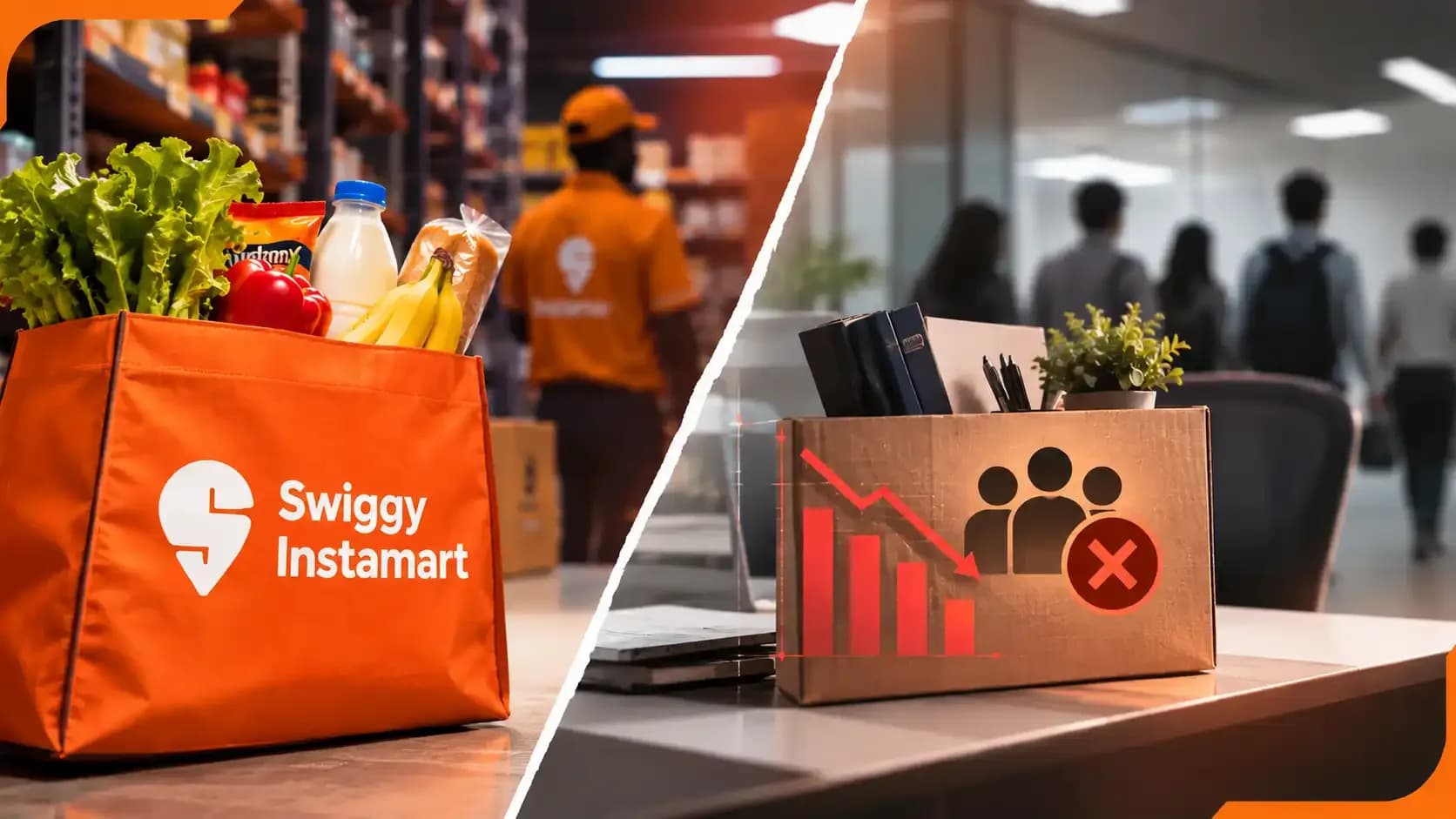
Swiggy's quick-commerce division, Instamart, is reportedly laying off approximately 340 employees as part of a broader organisational restructuring exercise. The move comes as the company looks to streamline its operations, improve workforce efficiency and strengthen its path towards profitability amid intensifying competition in India's quick-commerce sector.
According to media reports published on November 27, the job cuts primarily affect corporate and support functions, including analytics, category management and other central teams. The restructuring is also understood to involve mid-to-senior-level employees.
The development comes at a time when quick-commerce platforms are under increasing pressure to balance rapid expansion with operational efficiency and sustainable financial performance.
AI Adoption and Organisational Efficiency Behind the Restructuring
One of the key factors associated with the restructuring is the growing adoption of generative artificial intelligence (AI) across business operations.
Instamart is reportedly reorganising teams, reducing overlapping responsibilities and simplifying decision-making processes as it adapts to changing operational requirements. The company is also looking to improve productivity by making its organisational structure more efficient.
However, the reported layoffs should not be interpreted as evidence that AI has directly replaced all the affected employees. The restructuring involves broader organisational and operational changes.
Employees to Receive Severance and Extended Benefits
Swiggy has reportedly prepared a support package for employees affected by the restructuring.
The reported benefits include severance payments in addition to applicable statutory payouts, accelerated vesting of employee stock options until their last working day and extended health insurance coverage until May 2027.
Affected employees are also expected to receive extended wellness benefits, relocation assistance where applicable and outplacement support to help them explore new employment opportunities.
The reported assistance package reflects the company's efforts to provide transition support to employees impacted by the job cuts.
Instamart's Growing Business Faces Profitability Challenges
The workforce restructuring comes against the backdrop of Instamart's continued expansion and substantial operating losses.
In the September quarter of FY2027, Instamart reported a Gross Order Value (GOV) of approximately ₹9,230 crore, reflecting quarter-on-quarter growth of 16.7%. However, its adjusted EBITDA loss stood at ₹895 crore, compared with ₹849 crore in the corresponding quarter of the previous year.
The platform reportedly operated 1,240 dark stores across 133 cities during the quarter, adding 69 dark stores during the period.
These figures highlight the challenge facing Instamart: growing order volumes and expanding its delivery network while managing the substantial costs associated with warehouses, logistics, discounts and customer acquisition.
Competition Intensifies in India's Quick-Commerce Market
Instamart operates in an increasingly competitive market, facing competition from Blinkit, Zepto, Flipkart Minutes and Amazon Now.
These platforms are competing through faster deliveries, wider product selections, aggressive customer acquisition strategies and expanding dark-store networks.
As competition intensifies, quick-commerce companies are increasingly focusing on improving unit economics and controlling operating expenses rather than pursuing expansion alone.
For Instamart, improving productivity across its workforce and operational network could become an important part of its strategy to strengthen its financial performance.
No Reported Nationwide Dark-Store Shutdown
Despite the reported layoffs, there has been no indication of a nationwide shutdown of Instamart's dark stores as part of this exercise.
The company continues to invest in its quick-commerce infrastructure, product assortment and operational capabilities. Its expansion during the September quarter also indicates that the restructuring is primarily focused on organisational efficiency rather than an exit from the quick-commerce business.
The reported reduction of approximately 340 jobs marks another significant development in India's competitive quick-commerce industry.
For Instamart, the challenge is no longer just about expanding its presence and attracting more customers. It must also improve operational efficiency, manage costs and move towards sustainable profitability.
The restructuring highlights a broader shift across the quick-commerce industry, where companies are increasingly being pushed to demonstrate that rapid growth can translate into financially sustainable businesses.