


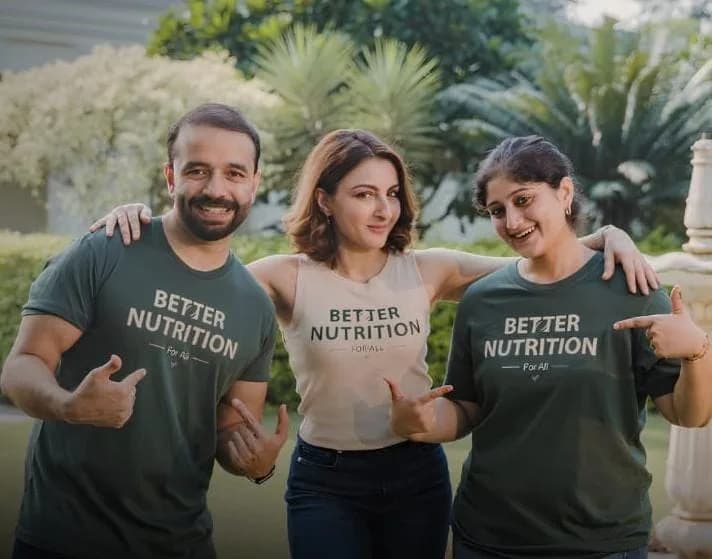
A Celebrity Investment That Begins in a Wheat Field
On about 45 acres of the Pataudi family's farmland in Haryana, wheat has been planted this rabi season that its backers say is richer in iron and zinc than ordinary wheat. Actor and author Soha Ali Khan has also invested in Better Nutrition, the Lucknow-based company behind the programme, and become its brand ambassador, The Tribune reported. Plans for biofortified rice from the coming kharif season and for neighbouring farmers were also reported.
The investment amount has not been disclosed in any coverage I found. The sowing month (November 2026) and an April 2027 harvest are not stated in the Tribune text I retrieved, which says only "this rabi season". Treat them as unverified until the company confirms.
The celebrity is the hook. The real question is whether changing the seed, or the way a crop is grown, can change what ends up in a roti, and whether anyone can make money doing it.
What Is Biofortified Wheat?
Biofortification raises nutrient levels inside the crop itself. Conventional fortification adds nutrients to flour during processing. They are not interchangeable: one changes the grain, the other changes the flour.
There are two routes. Genetic biofortification uses conventional plant breeding to develop varieties that pull more iron or zinc into the grain. ICAR describes it as slower and costlier but sustainable. Agronomic biofortification uses fertiliser, soil management or foliar sprays to push more of a nutrient into whichever variety is already growing.
India has released genetic varieties. ICAR-IIWBR's WB 02 and PAU's HPBW 01, both released in 2017, carry about 40 ppm iron and 41 to 42 ppm zinc, according to a table of released varieties in a peer-reviewed review. CIMMYT's brief describes the two as sister lines with roughly 7 ppm more zinc than comparison wheat. Later releases include DBW 187 (43.1 ppm iron), HD 3171 (47.1 ppm zinc) and several durums, per a second variety table.
Two cautions apply. First, ICAR itself notes that a variety bred for high grain zinc may not perform the same everywhere, so results depend on soil and conditions (ICAR, Indian Farming). Second, the agronomic route is uneven by nutrient: in ICAR-IIWBR field trials on WB 02, foliar zinc sulphate lifted grain zinc by roughly 40 per cent, while iron rose only about 5 to 6 per cent (Frontiers in Nutrition, 2024).
The Science Behind Better Nutrition
Better Nutrition's own description of its method matters here, because it is not simply "buy a biofortified variety". The company's proprietary protocol, TriNutriMax, is described by its founder as three steps: seed priming, soil enrichment and foliar sprays during vegetative growth (FnB News). Another interview adds microbes, controlled-release fertilisers and AI-driven nutrient scheduling, calls it patent-pending, and says it targets iron, zinc, iodine, selenium and protein (NuFoods Spectrum). In other words, a large part of the model is agronomic. Which seed varieties are on the Pataudi farms is not stated in any source I found.
The headline claim. A Business Today profile quotes the company as saying independent trials with state agriculture universities show iron and zinc 30 to 50 per cent higher than standard wheat and rice (Business Today, June 2025). I could not find those trial reports. For context, WB 02's published zinc advantage is about 7 ppm, and HarvestPlus-linked human studies have used control wheat around 24 to 28 ppm zinc. Gains of 30 to 50 per cent are plausible for zinc under some agronomic conditions, but the company should publish what was measured, where, and against which comparison wheat.
The testing claim. Better Nutrition says it uses X-ray fluorescence (XRF) to verify nutrients and screen heavy metals in every batch (SMEStreet), and has described a "scorecard" of 20-plus nutrients (Startuppedia).
XRF is a legitimate tool for this job. A HarvestPlus-funded study found benchtop energy-dispersive XRF could measure zinc and iron in whole-grain wheat, with quantification limits of about 7 ppm zinc and 3 ppm iron and prediction errors of roughly 2 to 3 ppm against lab-grade ICP reference methods (Paltridge et al., Plant and Soil, 2012). But the same literature stresses the instrument must be calibrated against reference samples, and it was positioned as a screening tool for breeding programmes. My analysis, not a finding from the sources: XRF reads heavier elements such as iron and zinc, and cannot measure protein, which needs methods such as Kjeldahl, Dumas or calibrated near-infrared analysis. Whether the company uses a second method for protein is unanswered. Equally unanswered: whether any NABL-accredited lab cross-checks its XRF readings, and whether batch reports are public.
One more distinction the article should hold onto: concentration (how much iron or zinc is in the grain), bioavailability (how much the body can absorb) and health outcome (whether anyone's status improves) are three different things. XRF speaks only to the first.
Does More Iron and Zinc Actually Reach Your Roti?
Nobody eats raw grain. The path is farm, storage, mill, atta, dough, roti.
Milling is where the advantage can leak. Minerals and phytic acid, the compound that binds them and limits absorption, sit largely in the bran. A 2026 CIMMYT study of 60 zinc-biofortified lines milled at 100, 85 and 70 per cent extraction, and made into both chapati and fermented bread, was designed to test exactly this (Frontiers in Plant Science); it notes most phytate is concentrated in the bran and that fermentation and lower extraction change bioavailability. An earlier study found that estimated zinc bioavailability fell sharply at 80 and 65 per cent extraction compared with whole-grain flour, and concluded only whole-grain biofortified flour gave optimum zinc (Hussain et al., 2013).
That matters for Better Nutrition's product choice. Its 2 kg pack on BigBasket is labelled stone-ground whole wheat (BigBasket), which keeps the bran. Whole meal also keeps the phytate, so more minerals are present but not all are absorbed.
What humans actually absorb. In a controlled study, women eating 300 g a day of zinc-biofortified wheat tortillas (41 versus 24 ppm) took in 68 to 72 per cent more zinc and absorbed about 0.5 mg more per day than on control wheat (Rosado et al., Journal of Nutrition, 2009). That is a real, measurable gain, in a short two-day feeding study of a specific zinc wheat, not proof of better health status. Longer trials exist: the BiZiFED trial in Pakistan was designed to test agronomically biofortified flour on women's zinc status (protocol); I did not retrieve its results.
Iron is the weaker half of the story. I found no retention or absorption data for iron in biofortified Indian wheat, and wheat iron is generally absorbed poorly because of phytate. This is a question for a nutrition scientist before publication.
What about Better Nutrition's own atta? Quick-commerce listings show a label of 3.5 mg zinc and 3.9 mg iron, with 13 g protein (Swiggy Instamart). If those figures are per 100 g, which the listing does not state, they equal about 35 ppm zinc and 39 ppm iron, in the same range as the ICAR varieties' grain values and above the 24 to 28 ppm control wheat in the human studies. The label is a company statement, not an independent test.
Can It Make a Difference to India's Nutrition Problem?
The need is real. NFHS-5 (2019-21) found about 57 per cent of women aged 15 to 49 and about 67 per cent of children aged 6 to 59 months were anaemic (NFHS-5 summary via PARI).
But anaemia is not the same as iron deficiency. It has several causes, including infection and other nutrient gaps. These figures show a large problem, not that wheat iron would fix it. And a zinc-richer wheat is not an anaemia treatment.
Where biofortification has a fair claim is at population level in wheat-heavy diets, as a low-cost complement to supplementation and fortification programmes, not a replacement. A policy brief from the Institute for Studies in Industrial Development-linked IEG notes that evidence on biofortified crops comes mostly from specific populations and crops (IEG policy brief). A premium-priced packet bought through quick commerce reaches urban, higher-income households, which are not the groups with the highest burden. That is my analysis, not a sourced finding.
What Does the Farmer Get?
This is the section the public record supports least.
What is reported: the company says it works with farmers across Uttar Pradesh, Telangana and Maharashtra, offers a "premium buy-back price" to farmers who follow soil-testing guidelines, and describes a supply chain with nutrient profiling and "pricing control" (Business Today; FoodTechBiz). On yield, WB 02 is listed at about 51.6 quintals per hectare (Krishi Jagran), a figure that should be checked against ICAR-IIWBR's own data.
What is not public: the size of the premium, whether the price is fixed, who pays for testing, who bears the loss if grain misses a nutrient specification, payment timelines, and whether farmers may sell elsewhere. I found no independent farmer or agricultural-economist account. Until contract terms are seen, "buyback" should not be read as guaranteed income.
The Business of Selling More Nutritious Atta
The company is growing, on its own numbers. It says consumer revenue reached about ₹1 crore a month within six months of launch, group run-rate crossed ₹2.5 crore a month, production is near 150 tonnes a month, and it is on track to pass ₹100 crore in FY 2026-27 (FoodTechBiz). These are unaudited company claims. It raised ₹10 crore in a seed round from investors including Namita Thapar and Shantanu Deshpande (Entrackr via Venture Intelligence), and sells on Blinkit, Instamart, BigBasket, Zepto, Amazon, Flipkart and JioMart.
Price snapshot (retrieved listings, not a systematic survey):
Listing | Pack | Price | Per kg | Per 300 g (the daily quantity in the Rosado study) |
|---|---|---|---|---|
BigBasket, selling price | 2 kg | ₹120 (MRP ₹200) | ₹60 | ₹18 |
BigBasket, MRP | 2 kg | ₹200 | ₹100 | ₹30 |
Third-party store listing | 2 kg | ₹350 | ₹175 | ₹52.50 |
The three prices differ sharply and should be re-checked on the day of publication. I did not retrieve current prices for regular whole wheat, fortified or organic atta, so the premium cannot be stated honestly yet.
Companies also contradict themselves slightly on farmer numbers: roughly 15,000 farmers in the seed-round report, more than 20,000 "growers" in the Kisan Ki Dukan network per the FY27 release, and more than 24,000 farmers in the Tribune piece. These may be enrolled, cumulative or active farmers at different dates; the company has not said. I would use none as "active farmers" without confirmation.
Why Soha Ali Khan's Investment Matters
Better Nutrition has a pattern. Varun Dhawan invested and began biofortifying his farm, and P.V. Sindhu is an early investor and ambassador (Hans India, an explainer featuring Better Nutrition's co-founder; Entrackr). A celebrity farm gives the brand a story, a photo-friendly proof of concept and reach among urban consumers. It does not give it evidence. Whether Ms Khan has any role in procurement or farming decisions, and how the Pataudi partnership is structured, is not disclosed.
Can Biofortification Scale Beyond Celebrity Farms?
Three things must hold. Nutrient levels must stay consistent across soils and seasons, which ICAR's own caution suggests is not automatic. Farmers must earn at least as much as from ordinary wheat, after testing and segregation costs. And consumers must keep paying a price for nutrients they cannot taste or see. Each is testable, and none is yet publicly demonstrated.
Is the Future of Nutrition in the Seed?
The science has a solid core: zinc-biofortified wheat has been shown to increase zinc intake and absorption in controlled studies, and Indian-bred varieties exist. What is unproven is whether Better Nutrition's specific atta delivers a meaningful, consistent advantage after milling and cooking, and whether that translates into better health. Biofortified atta is a promising complement to a varied diet and public programmes. It is not a cure for anaemia. Better Nutrition could settle most open questions by publishing independent, accredited lab reports, its comparison wheat, and its farmer contract.