

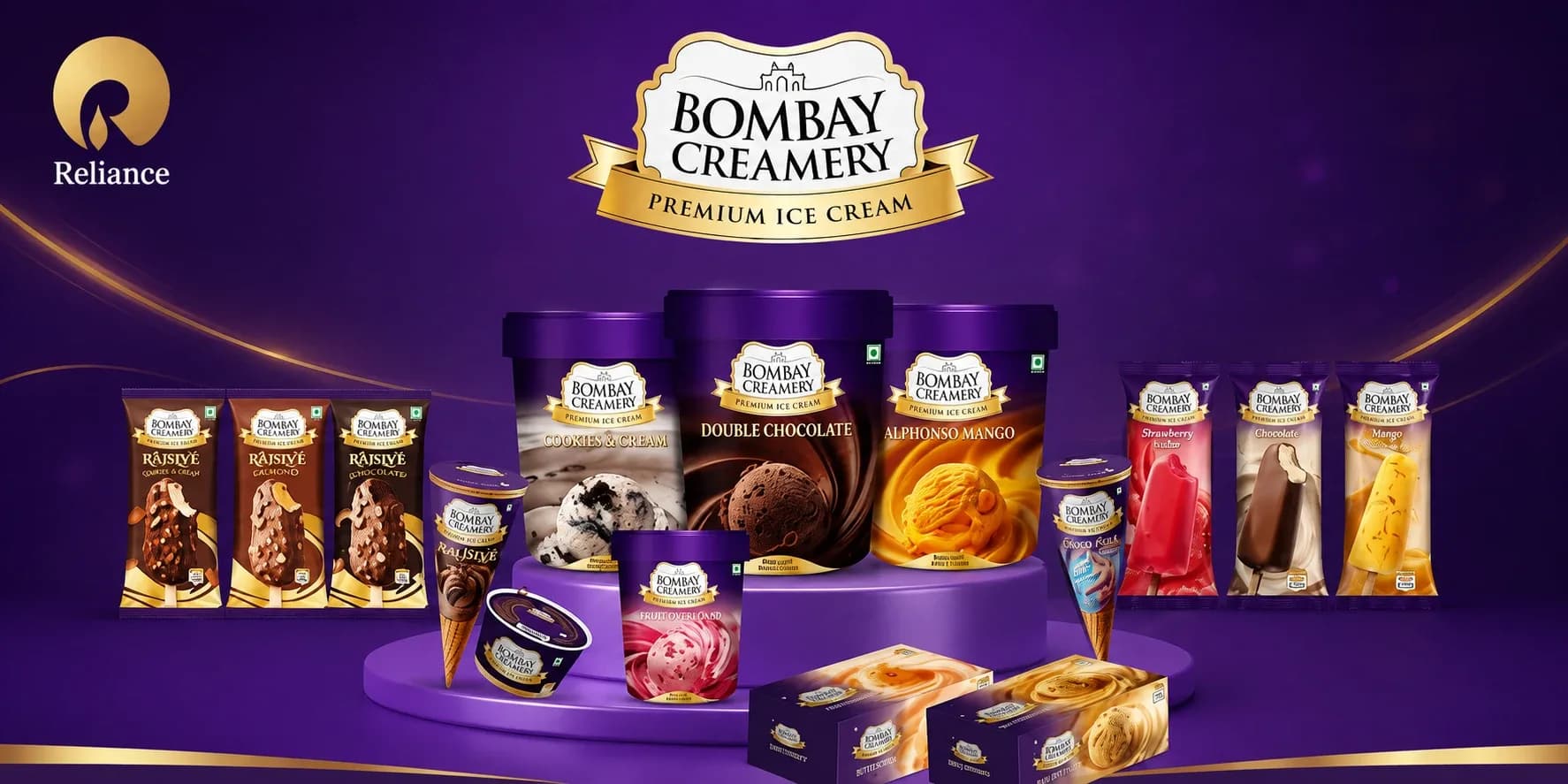
Reliance is making its entry into India’s competitive ice-cream market, with Reliance Consumer Products Ltd (RCPL) launching a new brand, Bombay Creamery, on September 1.
The FMCG arm of Reliance Industries is entering the category with a strategy that combines real dairy cream, multiple product formats and an entry price of ₹10, while initially focusing on Western India before expanding nationwide.
The launch marks RCPL’s formal entry into the ice-cream category and adds another consumer segment to Reliance’s rapidly expanding FMCG portfolio.
Bombay Creamery starts at ₹10
One of the most notable aspects of the launch is the pricing.
Bombay Creamery products will start at ₹10, giving Reliance an entry point into the mass market while positioning the brand as an accessible premium dairy ice-cream brand.
The company says the products are made with real dairy cream and are being built around its broader promise of “Global Quality at Affordable Price.”
The initial range will be available in several formats, including:
Cones
Cups
Tubs
Bars
Sticks
This gives the company room to compete across different consumption occasions and price points.
Western India launch first, pan-India expansion planned
Bombay Creamery is not being launched nationwide immediately.
The brand is initially available in Western India, with RCPL planning to expand it across the country in the next phase.
The Western India launch allows Reliance to establish the brand and distribution network before taking it to other markets.
For an ice-cream business, distribution will be particularly important because the category depends heavily on cold-chain infrastructure, freezer availability and retail reach.
RCPL says Bombay Creamery will be backed by its existing national distribution infrastructure, retail scale and consumer insights.
Reliance wants a slice of India's ice-cream market
The entry puts Reliance in direct competition with established names such as Amul, Kwality Wall’s, Vadilal, Mother Dairy, Havmor and Naturals, among others.
Unlike some FMCG categories, ice cream has a major operational challenge: companies need to maintain the product at the right temperature throughout the supply chain.
That makes distribution and retail infrastructure as important as the product itself.
Reliance, however, enters with an existing FMCG distribution network and a growing consumer-products portfolio, potentially giving Bombay Creamery a significant advantage as it expands.
‘Dairy shouldn't need shortcuts’
T Krishnakumar, Director at Reliance Consumer Products, said the brand has been built around the use of genuine dairy ingredients.
“We built Bombay Creamery around one simple idea that dairy shouldn't need shortcuts,” Krishnakumar said, adding that RCPL was not merely entering the category but was making a long-term commitment to it.
The company has made real dairy cream a central part of Bombay Creamery's positioning.
For consumers, that puts the brand into an increasingly important part of the ice-cream market, where dairy content, ingredients and premium positioning are becoming stronger selling points.
This isn't Reliance's first attempt at the category
Although the Bombay Creamery launch is new, Reliance's interest in ice cream goes back several years.
RCPL had reportedly been exploring the category since 2023, including discussions with a Gujarat-based manufacturer for a proposed brand tentatively associated with the name Independence.
The company subsequently registered the Bombay Creamery trademark in September 2025. The trademark application covered Class 30 products including ice cream, confectionery, biscuits, chocolates and wafers.
The trademark filing indicates that the brand had been under development well before today's formal launch.
Why ₹10 could matter
Reliance's entry-level pricing is likely to attract attention in an already crowded market.
The ₹10 price point allows Bombay Creamery to target price-sensitive consumers while its wider range of cones, cups, tubs, bars and sticks gives the company an opportunity to move into higher price points.
This approach is consistent with Reliance's broader consumer-products strategy of entering established categories with competitive pricing and using its distribution reach to scale quickly.
Reuters noted that Reliance has previously disrupted consumer categories through aggressive pricing, including the relaunch of Campa in the carbonated beverage market.
Whether the same strategy will work in ice cream remains to be seen, particularly because cold-chain infrastructure creates a different set of cost and distribution challenges.
A crowded market awaits
Bombay Creamery is entering a market where consumers already have a wide range of choices.
Amul has a particularly strong presence across India, while brands such as Vadilal, Mother Dairy, Havmor, Kwality Wall's and Naturals have established positions across different price segments and regions.
Reliance will therefore need more than a low entry price to gain market share.
It will need to build:
Retail availability → freezer presence → distribution → consumer trial → repeat purchases.
The first few months of the Western India launch could provide an indication of how aggressively RCPL plans to scale the brand.
Reliance's wider FMCG push
Bombay Creamery is another piece of Reliance's broader FMCG expansion.
RCPL has been building a portfolio across categories such as beverages, packaged foods, biscuits and other consumer products, with Campa among its most prominent recent launches.
The company's strategy is increasingly focused on using Reliance's retail and distribution ecosystem to challenge established FMCG players.
Ice cream now becomes another category where the company can leverage that infrastructure.
Another Ambani-linked ice-cream venture — but a separate business
There is another interesting development worth distinguishing from Bombay Creamery.
Vantara Creamery, associated with Vantara, the wildlife conservation initiative led by Anant Ambani, launched in Mumbai in May 2026.
However, it is important not to confuse the two.
Bombay Creamery is a product of Reliance Consumer Products, the FMCG arm of Reliance Industries.
Vantara Creamery is a separate venture and is positioned differently, with a more premium and artisanal focus.
The two brands should therefore not be described as part of the same FMCG business.
What comes next?
The immediate focus for Bombay Creamery will be establishing itself in Western India.
The bigger test will come when Reliance takes the brand nationwide.
The company will have to compete against brands that have spent decades building consumer loyalty and distribution networks, while also managing the costs associated with refrigeration and cold-chain logistics.
But Reliance's entry itself is significant.
With a ₹10 starting price, real dairy cream positioning, multiple formats and access to a large distribution network, Bombay Creamery has the ingredients for an aggressive national expansion.
And if Reliance follows the playbook it has used in other FMCG categories, India's ice-cream market could soon see another intense battle over price, distribution and shelf space.
Key Takeaways
Brand: Bombay Creamery
Company: Reliance Consumer Products Ltd
Parent: Reliance Industries Ltd
Launch date: September 1, 2026
Initial market: Western India
Planned expansion: Pan-India
Starting price: ₹10
Formats: Cones, cups, tubs, bars and sticks
Positioning: Accessible premium dairy ice cream
Key ingredient claim: Made with real dairy cream
Distribution: Backed by RCPL's distribution and retail network
Major competitors: Amul, Vadilal, Kwality Wall's, Mother Dairy, Havmor, Naturals and other regional players
The Bottom Line
Reliance's entry is unlikely to remain a small new-brand launch.
Bombay Creamery gives Reliance another opportunity to challenge established FMCG players — this time in India's ice-cream aisle.
The ₹10 starting price could help the brand gain initial consumer trial, but the real battle will be fought through distribution, freezer availability, product quality and repeat purchases.
For India's ice-cream industry, Reliance's arrival could make an already competitive market even more interesting.