
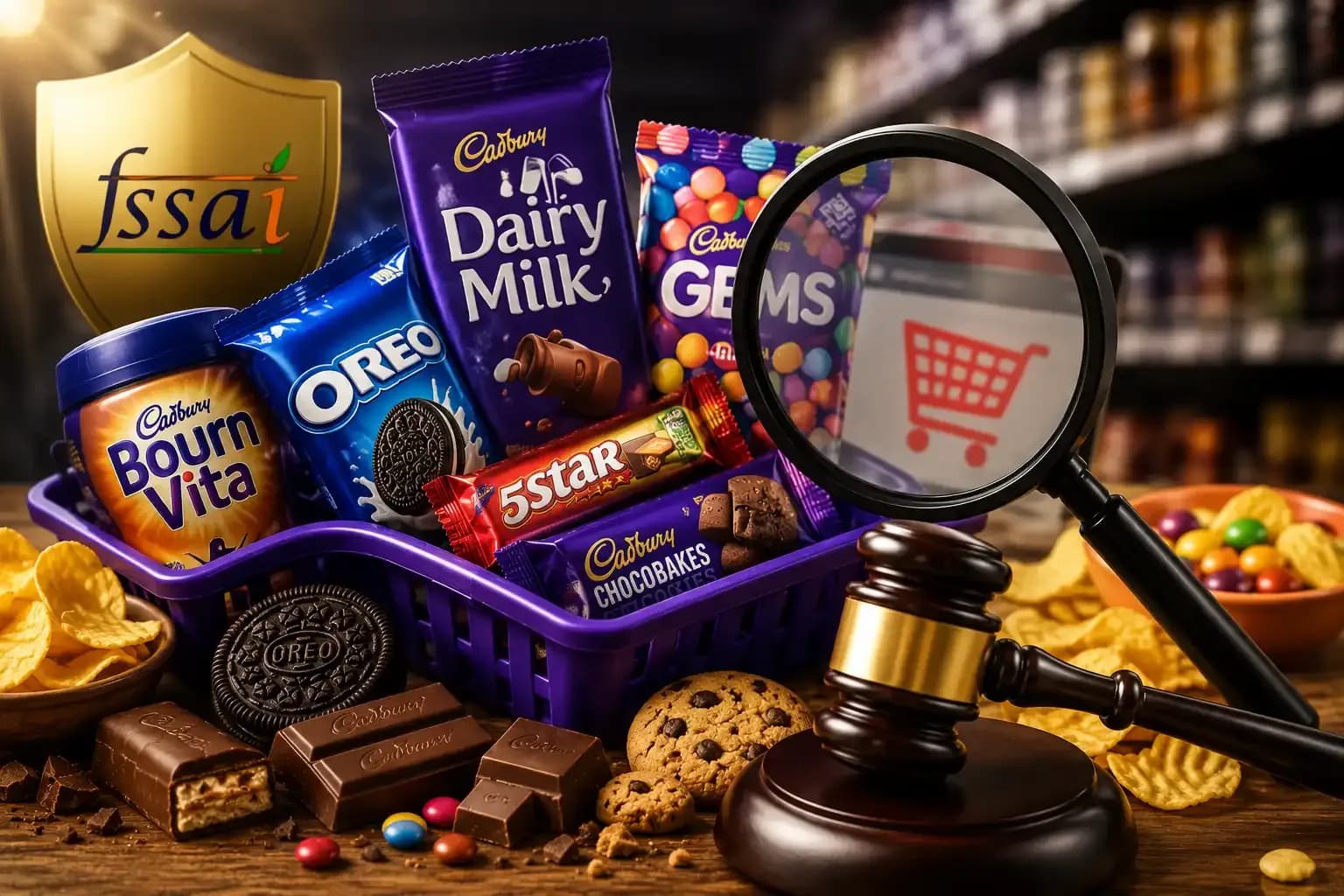
Mondelez India, the company behind some of the country's biggest confectionery and snacking brands, has withdrawn certain health and nutrient comparative claims after receiving a notice from the Food Safety and Standards Authority of India (FSSAI).
The development comes as India's food regulator steps up enforcement against misleading advertisements, unsupported health claims and labelling violations across the food and beverage industry.
According to recent updates on corrective action following FSSAI notices, Mondelez India Foods Pvt. Ltd. withdrew the claims flagged by the regulator and removed related advertisements from e-commerce platforms.
The action puts renewed focus on how packaged-food companies communicate nutritional and health benefits to consumers—particularly on digital marketplaces, where product descriptions and promotional claims can influence purchasing decisions just as much as information printed on packaging.
What did FSSAI flag?
FSSAI's action against Mondelez relates to misleading health claims and nutrient comparative claims associated with its products.
While the regulator's broader enforcement action has been publicly reported, the exact Mondelez product names and the precise wording of every claim cited in the notice have not been publicly disclosed in the reports currently available.
That distinction is important.
The available information does not indicate that FSSAI declared Mondelez products unsafe for consumption or ordered a general recall or ban. Instead, the issue concerns the manner in which certain nutritional or health-related benefits were communicated.
Following the notice, Mondelez took corrective measures, including withdrawing the disputed claims and related advertisements from e-commerce platforms.
Why health claims on food products matter
Food manufacturers increasingly use nutritional and health-related statements to differentiate products in a crowded market.
Claims relating to nutrients, reduced levels of particular ingredients or potential health benefits can influence consumers' perception of a product. However, under India's food advertising and claims regulations, such representations cannot be misleading and must satisfy prescribed conditions.
FSSAI's Food Safety and Standards (Advertising and Claims) Regulations, 2018 require food claims to be truthful, unambiguous, meaningful and not misleading.
Health claims also require appropriate scientific substantiation and must comply with the conditions prescribed under the regulations.
This means companies cannot simply use a nutritional or health benefit as a marketing proposition without ensuring that the claim meets the applicable regulatory requirements.
What are nutrient comparative claims?
The second category highlighted in the Mondelez action is nutrient comparative claims.
These are claims that compare the nutritional composition or energy value of one food with another.
Statements suggesting that a product contains less of a particular nutrient, more of another nutrient or otherwise offers a nutritional advantage over a comparable product can fall within this regulatory framework.
Such claims are subject to specific conditions under FSSAI's regulations.
For consumers, the distinction is significant: a statement that sounds like ordinary advertising may actually constitute a regulated food claim when it makes a nutritional comparison or implies a health benefit.
E-commerce platforms come under the spotlight
One of the more significant aspects of the Mondelez case is the reported removal of the claims and advertisements from e-commerce platforms.
Food advertising is no longer restricted to television commercials, print advertisements or the physical packaging displayed in supermarkets.
Online grocery stores, quick-commerce platforms and marketplaces increasingly act as digital shelves for packaged food products. Product descriptions, promotional banners and nutritional statements displayed alongside products can therefore influence consumers at the point of purchase.
The Mondelez action highlights the growing importance of regulatory compliance across these digital channels.
For food companies, compliance may therefore need to extend beyond the physical label to the entire digital ecosystem through which a product is marketed and sold.
Part of a wider FSSAI enforcement drive
The Mondelez action is not an isolated regulatory development.
FSSAI recently said it had issued more than 150 notices to food and beverage companies over alleged misleading advertisements, false claims and labelling-related non-compliance.
The companies named in reports on the enforcement drive include major domestic and multinational food and beverage businesses such as Nestlé India, PepsiCo, Abbott India, Red Bull India, Danone India, Monster Energy, Hell Energy, Mondelez India, Coca-Cola India, Diageo, Pernod Ricard, Ferrero India and Kenvue.
FSSAI has also taken action involving e-commerce companies and food-service businesses, underlining the regulator's broader focus on how food products and services are represented to consumers.
The scale of the exercise signals that scrutiny of food advertising and claims is becoming a much more prominent compliance issue for the industry.
This does not mean Mondelez products were declared unsafe
For consumers, one distinction is particularly important.
The FSSAI notice and subsequent corrective action should not automatically be interpreted as a finding that Mondelez products are unsafe or that the company has admitted its products are unhealthy.
The reported issue concerns specific health and nutrient comparative claims and their compliance with food advertising and claims regulations.
A regulatory objection to a claim is different from a food-safety finding against the underlying product.
Unless FSSAI separately announces a product recall, safety violation or prohibition, consumers should not interpret the withdrawal of a marketing claim as equivalent to a product ban.
The Bournvita connection needs caution
The latest action may inevitably bring earlier scrutiny of Mondelez's Bournvita marketing into the conversation.
In 2023, Bournvita came under public and regulatory scrutiny following questions over its sugar content and health positioning. The National Commission for Protection of Child Rights subsequently sought action over allegedly misleading advertising and labelling.
However, the current FSSAI action should not be presented as a continuation of that specific case unless the regulator confirms a direct connection.
The present action concerns health and nutrient comparative claims and is part of FSSAI's wider enforcement exercise.
What consumers should look for
The development offers a useful reminder for consumers navigating an increasingly crowded packaged-food market.
Marketing language such as "high in", "source of", "reduced", "less" or other health and nutritional statements should not be viewed in isolation.
Consumers should also check:
The complete nutrition information panel
Ingredient lists
Serving sizes
Added sugar and total sugar levels
Fat, saturated fat and sodium content
The actual quantity of the nutrient being highlighted
Whether the nutritional claim is relevant to the amount normally consumed
The broader lesson is simple: a health-related statement on a food package or online product page is a claim—not necessarily a guarantee of overall healthfulness.
Why the Mondelez action matters to the FMCG industry
For India's packaged-food sector, the development could have implications well beyond Mondelez.
Large FMCG companies increasingly compete through claims around nutrition, reformulation and product benefits. As consumers become more health-conscious, such claims have become an increasingly important part of food marketing.
At the same time, regulators are demanding greater substantiation and transparency.
The latest FSSAI action therefore sends a clear signal to the industry: food companies need to scrutinise not only their products, but also the exact language used to sell those products.
That scrutiny is likely to become even more important as food brands increasingly rely on digital commerce and quick-commerce platforms.
The bigger question: how much can food marketing promise?
The Mondelez case arrives amid a broader debate over food labelling and consumer protection in India, including discussions around how nutritional information should be presented on packaged foods.
For regulators, the challenge is to ensure that consumers receive accurate and meaningful information without creating unnecessary confusion.
For food companies, the challenge is equally clear: communicate product benefits without crossing the line between persuasive marketing and a claim that consumers could reasonably interpret as a health assurance.
For consumers, the episode reinforces an increasingly important rule of packaged-food shopping—read beyond the headline claim.
Mondelez's withdrawal of the flagged claims represents corrective action following the FSSAI notice. The development also demonstrates that the regulator's current enforcement campaign is moving beyond traditional advertising and physical labels to digital product listings.
The larger significance of the action will depend on how FSSAI continues its enforcement drive and whether further details emerge about the specific Mondelez products and claims involved.
For now, the message to India's packaged-food industry is unmistakable: health and nutrition claims are facing closer regulatory scrutiny, and digital platforms are firmly within that compliance spotlight.