
For years, the formula for a successful pub was relatively straightforward: good food, a strong drinks menu, music, ambience and a location that could pull in enough customers.
But that formula is changing.
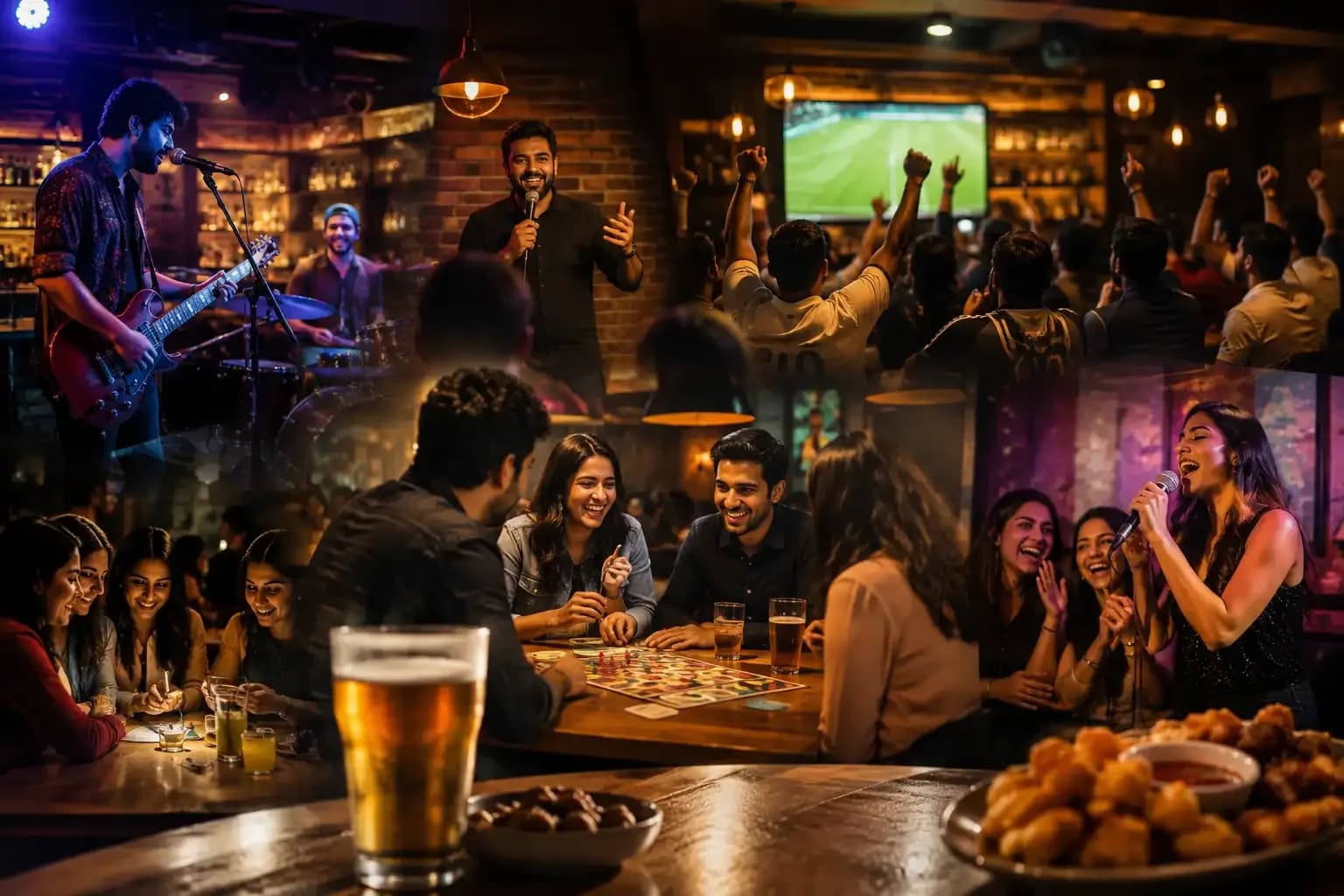
Across India’s hospitality market, pubs, breweries and bar-led restaurants are increasingly giving customers another reason to walk through the door — not simply to eat or drink, but to do something.
A quiz night. A comedy show. Live music. Karaoke. Board games. A sports screening. A workshop. A community gathering. A themed evening. Even networking or dating events.
The shift may look like a simple change in programming. But underneath it is a much bigger change in how the on-premise food and beverage business is trying to win customers.
The pub is increasingly becoming an experience business.
And the question for the industry is no longer just how good the food or drinks are.
It is: What is the reason for a customer to come here tonight?
From a place to consume to a place to participate
The traditional restaurant model was largely consumption-led.
Customers arrived, ordered food and beverages, spent some time at the table and left.
Pubs added music and atmosphere to the equation, but the basic proposition remained similar.
The newer model is different.
The venue itself becomes part of the entertainment.
A customer may arrive because there is a quiz at 8 pm. Another may come because a favourite band is performing. Someone else may book a table for a board-game evening, a comedy show or a themed event.
The food and drinks remain important, but they are no longer necessarily the only reason for the visit.
That distinction matters.
The industry is increasingly competing not just for consumers' food-and-beverage budgets, but for their leisure time.
And that is a much larger battlefield.
The economics of giving people a reason to go out
The timing of this shift is particularly interesting.
Consumers are becoming more selective about going out, while venues face the constant challenge of generating enough footfall across the week.
NIQ's 2026 research on India's on-premise market says nearly seven in 10 Indian consumers visit restaurants, cafés and bars at least once a quarter. More importantly, the research separates consumption into food-led, drink-led and event-led occasions, highlighting how different occasions can drive spending across the on-premise channel.
That means a pub does not necessarily have to wait for Friday evening to attract customers.
It can create its own occasion.
A Wednesday quiz can turn an otherwise ordinary weekday into an outing.
A Thursday comedy night can create a reason for a group to meet.
A weekend workshop can bring a different audience into the venue during the afternoon.
A live sports screening can turn a match into a group occasion.
The strategy is simple in theory:
Don't wait for demand. Create an occasion around which demand can form.
Weekdays may be the bigger opportunity
For many pubs and restaurants, the biggest challenge isn't necessarily getting customers on a Saturday night.
It is filling tables on the days when consumers have fewer reasons to go out.
This is where event-led programming can become particularly useful.
Instead of positioning Monday to Thursday as slow days, operators can give each day a distinct identity.
A weekly quiz can build a recurring audience.
A comedy night can attract a different group.
A live-music evening can bring another.
Over time, the venue can begin to develop something that a conventional restaurant may find difficult to replicate: habit.
Customers don't simply remember the restaurant.
They remember:
“Wednesday is quiz night.”
That is a very different kind of brand recall.
Doolally shows what this model can look like
One example is Doolally, whose taprooms in Mumbai, Pune and Goa position themselves around more than beer and food.
The brand describes its taprooms as spaces featuring beer, food, pets and board games, while its events calendar has included quizzes, workshops, board-game sessions and other community-oriented activities.
Its event listings illustrate just how broad the proposition can become — from pub quizzes and board games to art, craft and other workshops.
The important point isn't any individual event.
It is the underlying business model.
The venue can potentially serve different consumer occasions at different times of the day and week.
A customer might come for beer.
Another might come for a workshop.
Another might come because friends invited them to a quiz.
But all three occasions can eventually lead back to the same physical venue.
The rise of the experience economy is helping
This transformation is not happening in isolation.
India's wider events and experiences economy is expanding rapidly.
The Ministry of Information and Broadcasting said India's organised live-events sector was valued at around ₹14,500 crore in 2025 and described it as the fastest-growing segment of the country's media and entertainment sector.
A separate 2026 KPMG assessment estimates India's organised live-events segment at approximately ₹13,600 crore, while putting the broader organised MICE activity at about ₹46,739 crore and the commercial sports economy at around ₹18,864 crore, based on 2025 estimates. KPMG also found that event-related spending creates wider economic activity across sectors including hospitality, tourism, transport, retail and technology.
And the growth is attracting serious capital.
In August 2026, KKR agreed to acquire a minority stake in BookMyShow in a deal reported at $40 million-$50 million, amid growing investor interest in India's live-entertainment market.
For pubs, this creates an interesting opportunity.
They don't need to compete with a large concert or festival.
They can borrow the same underlying consumer psychology at a much smaller scale:
Give people an experience worth leaving home for.
Consumers are looking for more than a table
There is another important change taking place.
Going out is becoming more intentional.
NIQ's 2026 research on high-tempo occasions found that 61% of consumers are seeking new types of experiences when they go out, while 60% are visiting different types of venues compared with the previous year. At the same time, rising costs are making consumers more conscious about the value they receive from a night out.
That combination is particularly important.
Consumers may be going out less casually, but when they do decide to spend, they increasingly want the outing to feel worthwhile.
That could mean better food.
Better drinks.
A special ambience.
Or simply an experience they cannot get by staying at home.
In other words, consumers may increasingly be asking:
“What am I getting for my evening?”
rather than simply:
“Where should I eat?”
Pubs have one advantage: flexibility
This is perhaps why pubs are particularly well positioned for the experience-led model.
A traditional fine-dining restaurant has a relatively fixed proposition.
A pub can transform its atmosphere depending on the occasion.
The same venue can be:
A sports bar during a major match
A comedy venue on Thursday
A live-music space on Friday
A party destination on Saturday
A brunch venue on Sunday
A quiz or community space during the week
The physical infrastructure remains largely the same.
But the occasion changes.
That gives operators an opportunity to extract more value from the same real estate.
The new competition is not just another pub
This shift also changes the competitive landscape.
A pub is no longer competing only with the restaurant next door.
It is competing with:
Cinemas
Concerts
Comedy clubs
Gaming venues
Cafés
Food halls
Sporting venues
Community spaces
At-home entertainment
Streaming platforms
Social-media-driven experiences
That is why the experience component matters.
A customer can order food at home.
They can watch a match at home.
They can listen to music at home.
They can watch comedy online.
But they cannot replicate the feeling of being in a room with 100 people reacting to the same event.
That collective experience is what the physical venue is selling.
But there is a catch: experiences cost money
The experience-led model is not automatically more profitable.
Every event has an economics behind it.
A comedy night could involve performer fees.
Live music requires artists, sound and production.
Workshops require facilitators and materials.
Sports screenings require screens, infrastructure and licensing considerations.
The venue may also spend more on marketing, staff and event management.
And if an event attracts customers who spend very little, the additional footfall may not translate into attractive margins.
This is where the industry's next challenge lies.
Footfall alone is not the metric that matters.
Operators need to understand whether an event increases:
Covers
Average order value
Table utilisation
Dwell time
Repeat visits
Weekday sales
Customer acquisition
Customer lifetime value
A packed event that produces weak spending may look impressive on Instagram but may not necessarily make good business sense.
The smartest pubs may treat events as customer acquisition
There is another way to look at it.
An event does not necessarily have to make money directly.
It can function as a customer-acquisition channel.
Imagine someone discovers a pub because of a quiz night.
They come once.
They enjoy the food.
They like the ambience.
They follow the venue on Instagram.
They return with colleagues the following week.
Then they bring friends for dinner.
The original event may have been the entry point, while the restaurant relationship becomes the longer-term value.
This is where experiential programming becomes more than entertainment.
It becomes marketing.
Social media makes the model even more powerful
There is also a content advantage.
A normal dinner is difficult for a restaurant to turn into a memorable digital story.
An unusual event is different.
A packed quiz.
A comedian performing to a crowd.
A dramatic sports screening.
A themed party.
People participating in a workshop.
These moments naturally generate photographs, videos, Stories and Reels.
The customer becomes part of the marketing engine.
And that matters at a time when discovery is increasingly digital.
NIQ's research says 55% of consumers use Google to identify destinations for high-tempo occasions, while 31% use social media and 26% use AI tools. Recommendations from friends and family remain important as well, at 51%.
That makes discoverability part of the business model.
A venue with something interesting happening has more opportunities to be talked about, searched for and shared.
The pub is becoming a community platform
Perhaps the biggest change is psychological.
A successful pub increasingly wants customers to feel that they belong there.
The quiz team that returns every Wednesday.
The group that attends every live-music night.
The people who come for board games.
The regulars who meet for sports screenings.
The creative community that attends workshops.
These aren't just transactions.
They are communities.
And communities can be valuable because they create repeat behaviour that conventional advertising cannot easily manufacture.
The venue becomes familiar.
The staff know the customers.
Customers know other customers.
The experience becomes part of their social routine.
That is considerably harder for a competitor to steal than a menu item.
But not every pub needs to become an entertainment centre
There is a danger in chasing the trend too aggressively.
If every pub starts offering a quiz, karaoke, comedy night, DJ and workshop, the experience itself can become commoditised.
Consumers may eventually ask:
“What makes this experience different?”
The answer cannot simply be “we also have events.”
The strongest operators are likely to build experiences that fit their brand.
A craft brewery may build around beer education, community and games.
A sports-focused pub can own match-day experiences.
A premium cocktail bar can create intimate tastings and masterclasses.
A neighbourhood pub can build a loyal local community.
A large chain can use scale to create recurring formats across cities.
The objective isn't to offer everything.
It is to own a particular occasion.
The next battle may be for the consumer's calendar
This is where the pub industry could be heading.
Restaurants traditionally fought for the consumer's meal.
Pubs fought for the consumer's night out.
Experience-led venues are increasingly fighting for something broader:
the consumer's calendar.
If a pub can give customers a reason to visit every week, it becomes part of their routine rather than an occasional choice.
And that could be much more valuable than simply adding another dish or another cocktail to the menu.
The future pub may therefore look less like a place where people simply consume food and alcohol and more like a place where they consume experiences, relationships and occasions — with food and drinks around them.
The real question for India's pub industry
The transformation doesn't mean food and beverages are becoming irrelevant.
Quite the opposite.
Food and drinks remain the economic foundation of most hospitality businesses.
But the role they play may be changing.
The experience gets the customer through the door.
The food and beverage proposition determines how much they spend.
The service determines whether they return.
And the community determines whether they become a regular.
That creates a new equation for the industry:
Experience → Footfall → Spending → Repeat Visits → Community
The pubs that understand this equation could have an advantage over those still relying solely on Friday-night traffic.
Because in an increasingly competitive hospitality market, the hardest question may no longer be:
“What should we put on the menu?”
It may be:
“Why should anyone leave home and come to us tonight?”
And increasingly, India's pubs seem to be answering that question with something that cannot be delivered in a takeaway box: an experience.