

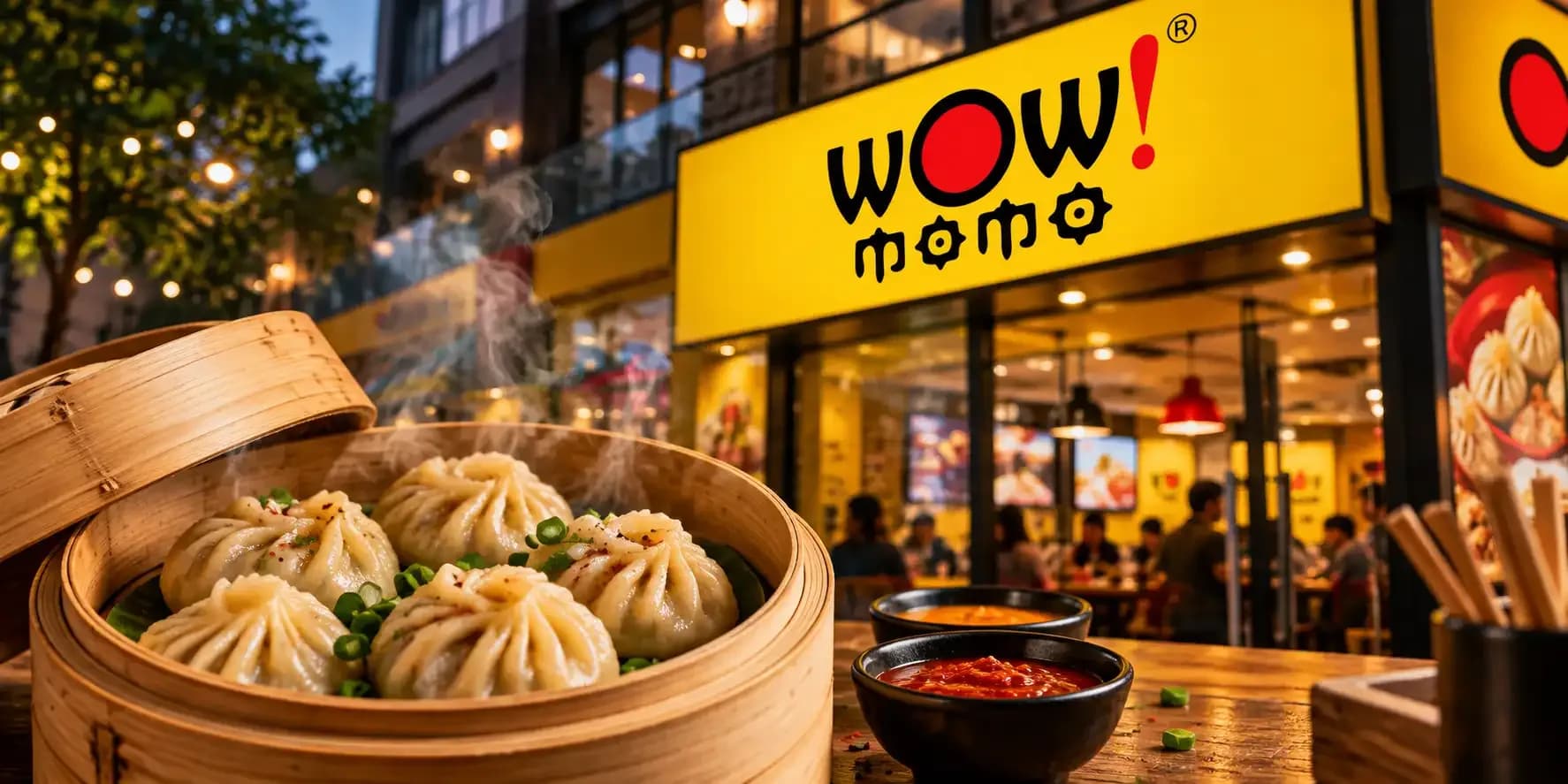
India’s momo market has grown from a niche Himalayan and Tibetan food into a nationwide street-food phenomenon. Industry estimates put the market at more than ₹30,000 crore a year, but over 90% of that business is still unorganised. Wow! Momo has emerged as the dominant organised national chain, while players such as Momo Nation Cafe, Momo Magic Cafe and Zomoz are building regional networks. So why has India not produced a second national momo giant yet?
Walk through almost any Indian city today and there is a good chance that momos are somewhere nearby.
They are being steamed at roadside carts, fried in small neighbourhood shops, delivered from cloud kitchens, sold in malls, served by QSR chains and increasingly pulled out of freezers at home.
The transformation has been remarkable.
Once associated primarily with Tibetan and Nepali communities and a handful of eateries in Delhi and Kolkata, momos have become one of India's most accessible street-food products.
But the country's momo story has an unusual business twist.
India has a huge momo market, but very few large momo companies.
Industry estimates cited by Mint put India's annual momo market at more than ₹30,000 crore. Yet more than 90% of that market is estimated to be served by small kiosks, roadside vendors and other informal operators. The organised segment—including QSRs, restaurants, B2B suppliers and frozen/FMCG businesses—is estimated at only around ₹3,000 crore.
That leaves a striking question:
If Indians are already spending tens of thousands of crores on momos, why has only one brand managed to build a truly national momo empire?
The answer lies in the economics of the category.
How big is India's momo market?
The most frequently cited recent estimate comes from industry reporting published by Mint in February 2025.
According to estimates from food-industry insiders, India's momo market is worth more than ₹30,000 crore annually.
Wow! Momo co-founder and CEO Sagar Daryani put the organised portion at approximately ₹3,000 crore, with the informal market at least ten times larger. That means more than 90% of momo consumption remains outside organised chains.
India momo market | Estimated size |
|---|---|
Total momo market | ₹30,000+ crore |
Organised market | ~₹3,000 crore |
Informal/unorganised market | ~₹27,000+ crore |
Informal share | 90%+ |
These numbers need an important caveat: ₹30,000 crore is an industry estimate, not an official government or audited market-size figure. There is also no single publicly available source that establishes a definitive India-only momo CAGR.
Still, the direction of the market is difficult to ignore.
The product has moved from street food to organised QSRs, frozen food, quick commerce and modern retail.
Who is the biggest momo player in India?
The clear leader in India's organised momo QSR market is Wow! Momo.
Founded in Kolkata, the company has spent years building what is arguably the country's most ambitious attempt to turn momos into a national QSR category.
And the company's expansion has accelerated.
In FY26, Wow! Momo Foods opened 200 stores, its highest annual addition to date. By April 2026, it had crossed 850 outlets across more than 90 cities. The company said it plans to add another 150–200 stores in FY27, with greater emphasis on Tier-II and Tier-III cities.
That is a remarkable footprint for a business built around a single food category.
The company is targeting ₹1,200 crore in revenue by 2027.
Its portfolio has also expanded beyond momos into brands such as Wow! China, Wow! Chicken and Wow! Kulfi.
So, increasingly, Wow! Momo is not simply a momo company.
It is trying to become a broader Indian QSR platform.
Wow! Momo's scale is its biggest advantage
Wow! Momo's competitive advantage isn't simply its recipe.
Momos themselves are relatively easy to reproduce.
A local operator can start with a steamer, basic ingredients and a small shop.
The difficult part is doing the same thing across hundreds of locations without losing consistency.
That is where scale becomes important.
In 2025, Mint reported that Wow! Momo was selling more than 1.2 million pieces a day across its network, including frozen products sold through retail and quick-commerce channels. At that point, the company had four manufacturing facilities and was developing a Taloja plant designed for capacity of up to 1.5 million pieces a day.
This changes the economics.
A small momo shop competes on:
price + location + taste.
A national chain must compete on:
procurement + manufacturing + logistics + consistency + branding + technology + real estate + marketing + distribution.
That infrastructure is considerably harder to copy.
The surprising competitors: Momo Nation Cafe and Momo Magic Cafe
It would be wrong to say that Wow! Momo has no competition.
There are several organised chains trying to build national or regional scale.
Momo Nation Cafe
Momo Nation Cafe currently claims 130+ outlets across 50+ cities and 15+ states, with more than 12,000 daily customers.
Its franchise strategy is particularly aggressive.
The company offers multiple formats, including express outlets, kiosks, cloud kitchens, dine-in stores and larger diner formats. Its smallest listed format requires approximately 150 sq ft, with investment starting at ₹6 lakh.
That model illustrates one of the fundamental advantages of the momo business:
Momos can be sold from very small footprints.
A business does not necessarily need a large restaurant to participate in the category.
Momo Magic Cafe
Momo Magic Cafe is another significant organised player.
The company currently lists 135 outlets across 23 states, with locations spanning Bihar, Jharkhand, Assam, Maharashtra, Karnataka, Uttar Pradesh, West Bengal, Gujarat, Rajasthan, Tamil Nadu and several other markets.
Its footprint is particularly notable because it demonstrates how regional momo chains can build meaningful scale without becoming household names nationally.
Zomoz is taking a different route
Hyderabad-based Zomoz has built another interesting model around momos and baos.
In June 2025, Zomoz said it operated 72 outlets across Telangana, Karnataka, Tamil Nadu and Maharashtra after turning profitable and raising ₹5 crore in a bridge round.
The company said it intended to use the funding to reach 100 outlets, particularly across Tier-II cities.
Zomoz also claims to use automated manufacturing technology and has been experimenting with technology-led production.
Its strategy is significant because it shows that the next generation of momo companies may not necessarily follow Wow! Momo's exact playbook.
They could instead focus on:
asset-light outlets
cloud kitchens
automation
regional expansion
franchise models
Tier-II and Tier-III cities
The real competitor isn't another momo chain
Here is where India's momo market becomes particularly interesting.
Wow! Momo's biggest competitor may not be Momo Nation Cafe, Momo Magic Cafe or Zomoz.
It may be the neighbourhood momo seller.
The reason is price.
Industry reporting has found B2B momo manufacturers supplying local outlets for as little as ₹2–₹7 per piece depending on the filling and customer requirements. Mint reported that around 70 B2B manufacturers were supplying outlets in the NCR alone, while some operators could enter the manufacturing business with less than ₹1 lakh.
This creates an enormous informal ecosystem.
A local operator can sell a plate of momos at a price that a branded QSR may struggle to match.
And consumers don't necessarily demand a premium experience for momos.
For many customers, the decision is simple:
₹70–₹100 at the local stall, or significantly more at a branded chain.
That is one of the biggest structural challenges facing organised momo companies.
Why is it so difficult to build the “second Wow! Momo”?
1. The entry barrier is low—but the scaling barrier is high
Starting a momo business is relatively easy.
Scaling one is not.
Anyone can make momos.
Far fewer companies can manufacture millions of pieces, maintain food-safety standards, manage cold chains, supply hundreds of outlets and maintain consistent taste across dozens of cities.
That creates an unusual market structure.
Low barrier to entry.High barrier to organised scale.
2. India's informal market is simply too large
More than 90% of the momo market is estimated to remain informal.
That means a challenger isn't simply competing with one established chain.
It is competing with thousands of local businesses that have:
low rent
low labour costs
small teams
flexible menus
local taste knowledge
low prices
strong neighbourhood relationships
This is why formalising the category is such a difficult proposition.
3. Momo consumers are extremely price-sensitive
The momo was born as an affordable food.
That creates a ceiling on how much consumers may be willing to pay.
The challenge for organised chains is therefore not just to sell better momos.
It is to convince customers that the additional money buys something valuable:
hygiene, consistency, ambience, convenience, variety, brand trust and experience.
Wow! Momo has attempted to solve this by moving the category into malls, high streets, food courts and delivery platforms.
4. Momos are not a complete meal for every consumer
This is another important difference from pizza or burgers.
A pizza chain can build an entire meal around pizza.
A momo chain often has to expand its menu to increase average order value.
That explains why the leading organised companies are increasingly moving beyond momos.
Wow! Momo has added Chinese food, chicken, desserts and other products.
The strategy is straightforward:
Use momos to bring the customer in.Use the wider menu to increase the basket size.
The next battle may be in frozen momos
There is another market developing alongside QSRs: frozen momos and ready-to-cook foods.
And this is where the competitive landscape gets much more interesting.
Prasuma launched its flagship frozen momos in 2019 and has built a substantial business around frozen and ready-to-cook food.
In 2025, ITC announced an agreement to acquire 100% of Prasuma over three years, beginning with an upfront 43.8% stake. ITC said the broader frozen, chilled and ready-to-cook foods industry in India was already worth more than ₹10,000 crore and expected to grow rapidly.
Prasuma had also built Prasuma Momo Kitchen, with 40 cloud kitchens, and had reached an annual revenue run-rate of around ₹200 crore at the time of the acquisition announcement.
This is strategically important.
Because the momo market is no longer just about restaurants.
It is increasingly about:
restaurants + frozen foods + quick commerce + modern retail + home consumption.
Wow! Momo is moving in the same direction
Wow! Momo has also been aggressively expanding into packaged food.
By early 2026, the company's FMCG business was reportedly generating around ₹100 crore in annual recurring revenue, growing at approximately 100% year-on-year, with products available at around 6,000 retail points.
The company expects FMCG to contribute around 12–15% of its ₹850-crore FY26 revenue target.
This could eventually become one of the most important parts of the story.
The company is effectively trying to move from:
“Where can I eat a Wow! Momo?”
to:
“Where can I buy Wow! Momo?”
That is a much larger addressable market.
Wow! Momo vs Prasuma: the battle is changing
The competitive picture increasingly looks like this:
Company | Core strength | Current scale / position |
|---|---|---|
Wow! Momo | QSR + FMCG | 850+ outlets, 90+ cities |
Momo Nation Cafe | Franchise QSR | 130+ outlets, 50+ cities |
Momo Magic Cafe | Regional QSR/franchise | 135 outlets, 23 states |
Zomoz | QSR + technology | 72 outlets reported in 2025 |
Prasuma | Frozen + ready-to-cook | 100+ cities; ₹200 crore ARR reported at ITC acquisition |
Local momo businesses | Price + proximity | Dominant share of total market |
The numbers are not perfectly comparable because the businesses use different models and report scale differently. But the strategic picture is clear.
Wow! Momo dominates organised QSR scale.Prasuma has strong frozen-food positioning.Regional chains are building local density.And informal sellers still control the overwhelming majority of consumption.
The Domino's comparison is tempting—but imperfect
Wow! Momo's ambition has often been compared with Domino's.
The company has said its goal is to make India a momo-loving nation in the same way Domino's helped build India's modern pizza market.
Reuters reported in 2024 that Wow! Momo was targeting 1,000 stores and looking to replicate the expansion playbook that helped Domino's become a major Indian QSR brand.
But there is one major difference.
Pizza had relatively little direct informal competition at the same scale.
Momos already have it.
In almost every city where a branded momo chain opens, there may already be dozens—or hundreds—of local momo sellers.
That makes the challenge much harder.
Is India's momo market actually growing?
Yes, but the available public data does not support a single definitive India-only CAGR.
What we can observe is strong growth across several parts of the ecosystem.
Wow! Momo said it had been growing at approximately 30–35% in recent years, while Prasuma reported 5x growth in its frozen momo category over the preceding few years.
Wow! Momo's packaged-food business was reported to be growing at approximately 100% year-on-year in 2026.
And the company's physical footprint jumped by 200 stores in FY26, taking the network beyond 850 outlets.
These aren't measures of the entire momo market, but together they show that the category is expanding beyond its traditional street-food base.
What could drive the next phase of momo growth?
Several factors could accelerate the market.
Tier-II and Tier-III cities
The biggest opportunity may lie outside India's metros.
Wow! Momo is explicitly targeting Tier-II and Tier-III markets as it adds another 150–200 stores.
Quick commerce
Frozen momos are particularly suited to quick commerce because they can move from freezer to consumer without requiring restaurant infrastructure.
Modern retail
Packaged momos allow brands to reach consumers who may never visit a branded momo outlet.
Food safety and consistency
As consumers become more conscious of hygiene and ingredient quality, organised brands can potentially capture a premium.
Product innovation
Momos have already moved beyond the traditional steamed chicken or vegetable format.
Fried, pan-fried, cheese-filled, tandoori, sauce-tossed and fusion variants have helped turn the product into a broader QSR proposition.
But there are serious risks
The market's biggest opportunity is also its biggest challenge.
Price competition
Street vendors can remain dramatically cheaper.
Real-estate costs
A national QSR network carries significantly higher fixed costs than a street-side operation.
Delivery economics
Wow! Momo's digital orders reportedly account for around 40% of sales, but the company has also highlighted pressure on delivery margins from commissions, discounts and marketing.
Quality control
The larger the network, the harder it becomes to maintain consistent taste and food-safety standards.
Regional preferences
A momo that works in Kolkata or Delhi may not automatically work in Chennai, Hyderabad or another market.
Brand fatigue
If every chain starts selling dozens of momo variants, differentiation becomes difficult.
So, is Wow! Momo really the only major momo player?
No.
That would be an inaccurate description of the market.
Momo Nation Cafe has more than 130 outlets. Momo Magic Cafe lists 135 outlets across 23 states. Zomoz had 72 outlets in four states as of June 2025.
What makes Wow! Momo different is scale and breadth.
It has crossed 850 outlets, operates in more than 90 cities and has expanded into multiple QSR categories and FMCG.
So the better description is:
Wow! Momo is India's dominant scaled national momo-QSR brand, but it operates in a highly fragmented market with several regional organised competitors and a massive informal sector.
The real question: Who will build the second Wow! Momo?
That may be the most important question for India's momo industry.
The market already has demand.
It already has supply.
It already has consumers.
It already has manufacturing infrastructure.
What it lacks is another company that has successfully combined all of these pieces at national scale.
The first mover has a substantial head start.
But the opportunity remains enormous.
If the industry's ₹30,000-crore estimate is even directionally correct, the organised market is still only a fraction of the total.
That means the biggest opportunity may not be taking customers away from Wow! Momo.
It may be converting India's enormous informal momo economy into organised consumption.
And that is a very different game.
Frequently Asked Questions
How big is India's momo market?
Industry estimates cited by Mint put India's momo market at more than ₹30,000 crore annually. The organised portion is estimated at around ₹3,000 crore, meaning more than 90% remains unorganised.
Who is the biggest momo chain in India?
Wow! Momo is the largest scaled national momo-focused QSR brand in India. As of April 2026, the company had more than 850 outlets across 90+ cities.
Is Wow! Momo the only momo chain in India?
No. Momo Nation Cafe, Momo Magic Cafe, Zomoz and other regional brands also operate organised momo businesses. Momo Nation Cafe and Momo Magic Cafe each report more than 130 outlets.
Who competes with Wow! Momo?
Its organised competitors include Momo Nation Cafe, Momo Magic Cafe, Zomoz and several regional and cloud-kitchen brands. In the wider market, thousands of informal momo sellers represent the largest competitive force.
Is India's momo market growing?
Yes, although there is no single authoritative public India-only CAGR. Wow! Momo has reported 30–35% growth in recent years, while Prasuma has reported 5x growth in its frozen momo category over several years. Wow! Momo's packaged-food business was also reported to be growing around 100% year-on-year in 2026.
Who is the biggest competitor to Wow! Momo?
There isn't one clear answer. In organised QSRs, several regional chains compete with Wow! Momo. But by sheer market share and consumer reach, the biggest competitive force is the informal momo sector, which accounts for more than 90% of the estimated market.
Is Prasuma a competitor to Wow! Momo?
Yes, particularly in frozen and ready-to-cook momos. ITC agreed in 2025 to acquire Prasuma, beginning with a 43.8% stake, giving the frozen momo business access to one of India's largest FMCG distribution platforms.
India's momo story is no longer just about street food.
It is becoming a battle between QSRs, regional chains, frozen-food companies, FMCG giants, quick commerce and thousands of informal entrepreneurs.
Wow! Momo has won the first round by building scale faster than anyone else.
But it has not “won” India's ₹30,000-crore momo market.
More than 90% of that estimated market is still outside organised chains.
And that may be the most important number in the entire story.
Because India's momo revolution may have already produced its first national brand.
What it hasn't produced yet is the second one.