


From Soy to Fermentation to Cultivated Meat: India Is Quietly Building a New Protein Industry
For most of human history, making protein meant growing crops or raising animals. India is now investing in a third option: manufacturing parts of the food system inside controlled biological systems fermentation tanks, bioreactors, engineered microbes. It sounds like science fiction. It is, instead, government policy.
The vehicle is BioE3 Biotechnology for Economy, Environment and Employment a national policy approved in August 2024 that treats biotechnology as an economic engine, not just a health-sciences niche. Within its six thematic areas sits one that touches every Indian dinner plate: Smart Proteins and Functional Foods, run jointly by the Department of Biotechnology (DBT) and its industry arm, BIRAC.
This is not a single splashy announcement. It's closer to plumbing calls for research proposals, funding tranches, new facilities the unglamorous infrastructure that decides whether a lab discovery ever reaches a supermarket shelf.
What "Smart Protein" Actually Means
The phrase gets used loosely, so it's worth unpacking. DBT's own programme documents group several distinct technologies under it: plant-based proteins (soy, pulses, pea protein), fermentation-derived proteins (microorganisms producing proteins or ingredients), precision fermentation (microbes engineered to churn out a specific target molecule, like a milk protein), mycoprotein (fungal biomass), single-cell protein, cultivated meat (animal cells grown outside the animal), and animal-free dairy.
These are not interchangeable. Plant-based protein is decades-old technology already sold in supermarkets. Cultivated meat, by contrast, remains largely experimental in India, with no commercial product yet approved for sale. Lumping them together as headlines about "lab-grown meat" often do misses the more interesting story: India is trying to build capability across an entire spectrum of production methods at once.
Farm, Meet Fermenter
The conceptual shift is simple even if the biology isn't. Traditional protein production runs:
animals or crops → farms → processing → food. The emerging alternative runs: microorganisms or cells → fermentation or bioreactor → processing → food.
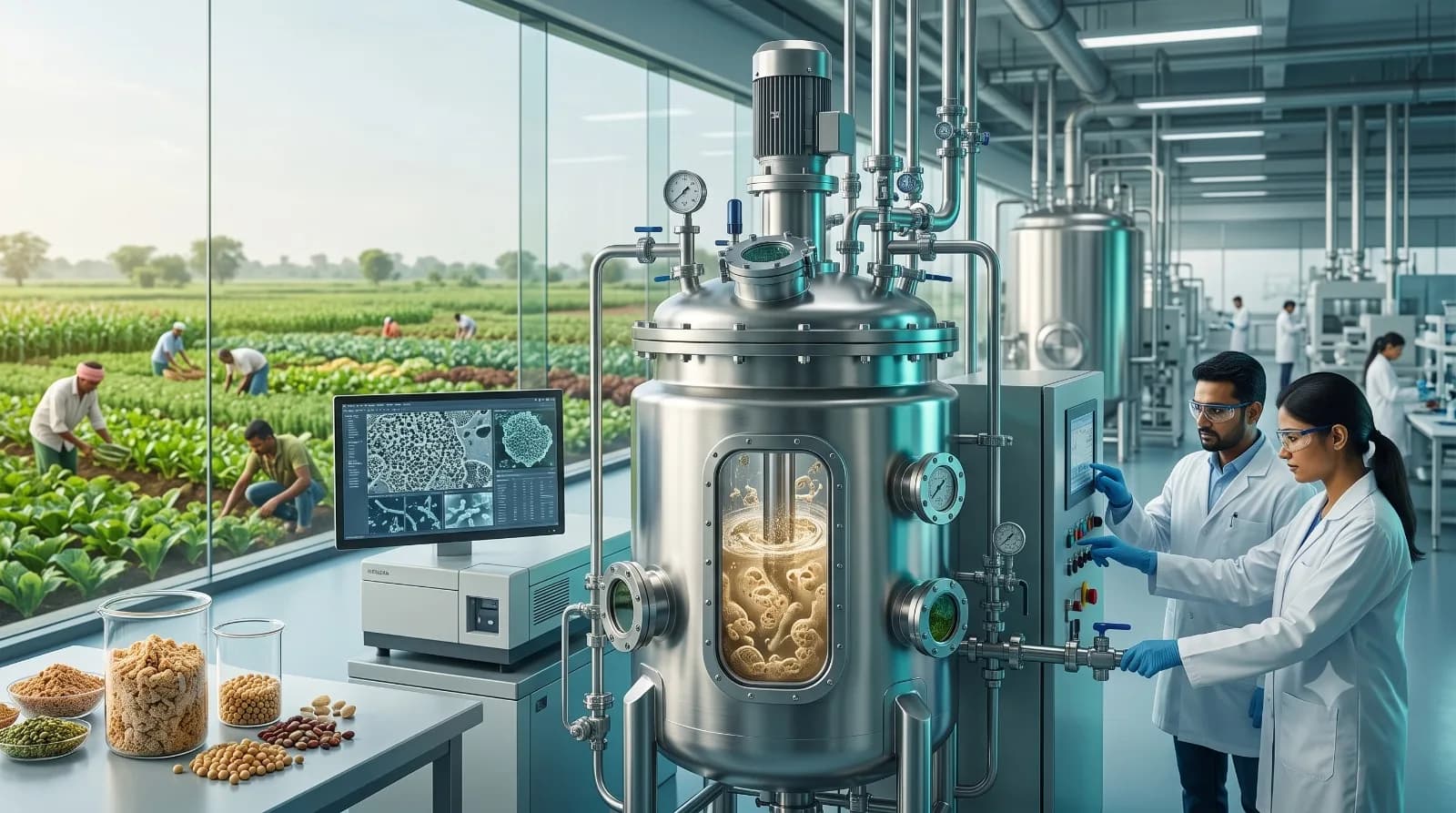
Instead of a field and a season, the "harvest" happens in a steel tank under controlled temperature and pH.
DBT and BIRAC's joint calls for proposals under this programme specifically fund work across that pipeline from early discovery research (technology readiness levels 3–5, in scientific shorthand) through to "bridging the gap" for scale-up (TRL 5–7), the stage where a lab-bench process has to survive being turned into an industrial one.
Why India Wants This
The case rests on a few converging pressures rather than one silver-bullet argument. India's population and rising incomes are pushing protein demand up. Nutrition surveys cited by industry groups suggest a large share of Indian adults fall short on protein intake. Meanwhile, conventional livestock farming carries real land, water and feed costs, and India still imports certain protein ingredients and dairy-adjacent inputs it would rather manufacture domestically.
That doesn't make fermentation-derived protein automatically "greener." Its actual footprint depends on the energy source powering the bioreactor, what feedstock the microbes are fed, and how efficiently the process runs at scale variables that differ from one facility to the next. DBT's own framing leans on efficiency arguments reduced land and water intensity relative to conventional systems but those gains are technology- and scale-dependent, not guaranteed.
From Policy to Pilot Plant
A handful of concrete moves show the policy edging into implementation. A BioFoundry Centre under DBT is being built at Mohali with a roughly ₹42-crore government investment, aimed explicitly at bridging lab research and industrial-scale alternative-protein production. Bengaluru got two dedicated facilities in 2024 an incubation hub and a scale-up centre for alternative proteins. The National Institute of Animal Biotechnology in Hyderabad opened India's first animal stem-cell biobank, a resource relevant to cultivated-meat research.
On the private side, Pune-based Praj Industries opened an AI-enabled precision-fermentation lab and signed a government MoU to help commercialise the technology. IIT Delhi-linked startup StrainX Bioworks raised $13 million this year to bring precision-fermented proteins to market. Biokraft Foods has held India's first public tasting of cultivated chicken, though it remains in pre-seed funding and pilot-facility stages, not commercial retail. None of these are mass-market products yet they are markers of a pipeline in motion, not its finish line.
The Manufacturing Problem
This is where the story gets genuinely difficult. Discovering that a microbe can produce a target protein in a flask is not the same as producing it cheaply, safely and consistently at industrial volume. The path runs from lab discovery to pilot production, to fermentation or bioreactor scale-up, through downstream processing and food formulation, past regulatory approval, and only then into commercial manufacturing and consumer adoption. Each step can fail independently a process that works beautifully at one litre often behaves unpredictably at ten thousand.
Cost is the recurring obstacle industry voices point to: getting these proteins to price parity with conventional alternatives, not just technical parity, is what actually determines whether they reach ordinary kitchens rather than premium niche shelves.
Regulation, Trust and Taste
India's food regulator, FSSAI, classifies cultivated and certain fermentation-derived proteins as "novel foods" products without a history of consumption in the country, requiring specific safety review before sale. A dedicated working group on cultured meat was set up in 2020, but as of recent industry reporting, no commercial cultivated-meat or biomass-fermentation protein has yet received approval to sell in India. Consumer trust, price and taste will matter just as much as regulatory sign-off; a technically approved product that tastes wrong or costs too much simply won't sell.
What About Farmers?
The more useful framing isn't "bioreactors versus farms" it's how the two might interlock. Smart-protein research explicitly includes valorising agro-residues, meaning crop waste could become fermentation feedstock rather than being burned or discarded. Plant-based protein platforms still need soy, pulses and legumes grown by farmers, potentially expanding demand for those crops. And fermentation and bioreactor facilities need staff, technicians and supply chains new categories of food-manufacturing jobs rather than a wholesale replacement of agricultural ones.
India's protein factory of the future may not resemble a factory at all in the traditional sense more likely a mix of fermentation tanks, bioreactors and microbial cultures managed with the same precision as a pharmaceutical plant. Whether that future arrives as a meaningful share of what Indians eat, or stays confined to niche premium products and export markets, depends on unglamorous execution: scale-up economics, regulatory clarity and whether these proteins can actually taste, cost and feel like food people already trust. India isn't just trying to invent the food of the future it has started laying the groundwork that could eventually build it.