
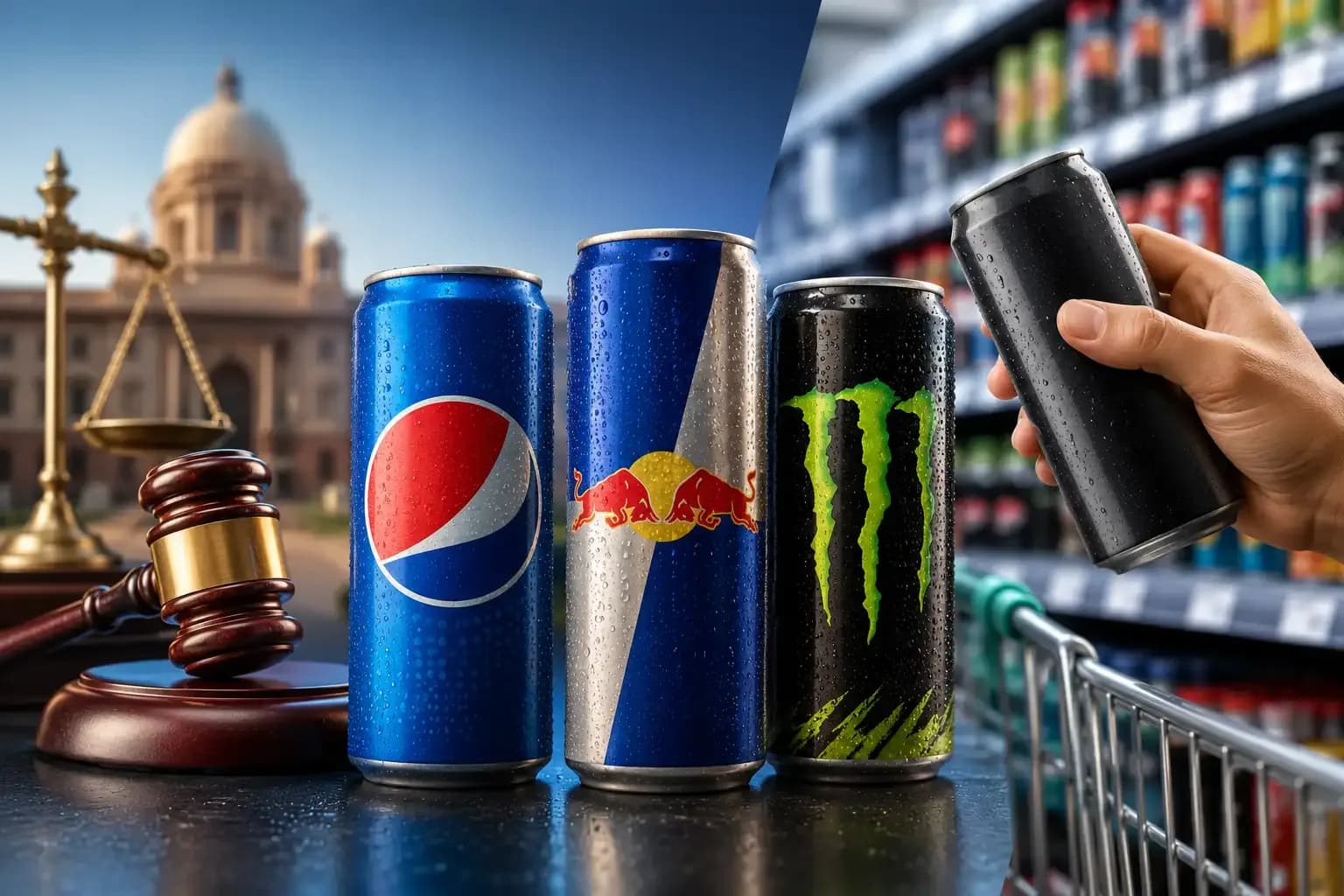
In a significant regulatory move that could reshape India's rapidly growing functional beverage market, the Food Safety and Standards Authority of India (FSSAI) has directed food business operators to discontinue the use of the term "Energy Drink" on product labels where no specific regulatory standard exists.
The decision affects several leading beverage brands operating in India, including products marketed by global companies such as PepsiCo, Red Bull, Monster Energy, and other manufacturers selling high-caffeine functional beverages.
Companies have reportedly been given 90 days to revise packaging and product labels to comply with the regulator's directive.
Although the products themselves are not banned, the terminology used on the packaging is changing because India's food regulations currently do not recognize "Energy Drink" as a standardized food category.
Why Has FSSAI Asked Companies to Remove the "Energy Drink" Label?
At the centre of the decision is a regulatory issue rather than a product safety concern.
Under the Food Safety and Standards (Food Products Standards and Food Additives) Regulations, India has established standards for several categories such as:
Carbonated beverages
Caffeinated beverages
Fruit beverages
Fruit juices
Packaged drinking water
Health supplements
Nutraceuticals
However, there is no officially defined food standard for "Energy Drink."
Without an approved legal definition, FSSAI believes using the term on product packaging could create ambiguity regarding product classification and regulatory compliance.
The regulator wants beverage companies to describe products using categories already recognized under Indian food laws.
Is FSSAI Banning Energy Drinks?
No.
One of the biggest misconceptions surrounding the announcement is that India has banned energy drinks.
That is not the case.
Consumers will continue to find these beverages on retail shelves.
The products themselves remain legal, provided they comply with existing FSSAI regulations regarding ingredients, caffeine limits, food additives, labeling requirements, and food safety standards.
The change applies specifically to how products are labeled and marketed, not whether they can be sold.
Why the Term "Energy Drink" Matters
From a regulatory perspective, food labels must accurately reflect categories defined under food laws.
If a category has no legal definition:
Product standards become difficult to enforce.
Compliance requirements may vary.
Consumer understanding can become inconsistent.
Regulatory actions become more complicated.
FSSAI's objective is to ensure that every food product sold in India falls within an officially recognized regulatory framework.
Which Companies Could Be Affected?
The directive is expected to affect several companies operating in India's functional beverage segment, including products sold by:
PepsiCo
Red Bull
Monster Energy
Other domestic and international beverage manufacturers
Each company may need to update:
Product labels
Packaging artwork
Marketing materials
Advertising campaigns
Retail product descriptions
Digital listings
The exact changes will depend on how each company chooses to classify its products under existing FSSAI regulations.
Why Was a 90-Day Timeline Given?
According to reports, FSSAI has allowed companies approximately 90 days to complete the transition.
The period is intended to help manufacturers:
Design new packaging
Print revised labels
Update inventories
Replace old stock over time
Inform distributors and retailers
Such transition periods are common whenever significant labeling changes are introduced.
Impact on India's Beverage Industry
India's energy and functional beverage market has witnessed strong growth over the last decade.
Increasing urbanisation, fitness awareness, esports, long working hours, and demand for convenience beverages have expanded the market significantly.
The labeling change is expected to have several implications.
Packaging Costs
Companies will need to redesign labels and packaging across multiple product variants.
Large manufacturers may incur substantial printing and logistics costs.
Marketing Strategy
The phrase "Energy Drink" has become a powerful marketing term globally.
Brands may now need to reposition products using alternative descriptions that comply with Indian regulations.
Marketing campaigns, digital advertising, point-of-sale material, and promotional assets may also require revisions.
Retail Adjustments
Retailers, supermarkets, and e-commerce platforms may need to:
Update product listings
Revise category names
Modify product descriptions
Align shelf labeling
Consumer Communication
Brands will likely invest in consumer awareness campaigns to explain that only the packaging terminology is changing—not the product itself.
What Does This Mean for Consumers?
For consumers, very little changes in terms of product availability.
Popular beverages will continue to be sold through supermarkets, convenience stores, restaurants, cafes, and online platforms.
However, consumers may begin noticing different terminology on product packaging over the coming months.
The formulation, taste, and ingredients of compliant products are not expected to change solely because of the labeling directive.
A Sign of Stricter Food Labeling Regulations
The move reflects FSSAI's broader effort to strengthen food labeling and regulatory clarity across India's food sector.
In recent years, the regulator has increased its focus on:
Misleading claims
Product classification
Front-of-pack information
Food traceability
Food safety compliance
Consumer transparency
Industry experts believe this latest decision is part of a larger push to ensure that food products are marketed using clearly defined legal categories rather than promotional terminology.
Industry Reaction
Regulatory experts believe the decision could encourage greater standardisation across India's beverage market.
While large multinational companies possess the resources to implement packaging changes relatively quickly, smaller beverage manufacturers may face higher compliance costs.
Some experts also argue that India may eventually develop a dedicated regulatory standard for energy drinks, similar to those adopted in several international markets.
If such standards are introduced in the future, companies may once again be able to use the category under clearly defined compliance requirements.
What Happens Next?
Over the coming months, beverage manufacturers are expected to:
Review packaging
Update product labels
Coordinate with distributors
Modify retail listings
Align marketing communication with FSSAI regulations
Consumers should not interpret the packaging changes as a product ban but rather as a regulatory update intended to improve labeling consistency.
Indian Food Times Analysis
FSSAI's directive is more than a packaging update—it reflects the regulator's growing emphasis on clear product classification, transparent labeling, and stronger consumer protection.
As India's functional beverage market continues to expand, regulators are increasingly ensuring that marketing terminology aligns with established food standards rather than promotional claims.
For major beverage companies such as PepsiCo, Red Bull, and Monster Energy, the immediate impact will likely be limited to packaging, branding, and compliance costs. However, the decision also highlights a broader trend: India's food and beverage regulations are becoming more structured, with greater scrutiny of product claims and labeling.
The move serves as a reminder that in today's food industry, regulatory compliance is no longer just a legal requirement—it is an essential part of building consumer trust and long-term brand credibility.
FAQs
Has FSSAI banned energy drinks in India?
No. FSSAI has not banned energy drinks. The directive relates only to the use of the term "Energy Drink" on labels where no specific regulatory standard exists.
Why is FSSAI removing the "Energy Drink" label?
Because Indian food regulations currently do not define "Energy Drink" as an official food category.
Which companies are affected?
The decision is expected to impact products sold by companies including PepsiCo, Red Bull, Monster Energy, and other beverage manufacturers using the "Energy Drink" label.
Will the taste or ingredients change?
Not necessarily. The directive concerns labeling and classification rather than product formulation.
When will consumers see the new packaging?
Companies have reportedly been given around 90 days to update labels and packaging, so revised products are expected to appear in the market gradually.