

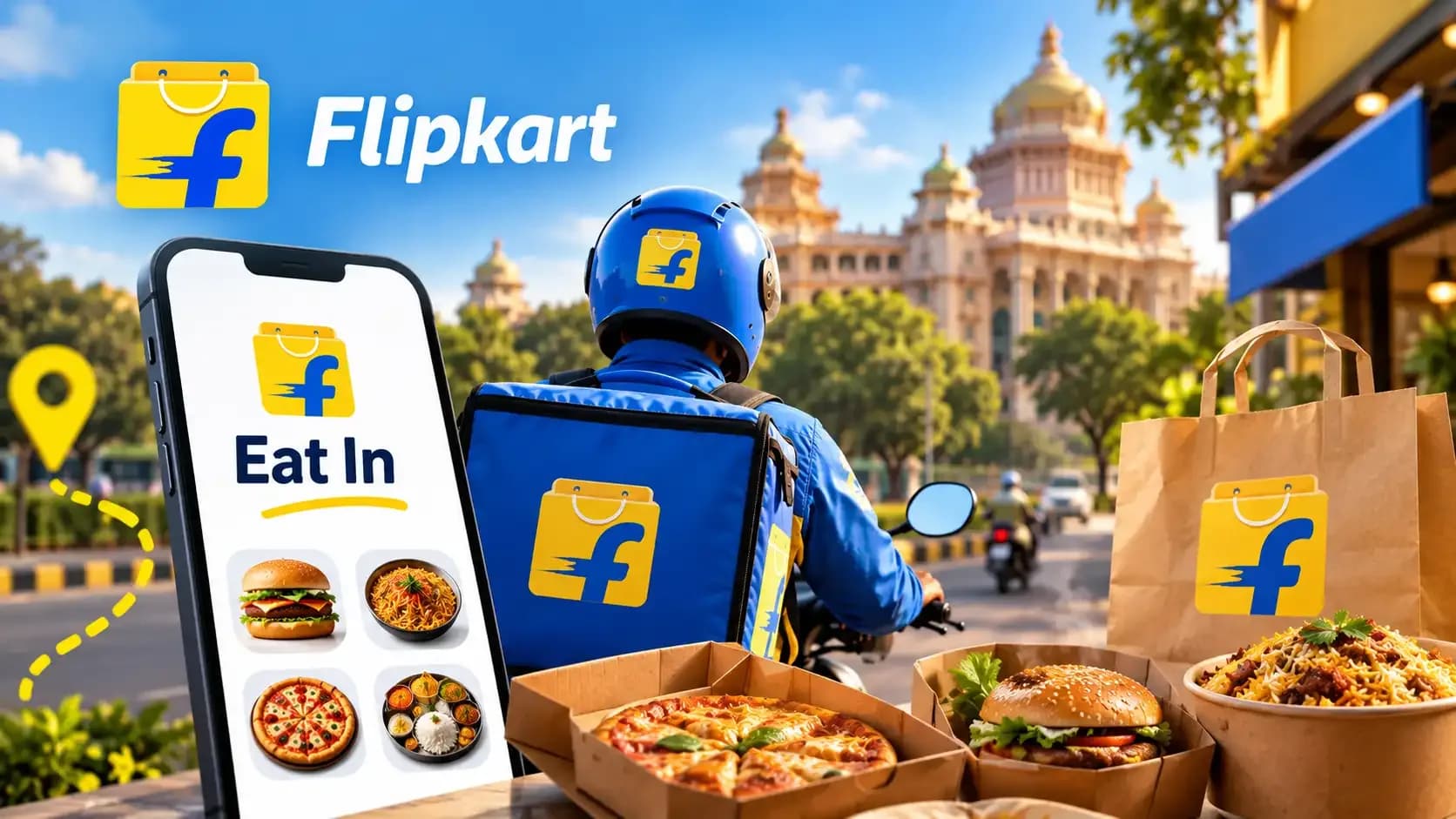
Walmart-backed e-commerce major Flipkart has begun testing its food-delivery service ‘Eat In’ among employees in Bengaluru, marking its first concrete move into a market that has long been dominated by Zomato and Swiggy.
The company is expected to expand the internal pilot to a wider employee base around September 15, before potentially opening the service to consumers in Bengaluru later this month, according to people familiar with the development.
The move comes at a time when India's online food-delivery sector is seeing a fresh wave of competition. While Zomato and Swiggy continue to command the largest share of the market, newer models are emerging around lower commissions and more price-sensitive consumers. Rapido's Ownly, for instance, has built its proposition around a zero-commission model, while Swiggy has launched Toing, a separate platform aimed at customers looking for lower-priced food.
For Flipkart, the entry is not simply about adding another food-ordering option. The company is attempting to build a different proposition around restaurant economics, selection and service, while leveraging the infrastructure and network it is developing across its broader commerce businesses.
ONDC at the centre of Flipkart's food-delivery strategy
Flipkart is building Eat In using the Open Network for Digital Commerce (ONDC), according to industry sources. The company has also been working towards a lower commission structure for restaurants.
Earlier reports indicated that Flipkart was targeting a commission of around 10%, significantly below the rates typically charged by established food-delivery platforms. The lower take rate is intended to make the platform attractive to restaurant partners at a time when commissions have become one of the most contentious issues in India's food-delivery ecosystem.
The strategy could put additional pressure on the incumbent platforms, particularly as restaurants increasingly look for alternatives to traditional marketplace economics.
The company's approach also appears to go beyond simply competing on price. Flipkart Group CEO Kalyan Krishnamurthy had previously indicated that the company's food-delivery proposition would focus on selection, service, reliability and the overall customer experience, rather than relying solely on discounts.
Bengaluru is only the beginning
Flipkart is expected to begin with Bengaluru before considering an expansion into other major markets, including Mumbai and Delhi-NCR, according to earlier reports.
Starting with Bengaluru gives the company an opportunity to test restaurant onboarding, delivery operations, customer behaviour and unit economics before committing to a larger rollout.
The company's decision to begin with an employee pilot is also significant. Rather than immediately opening the service to the wider market, Flipkart can use the initial phase to identify operational issues and fine-tune the customer and restaurant experience before a broader launch.
Food delivery battle gets more crowded
Flipkart's entry comes as the structure of India's food-delivery market begins to change.
Rapido's Ownly has emerged as a serious challenger with its zero-commission model. Moneycontrol reported that Ownly had crossed 50,000 daily orders in Bengaluru, representing roughly 10% of the city's estimated 500,000–600,000 daily food-delivery orders.
Swiggy, meanwhile, has been targeting price-conscious customers through Toing, while Zomato's parent company Eternal is pursuing lower-priced offerings on its existing platform and developing Bistro around a different operating model.
That means Flipkart will be entering a market where the battle is no longer limited to delivery speed and discounts. Commission rates, restaurant economics, customer acquisition and order frequency are becoming equally important battlegrounds.
Flipkart is simultaneously pushing quick commerce
The timing of Eat In's pilot is also notable because Flipkart is expanding aggressively in quick commerce.
The company has begun rolling out a standalone Flipkart Minutes app to select users, ahead of a broader rollout expected before its Big Billion Days festive sale in October.
The two initiatives point to a broader strategy: Flipkart is looking to strengthen its presence in high-frequency consumption categories, moving beyond its traditional e-commerce business into groceries, quick commerce and now food delivery.
The company already has a growing quick-commerce network through Minutes, giving it a potentially useful foundation for expanding its last-mile capabilities.
There is also evidence that Flipkart is preparing the operational infrastructure for Eat In. Its delivery-partner application, listed as “Eat-In by Minutes,” is already available and advertises digital onboarding, weekly payouts, flexible delivery slots and insurance coverage for delivery partners.
The real test will be economics
For Flipkart, launching Eat In may be the easy part. The harder question will be whether the business can achieve sustainable economics while maintaining attractive pricing for consumers and lower commissions for restaurants.
The company's proposed lower-commission model could help it attract restaurants, particularly smaller operators that have been vocal about the cost of food-delivery platforms. But delivery remains an expensive, operationally intensive business, and the long-term viability of low-commission models is likely to depend on order density, delivery efficiency and repeat customers.
With Zomato, Swiggy, Rapido and now Flipkart competing for restaurants and consumers, India's food-delivery industry could be entering a new phase—one in which the central question is no longer simply who can deliver food the fastest, but who can build a sustainable business model that works for customers, restaurants and delivery partners alike.
For now, Flipkart's Eat In remains in the testing phase. But its entry signals that the country's food-delivery market is once again becoming a major battleground for large technology and commerce companies.