

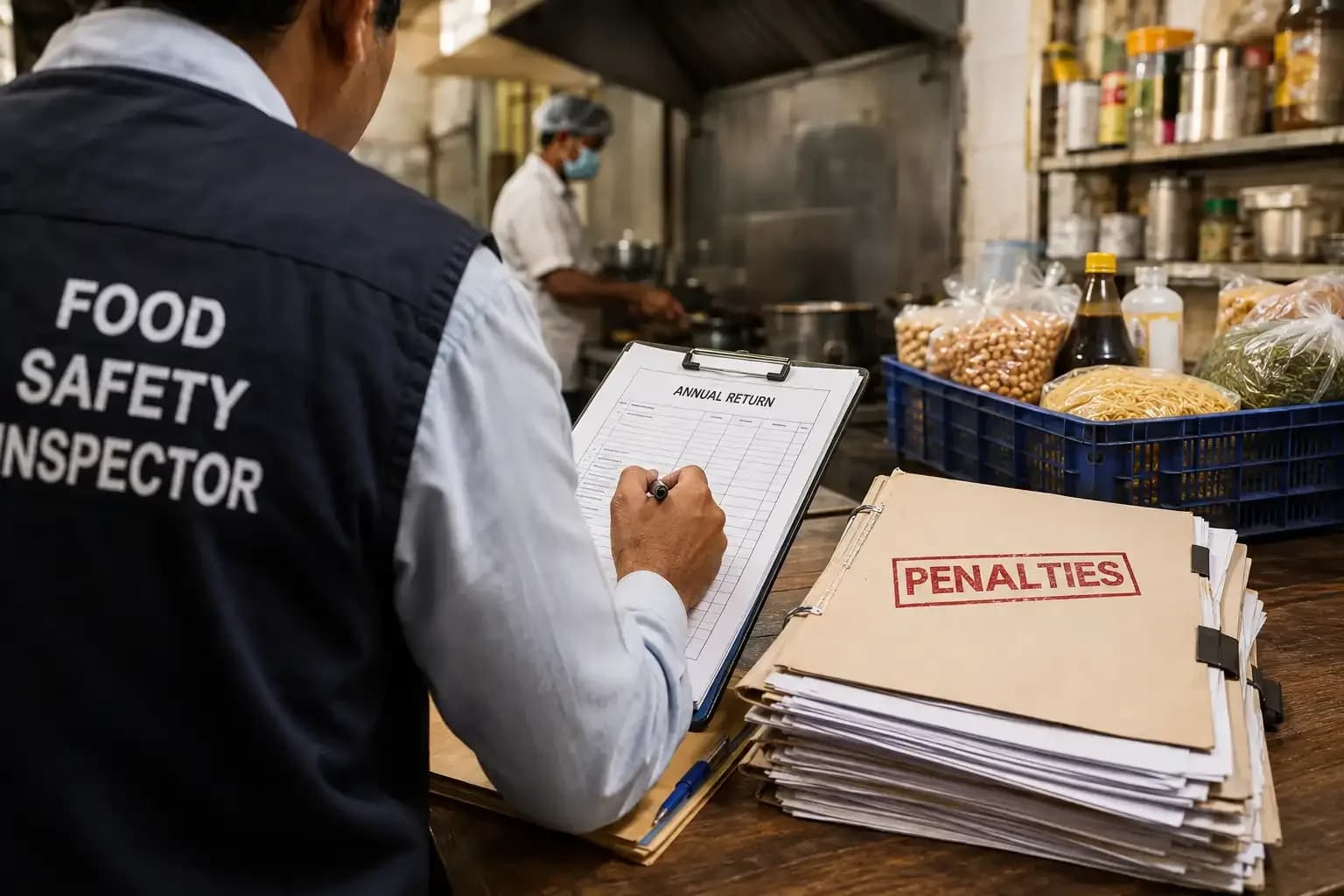
The Comptroller and Auditor General of India (CAG) has flagged significant shortcomings in the Food Safety and Standards Authority of India's compliance monitoring after an audit found that penalties estimated at ₹5.60 crore were not imposed on 2,430 Food Business Operators (FBOs) for failing to submit mandatory annual returns on time.
The finding forms part of CAG Report No. 9 of 2026 and relates specifically to the functioning of FSSAI's Eastern Region office in Kolkata. The audit examined annual-return compliance over multiple financial years and found a substantial number of businesses either failed to submit their returns altogether or submitted them after the prescribed deadline.
According to the audit, 1,018 FBOs had not submitted their annual returns, while another 1,412 businesses submitted them after the deadline. Together, the 2,430 cases resulted in an estimated penalty liability of ₹5.60 crore, which the audit said had not been imposed.
The finding is significant because annual returns form part of the statutory compliance framework through which food regulators track the activities of licensed food businesses.
What the CAG Audit Found
The CAG examined records concerning annual returns for the period from 2017-18 to 2022-23.
Under the Food Safety and Standards regulatory framework applicable during the audited period, specified licensed food businesses, including manufacturers, processors, repackers, relabellers and importers, were required to submit annual returns containing information on their food business activities.
The prescribed deadline was generally May 31 following the end of the financial year.
The audit found that, as of August 2023, 1,018 FBOs had failed to submit their returns while 1,412 had submitted them late.
Based on these defaults, the CAG estimated that ₹5.60 crore in penalties should have been imposed.
The audit's concern, therefore, was not merely about paperwork. It pointed towards shortcomings in the regulator's mechanism for identifying non-compliant businesses, imposing prescribed penalties and following through with enforcement.
₹100 Per Day Penalty for Delayed Returns
Under the regulations applicable to the audited cases, delayed submission of annual returns could attract a penalty calculated at ₹100 for every day of delay.
The compliance framework was subsequently modified, including the introduction of a ceiling on penalties for non-submission of annual returns. From FY 2021-22, the maximum penalty for non-submission was capped at five times the annual licence fee, pursuant to an order issued in November 2022.
The ₹5.60 crore cited by the CAG should therefore not be interpreted as a single fine or as a penalty imposed on one company. It represents the audit's estimated aggregate penalty arising from the delayed or non-submission of annual returns by the 2,430 FBOs identified in the audit.
FSSAI Subsequently Recovered ₹2.27 Crore
The audit report also records subsequent action by FSSAI, an important qualification to the headline ₹5.60 crore figure.
Following the audit observations, FSSAI's Kolkata office informed the auditors that ₹2.27 crore had subsequently been recovered for the period 2020-23.
After accounting for that recovery, the CAG referred to ₹3.33 crore remaining unrecovered from the ₹5.60 crore identified by the audit.
The CAG observed that failure to recover this amount represented a loss of revenue and pointed towards weaknesses in the regulator's monitoring mechanism.
The distinction is important: the audit did not establish that the entire ₹5.60 crore continued to remain outstanding after subsequent action by the regulator.
More Penalties Imposed in Following Years
FSSAI also reported further enforcement action in subsequent financial years.
For FY 2023-24, penalties amounting to approximately ₹2.06 crore were imposed, against which around ₹11 lakh was reported as recovered.
For FY 2024-25, approximately ₹68 lakh in penalties were imposed, while around ₹6 lakh was recovered.
These figures indicate that enforcement activity continued after the period initially examined by the audit, although the gap between penalties imposed and amounts recovered remains noteworthy.
Audit Also Raises Questions Over Licence Action
The CAG findings extend beyond monetary penalties.
According to records made available to the audit, FSSAI had not cancelled or suspended the licence of any of the identified defaulters as of August 2023.
This raises a broader enforcement question: what happens when licensed food businesses repeatedly fail to comply with mandatory regulatory requirements?
FSSAI subsequently informed the audit that Improvement Notices had been issued to 158 out of 327 defaulting FBOs between April 2021 and August 2023.
The regulator further indicated that notices would be issued to defaulting businesses and that failure to clear outstanding dues could result in action under the Food Safety and Standards Act and applicable regulations.
The episode therefore highlights two separate enforcement challenges—collection of financial penalties and escalation of regulatory action against persistent defaulters.
FSSAI Points to Earlier Lack of Online Monitoring
The Ministry also provided an explanation for some of the compliance-monitoring difficulties identified by the audit.
According to the response recorded by the CAG, FSSAI said that before FY 2020-21 there was no online mechanism for submission of annual returns.
Tracking whether individual businesses had filed their returns was consequently more cumbersome and labour-intensive.
The shift to the Food Safety Compliance System (FoSCoS) has since moved the annual-return process online, allowing the regulator to digitally track filings and compliance.
FSSAI currently states on FoSCoS that physical submission of annual returns is not permitted, with applicable businesses required to use the online system.
The digitalisation of the process has the potential to significantly reduce the monitoring gaps highlighted by the CAG, provided the filing data are systematically linked with penalty recovery and enforcement mechanisms.
What Are FSSAI Annual Returns?
Annual returns are part of the compliance obligations applicable to specified categories of licensed food businesses.
They provide regulatory authorities with information relating to the food products manufactured, handled, imported or exported by businesses during the preceding financial year.
They should not be confused with income-tax or corporate financial returns.
Annual-return compliance enables the food regulator to maintain an administrative record of businesses operating within regulated food categories and forms part of the broader licensing and monitoring framework.
Failure to file the return, therefore, represents a regulatory compliance violation.
Does This Mean 2,430 Businesses Were Selling Unsafe Food?
No.
That distinction is essential.
The CAG finding does not state that the 2,430 businesses were caught manufacturing adulterated, contaminated or unsafe food.
The violation identified in this particular audit observation concerns failure to submit, or delayed submission of, mandatory annual returns.
Non-filing is a regulatory violation and can attract penalties, but it does not by itself establish that the food manufactured or sold by a particular FBO was unsafe.
The significance of the CAG observation lies instead in what it reveals about the regulator's ability to consistently monitor and enforce compliance across the food industry.
Why the Audit Finding Matters
India's food regulatory system covers a vast network of manufacturers, processors, importers, distributors, retailers and food-service businesses.
That makes digital monitoring and consistent enforcement particularly important.
A regulatory framework can prescribe penalties, filing deadlines and licence conditions, but those provisions are effective only when authorities can identify violations, communicate with defaulters, levy penalties, recover dues and escalate action where necessary.
The CAG's observation suggests that this enforcement chain did not operate effectively in all the cases examined in the Eastern Region.
The ₹5.60 crore figure is therefore only one part of the story.
The larger issue is whether India's food-safety compliance infrastructure is sufficiently equipped to detect and act on regulatory defaults across a rapidly expanding food industry.
Digital Compliance Could Close the Gap
FSSAI's transition to FoSCoS represents an important structural change since the earlier years covered by the audit.
The portal now provides online facilities for licensing, registration, renewals and annual-return submissions, creating the possibility of identifying non-filers and delayed filings automatically.
A fully integrated compliance system could potentially flag missed deadlines, calculate applicable penalties, generate notices and escalate unresolved violations without depending heavily on manual scrutiny.
The CAG's findings demonstrate why such systems matter.
For food businesses, meanwhile, the report is a reminder that regulatory compliance extends well beyond hygiene inspections and food testing. Licence conditions, statutory filings and annual returns can carry direct financial and regulatory consequences when ignored.
A Compliance Issue With Wider Regulatory Implications
The CAG report ultimately raises questions not only about ₹5.60 crore in penalties but also about the effectiveness of compliance monitoring within India's food regulatory architecture.
FSSAI has subsequently recovered part of the amount identified by the audit and reported further enforcement action. The migration of annual-return filing to an online platform also addresses one of the operational difficulties cited in the government's response.
However, the audit's finding that thousands of delayed or missing returns could accumulate without the corresponding penalties being imposed illustrates the importance of linking digital compliance data with timely enforcement.
As India's organised food industry expands and millions of businesses interact with the country's food-licensing system, the effectiveness of that enforcement mechanism will be as important as the regulations themselves.
Source: Comptroller and Auditor General of India, Report No. 9 of 2026; Food Safety and Standards Authority of India/FoSCoS.