

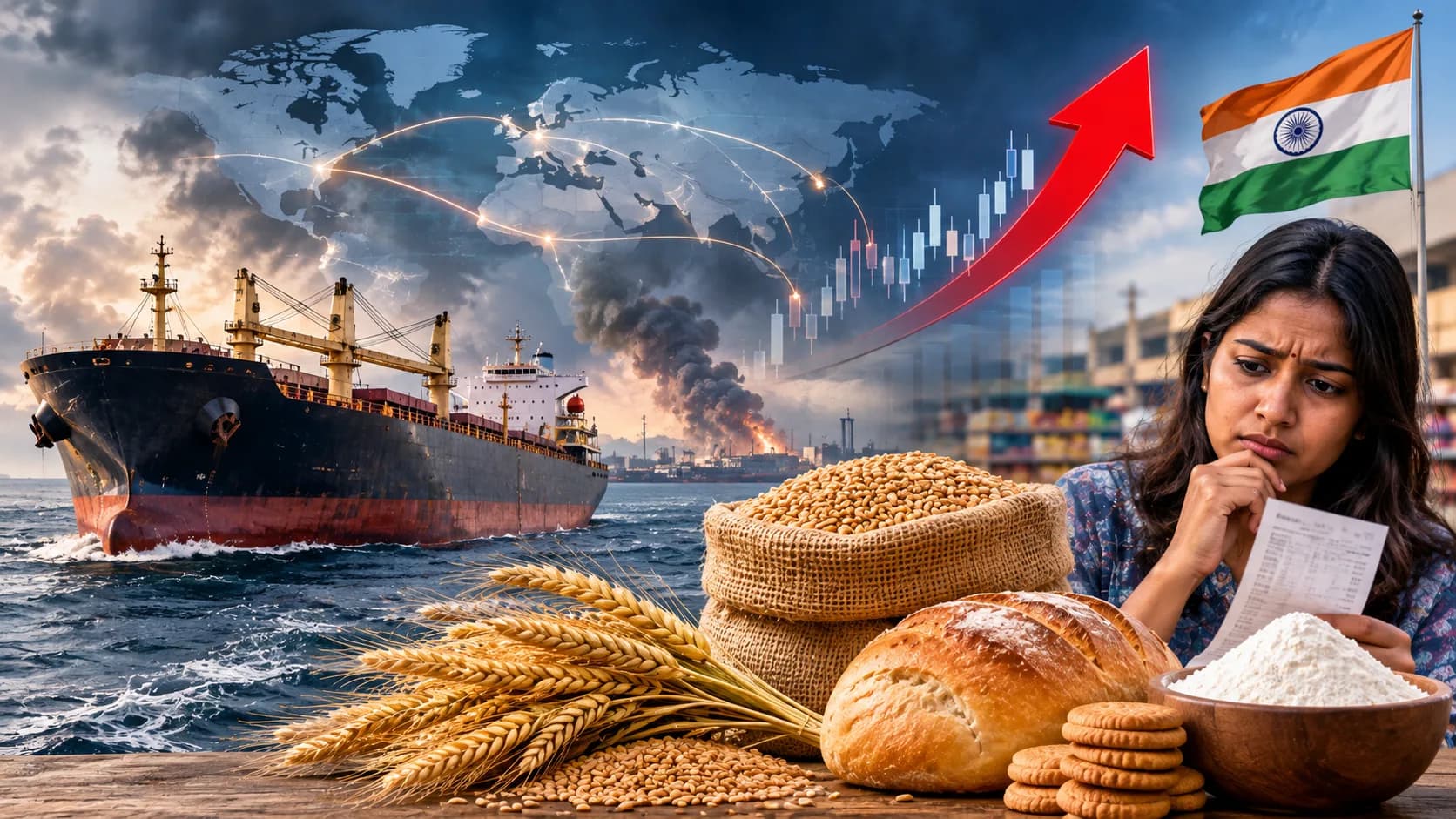
Full Godowns, Open Ports? How a War at Sea Can Still Reach India's Wheat Market. It names the real finding (stocks protect India, trade channels may not) and does not promise dearer bread.
On 28 October, drones sank a container ship off Bulgaria. It was not carrying wheat. But ten ships were struck at sea in October, and shipowners are now asking whether they must sail to Romanian and Bulgarian ports at all, Ambrey analysts told gCaptain. The Black Sea is the road much of the world's wheat travels.
India has no obvious reason to worry. Its central pool held 479.92 lakh tonnes of wheat on 1 September, per FCI data reported by BusinessToday. So the useful question is not whether India will run short. It is how a shock at sea can reach an economy with full godowns.
What is actually happening at sea
Both sides are hitting grain logistics. CSIS, in a 11 September analysis, says Ukraine struck Novorossiysk grain terminals on 12 August, halting all three, and that Russia has attacked Ukrainian ports, ships and Danube terminals. Moscow and Kyiv blame each other for attacks on shipping; Kyiv says the October drone strikes were Russian and Zelenskyy said Ukrainian forces ran no operations in that part of the sea, per Al Jazeera. IFT cannot independently confirm who fired.
The numbers going around need care.
"70%" (Russia). CSIS describes it as the estimated share of Russia's grain export capacity knocked out by Ukrainian attacks. It measures capacity, as of late summer, not tonnes actually shipped.
"90%" (Ukraine). The same CSIS piece uses it two ways: Ukraine's Black Sea ports once handled about 90% of its farm exports, and Russian attacks took roughly 90% of grain shipments offline. It does not mean 90% of Ukraine's grain cannot leave. Al Jazeera says the Danube's share of Ukrainian port cargo rose from about 10% to 74% by August, and that land routes can carry "hardly more than 50 percent" per a Ukrainian farm-group official.
"20%" (wheat futures). Al Jazeera puts Chicago wheat at $5.03 a bushel in October 2025 and $6.03 in October 2026. IFT calculates that as a 19.9% rise over twelve months. Other reports say 20% over the first nine months of the year. It is a Chicago futures move, not a price paid in India, and Al Jazeera lists other causes too, including the Iran war and drought. The FAO's index showed world wheat prices 15% higher in August than a year earlier, per CSIS.
Export data show the scale. SovEcon estimates, via UkrAgroConsult, that Russia's August grain exports fell almost 60% year on year to 2.2 million tonnes. CSIS puts Russia's July to September wheat exports at about half of last year's.
Why the world is watching
Russia is the largest wheat exporter and Ukraine the fifth; together they account for about 27% of global wheat exports, per USDA figures cited by CSIS. That is a share of exports, not of production. Most countries eat what they grow. Importers, many in North Africa and the Middle East, are the exposed ones, and the analysts quoted by Al Jazeera expect the Global South to feel most of it.
A disruption can bite even when the world has enough grain, because the grain has to move. CSIS projects 2026/27 output of the seven largest exporters to fall 11%, so this is not only a logistics story.
The hidden cost of moving grain
A tonne of wheat passes through four states: grown, stored, available for export, and delivered. The Black Sea problem is mostly at the third and fourth. Ukraine's agriculture ministry reportedly expects to need 10 to 12 million tonnes of extra temporary storage, and gCaptain reports forecast ending stocks of wheat, corn and barley roughly quadrupling to almost 25 million tonnes. Grain exists. Getting it out is the constraint.
Alternatives are partial. CSIS says Baltic ports could handle about 10 million tonnes, roughly a fifth of the more than 46 million tonnes Russia shipped through Azov and Black Sea ports in 2025-26. Al Jazeera reports Russian exporters testing the Arctic port of Murmansk, where the much longer distance will raise costs significantly. Ukraine's rail network is overloaded.
The insurance bill is harder to see. IFT found no published war-risk premium or freight-rate figures, so we do not quote any. What is documented is behaviour: some owners are reportedly seeking to refuse orders to Romanian and Bulgarian ports.
India is not short of wheat. So where is the exposure?
The cushion is large. Central-pool wheat was 522.74 lakh tonnes on 1 July against a norm of 275.80, per government data reported by BusinessToday. IFT calculates that as about 1.9 times the norm. Total wheat and rice on 1 September, 870.45 lakh tonnes, was almost 2.8 times the 1 October norm. Production was 120.7 million tonnes in 2025-26 against 110.6 million the year before, about 9% higher on IFT's arithmetic, and procurement for 2026-27 reached about 33.8 million tonnes by 15 June against 30.2 million a year earlier.
IFT tested five ways a global shock could reach Indian food. The evidence is uneven.
Benchmark prices. Weak evidence. We could not retrieve Department of Consumer Affairs atta or wheat price series, so we cannot compare 5 November with a week, month, six months or a year earlier, and we do not claim the Black Sea has moved Indian atta prices. A trade-press report in August described Delhi wheat at roughly Rs 2,880 a quintal, sideways to weak, and its own authors called the conversion approximate. Those are not retail prices.
Export policy. The strongest evidence. A DGFT notification dated 24 August moved wheat from "prohibited" to "free"; the summary we read does not name flour or atta. A trade site reports Indian wheat bookings of over 200,000 tonnes by Bangladesh and about 60,000 by Sri Lanka, at roughly $305 to $326 a tonne. It also warns that re-tightening policy could redirect buyers. Exports are now a route by which world demand can reach Indian stocks, and policy decides how open it stays.
Freight and insurance. Real for the Black Sea; we found no Indian evidence.
Manufacturers' input costs. No evidence found. IFT did not obtain comments from millers, bakers or biscuit and noodle makers, and does not attribute any cost to named firms.
Farmer incentives. Documented in Russia, not India.
That last channel is the sleeper for the world, and it is why this story may outlast the ships.
The next harvest
StoneX's Bertrand Oesterle said in August that farm prices in Russia and Ukraine are falling because "there's nothing coming out", while freight costs rise. UkrAgroConsult, citing SovEcon, says Russian winter crops sown by early September were about 25% below recent averages, with farmgate prices in some regions below production costs. In its farmer survey, 26% planned to abandon winter wheat. ProZerno's pessimistic scenario puts up to 22 million tonnes of Russian wheat unsold if export problems persist.
That is a scenario, not a forecast. Oesterle thinks fears of unharvested wheat are probably overstated given state intervention. Nothing here establishes a shortage of Indian wheat, and IFT makes no such prediction.
What it means
Indian readers can reasonably take three things away. India's own stocks are the cushion. The exposure comes through trade choices: whether export doors stay open, and at what domestic price. And an acute disruption is not a shortage; a shortage, if one comes, would come from the next planting.
Food security is not only about producing enough grain. It is about whether grain is affordable, movable and there when it is needed. Right now, a ship that does not sail matters more than a godown that is full.