
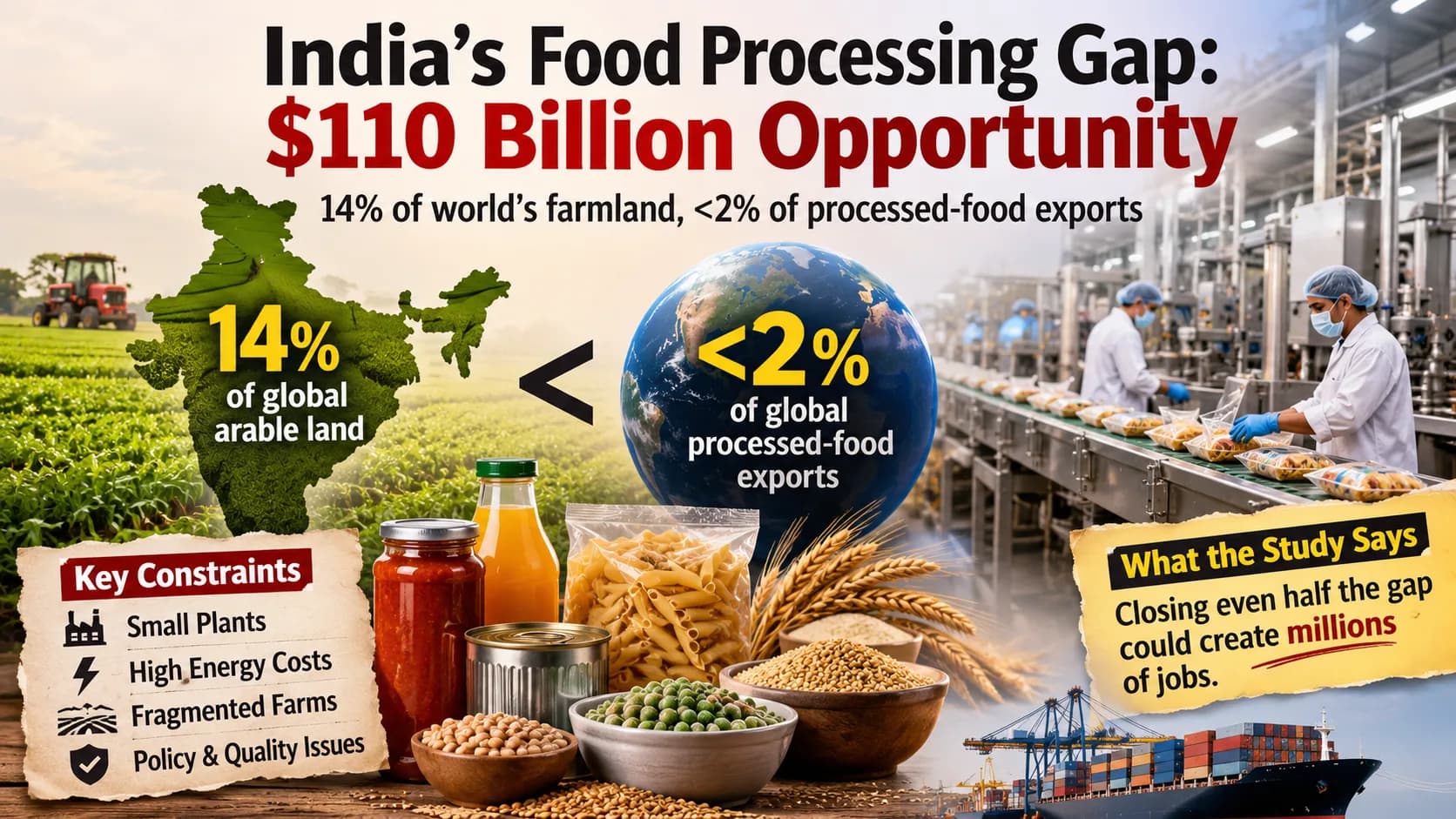
India holds about 14% of the world's arable land but accounts for less than 2% of global processed-food exports, a gap that economist Shoumitro Chatterjee puts at roughly $50–110 billion a year.
The estimate comes from a paper titled "Is Food Processing the Missing Link in Development?", presented at the NCAER India Policy Forum in New Delhi on August 6–8, 2026. Chatterjee is affiliated with Johns Hopkins University, CEPR, ICRIER and the Carnegie Endowment. The paper is a preliminary draft, and NCAER says the views expressed are the author's own.
How the $110 billion figure is calculated
The figure compares India's share of world farmland with its share of processed-food exports. The larger number of about $110 billion a year includes minimally processed goods such as shelled pulses. Excluding them brings it to about $50 billion. It is a benchmark of unrealised potential, not a projection of what India will earn. The paper says closing even half the gap could create millions of jobs.
The market is large. Global processed-food exports averaged about $1.2 trillion a year in 2021–24, excluding tea, coffee and re-exports through trading hubs, compared with about $489 billion for apparel.
Where India falls short
Chatterjee points to wheat as an example. India produces about 14% of the world's wheat but holds only about 2.5% of the export market for products such as flour and pasta. It grows 27.4% of the world's dry beans but has about 0.5% of the frozen and canned bean trade.
He names four main constraints :
Small plants. India has around 43,000 formal food-processing factories, and the median one employs only 13–14 workers.
Energy costs. Energy takes about 22% of value added in food processing, more than twice the share in apparel or electronics.
Fragmented farms. Small holdings, especially in the Gangetic belt, make it hard for processors to source consistent volumes.
Policy and quality. The paper cites sudden export restrictions and rejected shipments, and says a large share of approved production-linked incentive support has gone to advertising and marketing.
Pockets of success
Between 2010 and 2024, India's share of global shrimp exports rose from about 7% to 20%. Its share of frozen French-fry exports grew from almost nothing to about 2%, and table grapes from 1% to 4%. The paper credits private investment, contract farming and farmer-producer companies in each case.
Role of the India–EU trade deal
India and the EU concluded a free trade agreement on January 27, 2026. On September 11, 2026, the European Commission asked the EU Council to authorise its signing and conclusion. The government has said it expects a boost for agricultural and processed-food exports. Chatterjee says market access alone will not build a competitive industry. Exporters will also need to meet EU food-safety standards.
What the paper recommends
The paper does not offer a detailed blueprint. Chatterjee says food processing can become an important source of rural jobs and growth, but cautions that the path is not easy:
"There are few low-hanging fruits."
— Shoumitro Chatterjee, Is Food Processing the Missing Link in Development?, NCAER India Policy Forum 2026
He argues for policy covering the whole chain from farm to port: reliable power, credit, testing and traceability, and stable trade rules, with farmers sharing the gains. The paper also cautions against export bans as a tool to force domestic processing.