

Ghaziabad Destroyed 1,000 Kg of Rasgulla. No One Has Said Where the Rest of the Batch Went
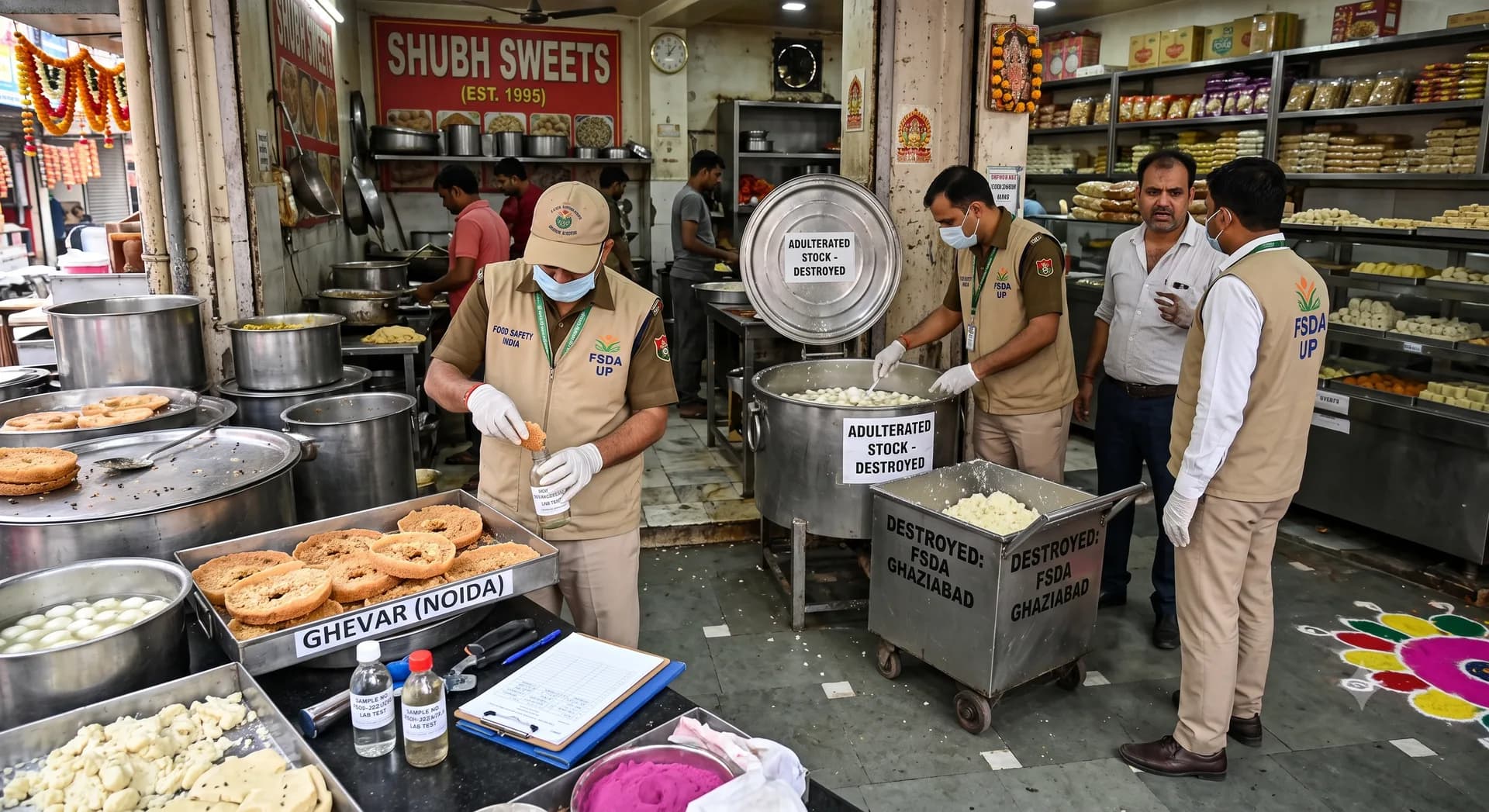
On the evening of August 24, food safety officials in Ghaziabad walked into Sachin Chhena Store in Bhim Nagar and destroyed nearly a tonne of Chhena Rasgulla on the spot. Four samples went to the lab. A chemical used to whiten paneer, banned from food use, was named on record. Licence suspension proceedings were promised.
By the standard of a festival-season food raid, that is a complete story: what was found, what was destroyed, what will be tested. But it answers only one question what was on the premises at the moment officials walked in. It does not answer how long Sachin Chhena Store had been producing rasgulla before that evening, how much had already left in the days or weeks prior, or where it might have gone. Ahead of a festival when sweets move fast, in large volumes, through informal and formal retail alike, that gap matters as much as the raid itself.
The 1,000-Kg Raid
The sequence, as reported by the Food Department, is straightforward. Acting on the ongoing pre-festival inspection drive ordered by Food Safety and Drug Administration Director Dr Roshan Jacob, a departmental team raided Sachin Chhena Store, owned by Uday Singh, in Ghaziabad's Bhim Nagar area on the evening of Monday, August 24. Officials found what they described as suspected irregularities in the rasgulla being prepared and destroyed approximately 10 quintals 1,000 kg on-site.
Food Department official Suresh Kumar Mishra said the department has been intensifying inspections of chhena and paneer products across the district as part of the same campaign that led to this action. Four samples were collected: prepared rasgulla, arrowroot, paneer, and a sample the department recorded as "cefolite." Officials stated they would move to suspend the establishment's food licence.
What Officials Actually Found
According to the department, officials observed paneer being mashed with starch and treated with a chemical they identified as sodium formaldehyde sulfoxylate used, they said, to whiten the paneer while doubling as a preservative. This is the department's stated on-site observation and identification, not yet a laboratory-confirmed result.
It's worth being precise about the terminology here, because "cefolite" is not a recognised chemical name. Sodium formaldehyde sulfoxylate also known industrially as Rongalite, or sodium hydroxymethanesulfinate is a well-documented industrial bleaching and reducing agent, used legitimately in textile dyeing and paper processing. It is not approved for use in food anywhere it has been studied, including India, because under heat or acidic conditions it breaks down into formaldehyde and sulfur compounds. "Cefolite" most likely reflects a market-floor or trade name under which the substance circulates informally, rather than a second, different chemical. Available records do not include independent laboratory confirmation that the sample collected under that name is chemically identical to sodium formaldehyde sulfoxylate that confirmation, if it comes, will be part of the pending lab report.
The Lab Report That Has Yet to Answer the Biggest Question
As of the most recent available reporting, the four collected samples rasgulla, arrowroot, paneer and cefolite were with the laboratory, and results had not been announced. This is the detail that separates what officials alleged from what has been proven. The destruction of the rasgulla was carried out on the basis of on-site findings and departmental judgment, as the law permits when officials have reason to believe food is unsafe but a laboratory report is what will formally establish adulteration, and that report was still pending.
It's equally important to state what is not being claimed here. No reporting reviewed for this piece includes a claim that any consumer fell ill from rasgulla sourced from this shop, or that testing has confirmed the presence of sodium formaldehyde sulfoxylate at a specific concentration. The available record supports only: officials alleged adulteration, destroyed the stock they found, and are awaiting confirmation.
Where Could the Earlier Batches Have Gone?
This is the question the raid itself cannot answer, and no publicly available document reviewed for this piece answers it either.
Chhena rasgulla is not typically made and sold within hours; production runs, especially during a high-demand period like Raksha Bandhan, usually build up stock over days. A raid that finds and destroys 1,000 kg on a single evening reveals the scale of what remained on-site at that moment not the scale of what may have been produced and moved out over the preceding days or weeks. Whether Sachin Chhena Store supplied any retail sweet shop, wholesaler, or informal seller in Ghaziabad, Noida, or beyond is not established in available records. Whether the shop had any invoices, delivery records, or identifiable buyers that investigators reviewed is also not stated in any report examined for this piece.
This is not a claim that adulterated sweets did reach consumers. It is a statement of an evidentiary gap: the raid establishes what was found, not what preceded it.
Can Food-Safety Authorities Trace a Sweet from Factory to Consumer?
India's food-safety framework does provide tools for exactly this kind of backward and forward tracing, at least on paper. Under the Food Safety and Standards Act, 2006, a Food Business Operator is required to maintain traceable records under general licensing conditions, and Designated Officers have the power to inspect and demand records during an investigation, not merely to seize what's physically present. In principle, invoices, delivery challans, or supplier records at a raided premises can be used to identify where raw material came from and where finished product went.
Whether that step was taken at Sachin Chhena Store whether officials reviewed sales records, questioned the owner about buyers, or attempted to identify a paneer or starch supplier is not stated in any of the reporting reviewed for this piece. Publicly available records reviewed for this report do not establish whether any downstream tracing occurred, whether other premises were inspected as a result of this raid, or whether any other district was notified. That does not mean such steps didn't happen; it means they have not been publicly reported, and this piece is not in a position to assume either way.
What the Law Requires After Suspected Adulteration
When a Designated Officer under the FSS Act has reason to believe food is unsafe, the law allows immediate action including seizure and destruction of the offending stock without waiting for laboratory confirmation first, precisely because delay in a case of suspected active adulteration could allow more product to reach consumers. Samples must still be drawn and sent for laboratory analysis to formally establish the nature and extent of adulteration; this is what determines the eventual legal outcome, including whether the case proceeds as a food-safety offence and what penalty or prosecution follows.
A food business's licence can be suspended pending inquiry and, depending on findings, cancelled. Officials in this case said they would move toward suspension. Separately, if adulteration is confirmed and involves a substance injurious to health, the FSS Act allows for more serious penal provisions, including prosecution, beyond a simple licence action but that determination follows, rather than precedes, laboratory confirmation.
What the law does not automatically provide, once a single premises is raided, is an immediate map of where that premises' prior output went. That requires an active investigative step reviewing records, questioning suppliers and buyers, checking connected businesses which is a matter of enforcement practice and resourcing, not something the destruction of stock accomplishes by itself.
What Is Known About the Chemical And What Is Not
Sodium formaldehyde sulfoxylate, commercially known as Rongalite, is a genuine and well-documented industrial chemical: a reducing and bleaching agent used in textile dyeing, paper de-inking, and some industrial synthesis. Scientific literature on food-adulteration detection methods for this compound consistently notes that when it decomposes under heat or in acidic conditions, both of which occur during food processing and digestion it releases formaldehyde and sulfur dioxide-related compounds. Formaldehyde is recognised as a carcinogen at sustained exposure levels, and the chemical is not approved for use in food in India or most other jurisdictions studied.
That established toxicological profile describes the substance in general. It does not, by itself, establish the concentration present in the Ghaziabad samples, whether that concentration reached a level of health concern, or what if any exposure a specific consumer might have had. Those are precisely the questions the pending laboratory report is meant to answer. Stating that the chemical is "not permitted in food" and is "known to release toxic compounds on decomposition" is accurate and supported by the science. Stating that the Ghaziabad rasgulla "caused" any specific health harm would not be no such claim appears in any source reviewed for this piece.
The Festival Food-Safety Problem
Raksha Bandhan, like most Indian festivals built around sweets exchange, drives a sharp, short-term surge in demand. Sweet shops and informal producers typically ramp up production in the days beforehand, and shelf-life pressures on items like chhena rasgulla a fresh, dairy-based product with limited durability can create incentive for preservative misuse, since a bleaching-preservative combination like sodium formaldehyde sulfoxylate can mask spoilage and extend apparent freshness cheaply.
This dynamic is precisely why enforcement activity increases before festivals as it evidently did here, per official Suresh Kumar Mishra's statement that the department has been stepping up inspections of chhena and paneer more broadly. But higher enforcement intensity at the point of inspection does not by itself close the traceability gap described above: a shop inspected on August 24 may have already completed several days of higher-volume, pre-festival production.
What Happens Next?
Laboratory results on the four collected samples remain the immediate next development to watch they will formally establish whether, and to what extent, adulteration occurred. Beyond that, licence suspension proceedings against Sachin Chhena Store were stated as forthcoming. What is not yet known, and what this piece could not establish from available records, is whether any parallel investigation into the shop's supply sources, prior output, or possible downstream buyers is under way, or whether the department's broader pre-festival campaign will extend to inspecting other premises connected to this one.
Conclusion
The real test of a food-safety raid like this one is not only how much adulterated stock can be found and destroyed at a single site it is whether the system that follows can identify what, if anything, had already left that site and entered the market before the raid happened. On the available record, Ghaziabad's Food Safety Department has answered the first question clearly. The second one remains open, and nothing in the public reporting so far suggests it has been asked in public yet.