
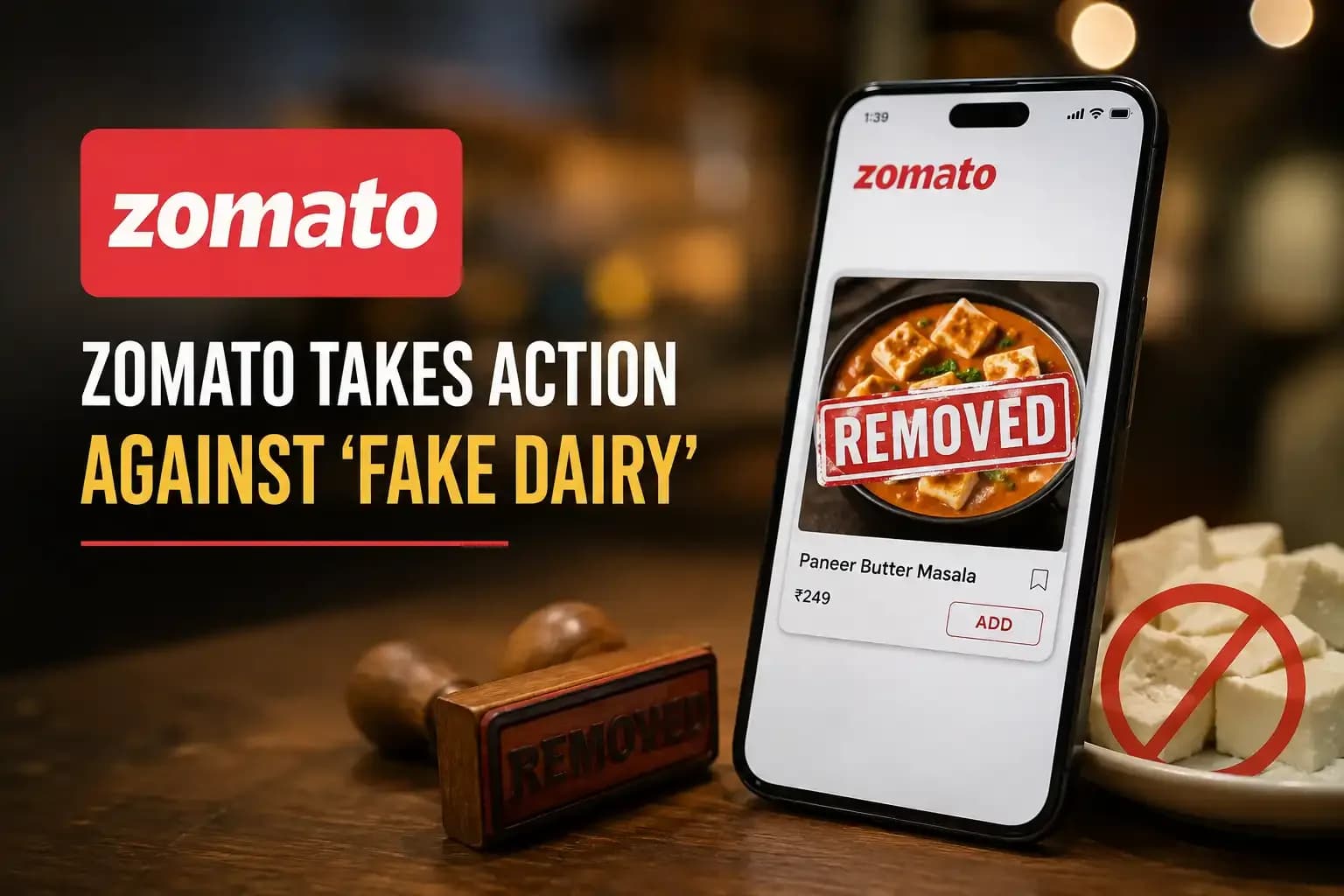
India’s growing debate over analogue paneer and dairy substitutes has now reached the country’s food-delivery platforms.
Zomato has begun taking action against restaurant dishes containing analogue dairy, delisting such items from its platform and warning restaurant partners that continued non-compliance could result in their removal from the platform.
The move comes amid increasing regulatory scrutiny of analogue dairy products across India, particularly products being sold or served as conventional dairy items without adequate disclosure.
Zomato draws a line on analogue dairy
Zomato’s latest action targets dishes that restaurants have declared as containing analogue dairy. Such dishes are being removed from listings with immediate effect.
The company has also made it clear that restaurants are expected to review the ingredients they use, check supplier labels and ingredient declarations, and ensure that the food being sold through the platform is accurately represented.
For restaurants, the message is straightforward: if a dish contains analogue dairy, it cannot simply be presented to customers as a conventional dairy-based product.
Restaurants that fail to comply could face stronger action, including being delisted from Zomato.
What is analogue dairy?
Analogue dairy refers to products designed to replicate the characteristics of conventional dairy products but made partly or substantially using non-traditional dairy ingredients.
Depending on the product and formulation, these can involve ingredients such as vegetable fats or oils, starches, milk solids and plant-based proteins.
The controversy is not simply about the existence of such products.
The bigger issue is transparency.
A consumer ordering a paneer dish, cheese-based preparation or another dairy-labelled food generally expects the product to correspond with what is represented on the menu.
When an analogue product is used without appropriate disclosure or is represented as genuine dairy, questions around food safety, labelling and consumer choice arise.
Why paneer has become the centre of the controversy
Paneer has emerged as one of the biggest flashpoints in India's analogue-dairy debate.
The product is widely used by restaurants, cloud kitchens and caterers, from butter paneer and shahi paneer to paneer tikka and a range of Indo-Chinese preparations.
For commercial kitchens, the economics can be significant.
Analogue products can potentially offer restaurants a lower-cost alternative to conventional dairy ingredients while providing certain functional properties required in large-scale food preparation.
That makes the issue particularly important for the restaurant industry, where food costs, margins and consistency are constant concerns.
But what may work as a cost-saving ingredient for a kitchen becomes a consumer-transparency problem if customers are not clearly told what they are eating.
Maharashtra's crackdown adds pressure
Zomato's move comes against the backdrop of increasingly aggressive enforcement by state food-safety authorities.
Maharashtra has taken particularly strong action against analogue or non-dairy paneer, with the state imposing a one-year prohibition covering the manufacture, processing, packing, storage, transportation, distribution and sale of such products.
The restrictions also extend to food businesses such as hotels, restaurants, caterers and cloud kitchens using analogue paneer.
The enforcement data illustrates why authorities have become concerned.
Between April 2025 and March 2026, Maharashtra tested 308 paneer and dairy-analogue samples. Of these, 109 samples — around 35.4% — failed to conform to prescribed standards, while 79 were classified as sub-standard and 30 were declared unsafe.
The findings have intensified scrutiny of what is being supplied to restaurants and ultimately served to consumers.
From disclosure to delisting
The regulatory approach has also been evolving.
Restaurants and food businesses have increasingly been pushed towards clear disclosure of dairy analogues, including through menus, display boards and bills.
Zomato's intervention takes that debate one step further.
Instead of leaving the responsibility entirely at the restaurant level, the food-delivery platform is now taking action at the listing level.
That is significant because food-delivery apps have effectively become the digital menu boards of India's restaurant industry.
Millions of consumers make ordering decisions based on what appears on these platforms.
If an item is removed from a major food-delivery marketplace, its commercial impact can be substantial.
What this means for restaurants
Restaurants using analogue dairy now face a business decision.
They can switch to compliant dairy ingredients, reformulate their dishes or remove affected items from their online menus.
For restaurants already operating on tight margins, replacing lower-cost ingredients with conventional dairy could put pressure on food costs.
That could eventually translate into higher menu prices — or force restaurants to absorb the additional cost.
But there is another side to the equation.
Restaurants that invest in genuine ingredients and transparent labelling could potentially benefit from growing consumer demand for food authenticity and ingredient transparency.
The issue could therefore create a competitive divide between restaurants that prioritise cost and those that position themselves around quality and transparency.
The bigger question: How will Zomato verify compliance?
This may become the next major chapter in the story.
Zomato has moved against dishes that restaurants have declared as containing analogue dairy and has asked restaurant partners to review supplier labels and ingredient declarations.
But questions remain about how extensively the platform will verify compliance across its restaurant network.
Will verification rely primarily on restaurant declarations?
Will supplier documentation be checked?
Could customer complaints trigger investigations?
Could food-safety authorities and delivery platforms eventually share information?
These questions will become increasingly important if platform-level enforcement expands.
Is analogue dairy itself illegal?
This is where consumers need to be careful with terminology.
It would be misleading to simply describe every analogue dairy product as “illegal” or every analogue paneer product as “fake paneer.”
The regulatory question depends on the product's composition, applicable standards, labelling and how it is represented or sold to consumers.
The central concern is whether consumers are being misled and whether products comply with the relevant food-safety and labelling requirements.
That distinction is particularly important as the debate moves from government enforcement into the mainstream restaurant and food-delivery ecosystem.
A warning shot for India's food-delivery industry
Zomato's decision could ultimately have implications beyond paneer.
If platforms begin taking a more active role in verifying ingredient claims, similar scrutiny could potentially extend to other dairy products and food categories where substitutes or analogues are commonly used.
That could change how restaurants describe dishes online — and how food-delivery platforms monitor the accuracy of those descriptions.
For consumers, the immediate takeaway is simple: what appears on a digital menu may increasingly have to match what actually goes into the kitchen.
For restaurants, the message is even clearer.
The era of treating ingredient disclosure as a minor menu detail may be coming to an end.
With regulators tightening scrutiny and platforms beginning to enforce their own standards, analogue dairy is no longer just a kitchen-level cost decision. It is becoming a food-safety, compliance and consumer-trust issue.