

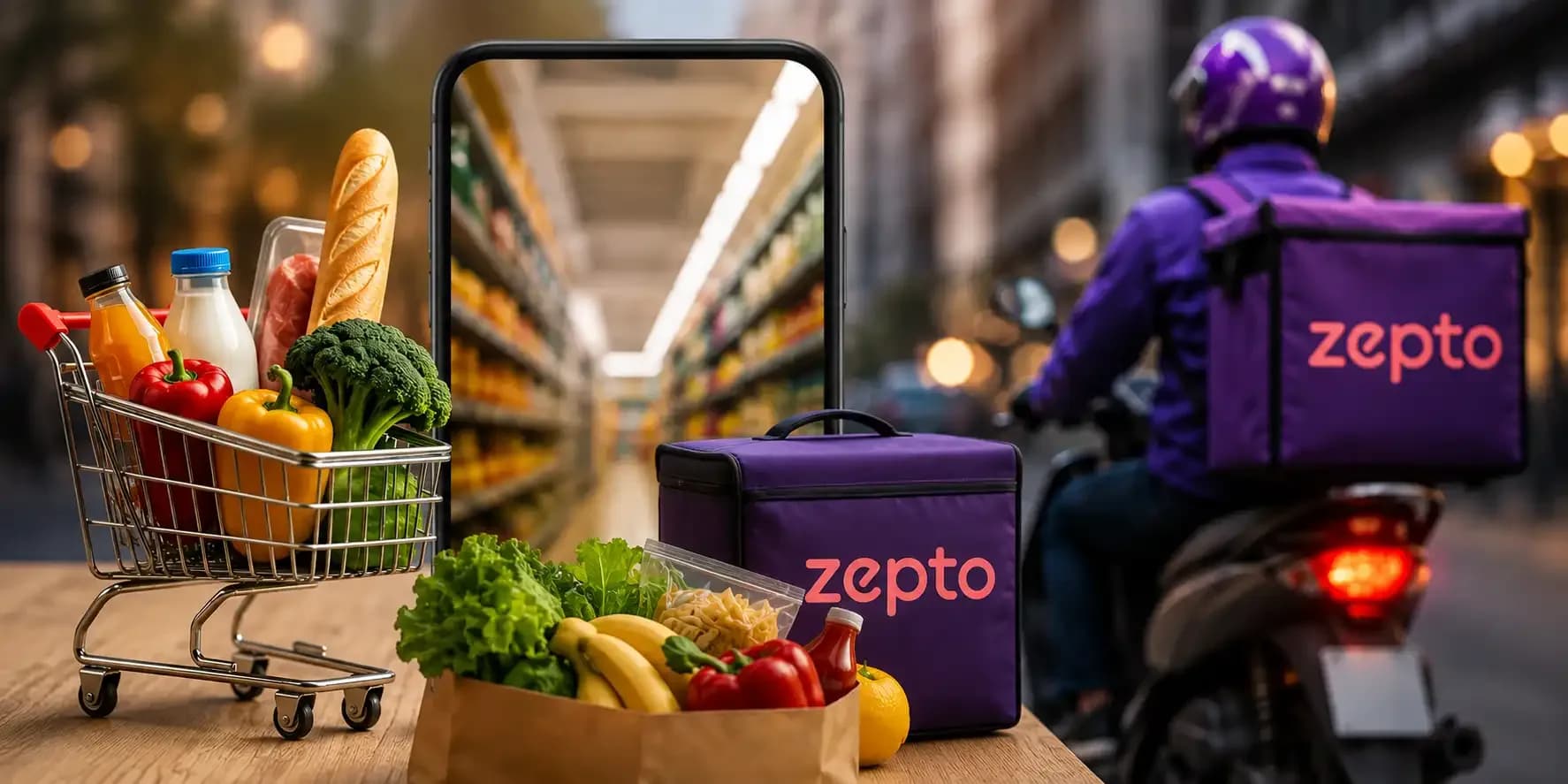
For years, quick commerce in India has been built around one powerful promise: order almost anything you need and get it delivered within minutes.
But as the industry matures, the race is changing.
The latest moves by Zepto suggest that the company is becoming less interested in simply generating more orders and increasingly focused on making each order and each customer more valuable.
From raising the minimum order value for free delivery to ₹199, to bringing back a paid membership programme through Zepto Club, and pushing premium and gourmet groceries through Select, the company is putting greater emphasis on basket size, customer retention and unit economics.
The shift comes at a crucial time for Zepto. The quick-commerce company has rapidly scaled its business but continues to operate at a significant loss, while its planned IPO has been delayed amid investor concerns around valuation, profitability, cash reserves and the competitive environment.
In other words, Zepto now appears to be asking a different question:
How can it earn more from the customers it already has?
Zepto raises free-delivery threshold to ₹199
The clearest sign of the change came in August when Zepto increased the minimum order value required for free delivery from ₹149 to ₹199 in select cities and PIN codes.
During periods of high demand, the threshold can reportedly rise further to ₹299.
Orders below the applicable threshold can attract a delivery charge.
At first glance, this looks like a small pricing adjustment.
It isn't.
The move directly targets one of quick commerce's biggest challenges: the economics of small orders.
If a customer opens Zepto to buy a ₹120 item, the company still has to pick the product, pack it, process the order and send a delivery partner to the customer's location.
The cost of fulfilling that order does not fall dramatically just because the basket is small.
But if the same customer adds a few more products and turns that ₹120 purchase into a ₹220 basket, Zepto gets considerably more merchandise value from roughly the same fulfilment trip.
That is the logic behind the higher threshold.
Instead of subsidising every small order, Zepto is effectively encouraging customers to build a bigger basket before checking out.
The bigger issue is Zepto's relatively low basket value
This strategy becomes more understandable when its financial numbers are examined.
Zepto's FY26 revenue from operations rose to around ₹22,623.5 crore, more than double the previous year's figure.
The company also processed around 210 million orders in the March 2026 quarter, while its annual transacting user base stood at approximately 47.9 million at the end of FY26.
But despite that scale, profitability remains a major challenge.
Zepto reported a ₹5,905 crore net loss in FY26, while free cash flow remained negative at roughly ₹4,330 crore.
At the same time, some of its operating metrics have improved significantly.
The company's adjusted EBITDA loss per order fell from ₹109.8 in June 2023 to ₹59.4 by March 2026, while total cost per order declined from ₹180.6 to ₹127.8 over the same period.
So the picture isn't one of a business that has failed to improve its efficiency.
Rather, Zepto has made meaningful progress on unit economics, but the company still needs to turn that improvement into sustainable profitability.
And bigger baskets can help.
Why a bigger basket matters to quick-commerce companies
Consider two hypothetical orders.
A customer buys groceries worth ₹150.
Another customer buys groceries worth ₹400.
Both orders require a dark store to pick and pack the products, technology to process the transaction and a delivery rider to complete the last-mile journey.
The second order generates much more merchandise value from broadly similar fulfilment infrastructure.
That's why average order value (AOV) has become such an important metric for quick-commerce companies.
The ₹199 threshold is therefore not just a delivery-fee decision.
It is an attempt to influence customer behaviour:
“If you're already ordering, add a few more products to the basket.”
The risk, of course, is that customers who genuinely need only one or two products may decide not to place the order at all.
That creates a delicate balancing act between higher AOV and order frequency.
Zepto Club puts discounts behind a paywall
The second major change is Zepto's return to paid membership.
In July, the company launched Zepto Club, an invite-only membership programme priced at an introductory ₹99 per month.
The programme offers benefits including 5% cashback in the form of Z-Coins, priority packing and delivery, priority customer support, exclusive discounts and early access to selected offers and products.
The significance lies less in the ₹99 subscription fee and more in who gets the incentives.
Earlier quick-commerce strategies often relied heavily on broad discounts and promotions to acquire and retain users.
Club creates a different model.
Instead of giving the same incentives to everyone, Zepto can increasingly concentrate benefits on customers who are already frequent users and are more likely to generate enough orders to justify the membership.
Recent reporting suggests that Zepto is moving away from blanket discounting towards more targeted incentives aimed at customer retention.
That is a subtle but important change.
The strategy moves from:
“Give everyone a discount to generate an order.”
to:
“Give our most valuable customers a reason to keep ordering from us.”
This is not Zepto's first subscription experiment
Zepto has tried subscription-led offerings before, including Zepto Pass and Zepto Daily.
Those programmes were eventually discontinued, making Club the company's third attempt at building a subscription business.
The difference this time is the broader strategy around it.
Club is arriving alongside a higher free-delivery threshold and a push into premium grocery.
That makes the programme less like a standalone loyalty product and more like one part of a broader attempt to improve customer lifetime value.
If a frequent customer pays for Club, receives targeted benefits and places larger orders, Zepto potentially gets three advantages:
higher customer retention;
more predictable order frequency; and
better economics per customer.
Whether customers will pay for those benefits at scale remains to be seen.
Then comes Select: Zepto wants consumers to buy premium
Perhaps the most interesting part of Zepto's strategy is its move into premium grocery.
The company launched Select in July as a premium grocery offering featuring imported foods, gourmet products and other premium products.
The service was initially piloted in select areas before being rolled out more widely. Zepto has also been looking to onboard premium consumer brands and compete with offerings such as Blinkit Gourmet and FirstClub.
This matters because premium grocery changes the basket equation.
A customer buying basic staples may generate a relatively modest order.
But a basket containing imported snacks, speciality ingredients, premium dry fruits, gourmet products or health-focused brands can quickly become a much higher-value transaction.
Zepto's own platform already has a premium product assortment, including higher-priced imported and speciality-style grocery products.
The company's bet is essentially that convenience can be monetised at the premium end of the grocery market as well.
Quick commerce is moving beyond the 10-minute delivery race
This is part of a larger shift across the industry.
Quick commerce initially competed on three things:
speed, convenience and discounts.
Now the sector is increasingly competing on:
basket size, premium assortment, memberships, advertising and profitability.
Blinkit has expanded its Gourmet offering, while other platforms are also experimenting with premium grocery and speciality products.
Industry analysts have described premium grocery as the next potential growth engine because higher-value products can lift AOV and encourage customers to spend more during the same delivery.
That means the next battle may not be:
Who can deliver in 10 minutes?
It could increasingly become:
Who can get the customer to spend ₹500 instead of ₹250?
Zepto's IPO delay makes the timing even more important
There is another piece of the puzzle that cannot be ignored.
Zepto had been preparing for what would have been a landmark IPO for India's quick-commerce sector. But in July, the company delayed the listing by roughly two quarters, with investors seeking greater clarity around valuation, profitability, cash reserves and future growth.
That puts greater importance on the company's financial trajectory over the next few quarters.
Zepto's FY26 numbers show both sides of the story.
Revenue more than doubled to ₹22,623.5 crore, but the company still recorded a ₹5,905.1 crore loss. Meanwhile, adjusted EBITDA loss per order improved materially.
This is why the company's current strategy matters.
Investors don't necessarily need Zepto to stop growing.
They need to see evidence that growth can eventually translate into sustainable economics.
Zepto is already improving store productivity
Another important part of the company's profitability strategy is density.
Instead of simply opening stores everywhere, Zepto has been focusing on building greater order density in markets where it already operates.
Its dark-store network reached 1,139 stores in FY26, while orders per store per day rose substantially. In the March 2026 quarter, the company reported approximately 2,140 orders per store per day, up from around 1,425 a year earlier.
Higher density can mean shorter delivery distances, greater utilisation of stores and delivery fleets, and lower fulfilment costs per order.
So Zepto is attacking its economics from multiple directions.
Operational efficiency through greater store and order density.
Higher basket values through the ₹199 free-delivery threshold.
Retention through Club.
Premium spending through Select.
And increasingly, advertising revenue is another important part of the business, with Zepto's advertising revenue growing sharply in FY26.
But there is a catch
The strategy could work beautifully — or it could create a new problem.
Quick commerce has historically benefited from customers placing frequent, small and impulsive orders.
A higher free-delivery threshold could encourage some customers to add more products.
But it could also cause others to think:
“I only needed one item. I'll buy it later.”
Similarly, Club only works if customers order frequently enough to see value in paying ₹99 a month.
And Select requires a sufficiently large base of consumers willing to pay more for premium products.
In other words, Zepto is making a bet on quality of demand rather than simply quantity of demand.
What Zepto's strategy really tells us
Taken individually, the moves look unrelated.
₹199 free delivery.
₹99 Club membership.
Premium grocery through Select.
But together, they tell a much clearer story.
Zepto is trying to move from:
more orders → bigger baskets → higher-value customers → better retention → stronger unit economics.
That is a very different growth philosophy from the discount-heavy quick-commerce race of the past few years.
And it may be exactly what Zepto needs at this stage of its journey.
The company has already demonstrated that Indian consumers are willing to order groceries at extraordinary frequency.
The next challenge is proving that those orders can become profitable orders.
For Zepto, the future may therefore be less about asking customers to order more often at any cost — and more about getting them to put more into the basket when they do order.
Zepto isn't abandoning discounts or convenience.
It is repackaging them.
Free delivery is increasingly tied to a higher basket.
Discounts are increasingly tied to membership.
And the grocery assortment is expanding towards premium products.
That suggests a broader transformation in India's quick-commerce market: the era of winning customers at any cost is gradually giving way to the era of monetising customers more intelligently.
Whether Zepto's ₹199 threshold, Club membership and Select can deliver that improvement will become clearer in its upcoming operating numbers.
For now, one thing is clear:
Zepto doesn't just want more orders. It wants better orders.