

For years, India's quick-commerce battle was defined by a deceptively simple question: Who can deliver faster?
Then came another question: Who can open more dark stores?
Now, as the sector matures and investors become increasingly focused on profitability, Swiggy appears to be asking a different question:
How much more money can it make from every order?
That shift sits at the heart of Swiggy's next phase for Instamart.
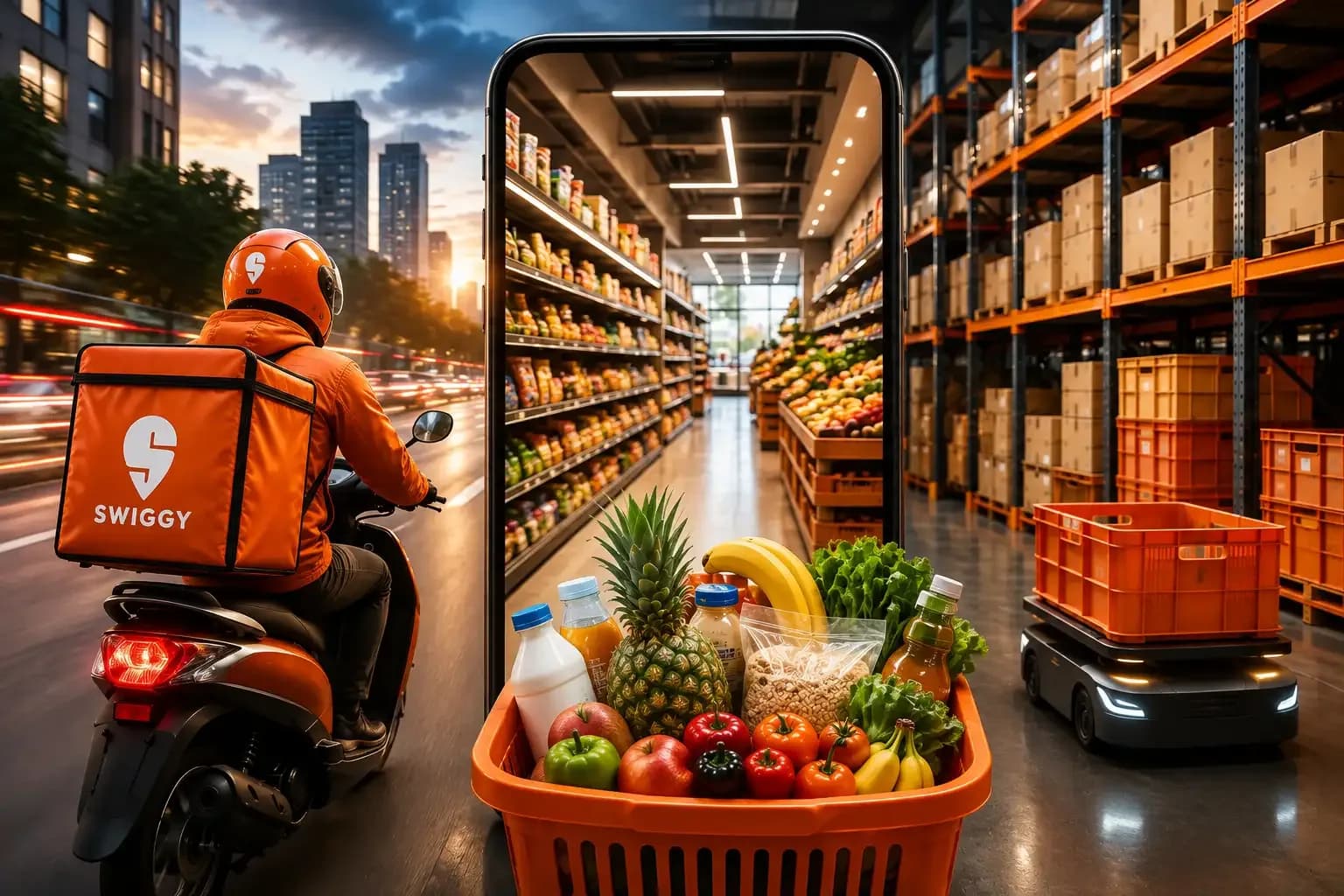
The company is preparing to move its quick-commerce business towards an inventory-led, or first-party (1P), model after clearing a regulatory and ownership hurdle. But treating the move simply as Swiggy copying rival Blinkit's playbook would miss the larger story.
Swiggy is attempting something broader: turning Instamart from a fast grocery-delivery service into a higher-value local commerce platform, where bigger baskets, wider assortment, better inventory control and higher utilisation of existing infrastructure can improve unit economics.
The scale of the ambition is substantial. Swiggy wants Instamart to grow from roughly ₹28,000 crore in FY26 GOV to more than ₹1.5 lakh crore by FY31.
That is not merely a profitability exercise. It is a bet on what quick commerce becomes after the initial obsession with speed begins to fade.
The real problem with quick commerce: small baskets are expensive
Quick commerce has always had a difficult economic equation.
A customer may place an order worth ₹250 or ₹300, but the platform still has to deal with many of the same costs associated with picking, packing, processing and delivering that order.
That makes basket size critical.
Swiggy's Instamart numbers show that the company has been working on precisely this problem.
Its average order value increased to ₹691 in FY26, from ₹514 in FY25. At the same time, Instamart's GOV reached ₹28,496 crore, up 94.1% year on year.
The significance of the ₹691 figure goes beyond the headline growth.
A bigger basket gives Swiggy more revenue from an individual delivery without necessarily increasing fulfilment costs in proportion.
In other words, the company's objective is gradually shifting from:
more orders → more scale
to:
more value per order → better economics.
That is a much more important transition for a business that is still working towards full profitability.
Swiggy is trying to make Instamart less dependent on groceries
The next part of the strategy is even more interesting.
Instamart is increasingly moving beyond its original identity as a grocery and essentials platform.
Swiggy is expanding into categories such as electronics, home and kitchen products, toys, accessories, gifting and other general merchandise. At its Capital Markets Day, the company described the broader proposition as part of its effort to redefine everyday convenience.
This matters because quick commerce does not necessarily need to win the profitability battle by extracting a few more rupees from every packet of biscuits.
It can also change what customers put into their carts.
A ₹700 order containing a mixture of groceries, household products and higher-value merchandise can be economically very different from a ₹250 grocery-only order.
That is why the future of quick commerce may not be about delivering groceries faster.
It could be about turning a neighbourhood dark store into a miniature, on-demand retail outlet.
The dark store is becoming a retail asset, not just a delivery point
The first generation of quick commerce was built around dense networks of small dark stores.
The logic was straightforward: put inventory close enough to consumers and delivery times fall.
But once a company has built that network, the next question becomes: How much business can each store handle?
Swiggy is increasingly focusing on this question.
In Q1 FY27, Instamart had more than 1,200 dark stores across 130+ cities, serving more than 14 million monthly transacting users. Its GOV reached ₹7,907 crore, up 40% year on year.
The company is also moving towards larger-format stores and broader assortment.
That changes the economics of the network.
Instead of simply adding another store every time it wants more growth, Swiggy can potentially generate more orders and more GOV from infrastructure it has already built.
This is where store utilisation and throughput become as important as store count.
And then comes the Blinkit question
This is where Blinkit enters the story.
Swiggy has historically operated Instamart under a marketplace model. The company is now preparing to transition towards an inventory-led model after shareholders approved changes that help Swiggy qualify as an Indian-owned and controlled company under India's foreign investment rules.
The change is strategically important.
Under an inventory-led structure, Swiggy can have greater control over:
procurement
pricing
assortment
inventory allocation
supply-chain decisions
private-label products
inventory planning
It can also potentially negotiate better terms through bulk procurement.
Analysts cited by Reuters estimate that the shift could improve Instamart's contribution margin by around 80 basis points, equivalent to roughly ₹4–₹5 per order.
That may sound small.
At quick-commerce scale, it isn't.
When millions of orders are processed, a few rupees of additional contribution per order can become a meaningful improvement in the overall economics.
But there is an important caveat: the inventory model is not a magic profitability button.
Swiggy still has a ₹30-per-order problem
The ₹4–₹5 potential improvement needs to be viewed against the larger profitability gap.
Reuters reported that Instamart needs roughly another ₹30 per order to reach contribution-margin breakeven based on analyst estimates. The inventory transition therefore addresses only one part of the equation.
And Swiggy's own numbers show how much progress has already been made.
Instamart's contribution margin improved to -0.2% of GOV in Q1 FY27, compared with -1.8% in the previous quarter. Swiggy says revenue per order has increased by ₹25 while cost per order has declined by ₹3 since Q4 FY25.
More than 45% of Instamart's store network is now contribution-margin positive, while five of its seven largest cities, including Bengaluru, are operating profitably at the relevant operating level, according to Swiggy.
The company estimates it needs another 2.5 times scale and approximately four percentage points of additional contribution-margin improvement to reach the roughly 4% contribution margin it considers necessary for EBITDA breakeven.
So the inventory transition is better understood as an accelerator rather than the entire profitability strategy.
Swiggy's bigger bet: make the basket do more work
This may ultimately be the most important part of the strategy.
Swiggy's improvement in revenue per order, larger baskets and broader assortment all point in the same direction.
The company wants customers to use Instamart not only when they suddenly realise they are out of milk or bread, but also when they need:
something for the home
a gift
a toy
an electronic accessory
personal-care products
fresh produce
packaged foods
other everyday merchandise
That changes the role of the dark store.
It is no longer simply a warehouse designed to deliver groceries in minutes.
It becomes a local retail inventory pool that can serve multiple consumer needs.
And the more frequently consumers use that inventory pool, the more productive the underlying infrastructure can become.
Swiggy is also trying to consolidate the cart
Another piece of the strategy is encouraging consumers to put more items into a single order.
Swiggy has pushed initiatives such as Maxxsaver, designed to encourage cart consolidation.
The principle is simple.
If someone is already paying the cost of placing an order, there is an opportunity to encourage them to add more products rather than placing multiple small orders.
That makes the same delivery infrastructure more productive.
The broader strategy therefore becomes:
Increase basket size.Increase assortment.Increase order frequency.Increase revenue per order.Reduce cost per order.
And then layer better procurement and inventory control on top.
That is a far more sophisticated equation than simply competing on delivery time.
Swiggy's ecosystem could become another advantage
There is another asset Swiggy can bring into the equation: its existing consumer ecosystem.
A customer may already use Swiggy for food delivery, and the company can potentially move that customer into Instamart without having to build an entirely new consumer relationship.
Swiggy One also connects benefits across food delivery, quick commerce and dining out. The company is positioning this multi-service ecosystem as an important part of its long-term consumer strategy.
That matters because customer acquisition can be expensive in a highly competitive quick-commerce market.
The more frequently a consumer uses multiple Swiggy services, the greater the potential value of that relationship.
The ₹1.5 lakh crore ambition
Swiggy's long-term target makes clear just how aggressively it intends to pursue this strategy.
The company wants Instamart to become a ₹1.5 lakh crore-plus GOV business by FY31, compared with around ₹28,000 crore in FY26. It expects the business to serve more than 40 million monthly transacting users by then.
At the consolidated level, Swiggy is targeting approximately ₹2.5 lakh crore of GOV and ₹10,000 crore of adjusted EBITDA by FY31.
That means the company is not planning to improve profitability by simply slowing Instamart's growth.
It wants to achieve both scale and better economics.
That is the harder challenge.
But the inventory model comes with its own risk
There is a catch to owning inventory.
The same inventory that gives Swiggy more control also puts more responsibility on its balance sheet.
An inventory-led model means more working capital requirements and greater exposure to:
unsold stock
wastage
markdowns
inventory ageing
inaccurate demand forecasts
working-capital cycles
Reuters noted that the transition will increase working-capital requirements, with inventory ownership becoming a more important component of the business.
This makes inventory management critical.
The winner won't simply be the company that owns more products.
It will be the company that knows which product to stock, in which store, in what quantity and at what price — before the customer even searches for it.
That is where data and technology can become a genuine competitive advantage.
So, is Swiggy copying Blinkit?
There is certainly some convergence.
Blinkit has already moved towards an inventory-led model and has been improving its margins while expanding into higher-value categories. Reuters reported that Blinkit's margin performance has benefited from inventory ownership, supply-chain efficiencies and expansion into categories such as electronics, home décor and gourmet foods.
Swiggy is now moving in a similar direction.
But saying “Swiggy is copying Blinkit” would be too simplistic.
The more interesting interpretation is that both companies are responding to the same structural reality:
The first phase of quick commerce was about proving that consumers would pay for speed. The next phase is about proving that speed can produce sustainable profits.
For Swiggy, that means combining inventory control with bigger baskets, broader assortment, higher store productivity and its existing consumer ecosystem.
The quick-commerce race is entering its second chapter
India's quick-commerce market is no longer just a battle between Blinkit, Instamart and Zepto.
Amazon, Flipkart and other large players are also pushing into faster local commerce, increasing the pressure on the established players.
That competition will make the next phase particularly interesting.
The winner may not necessarily be the company with the fastest delivery.
It may be the company that can build the most economically productive local-commerce network.
Swiggy's strategy suggests that it believes the path there runs through bigger baskets, more valuable products, better inventory economics and greater utilisation of every dark store it has already built.
The headline may be about Swiggy moving to an inventory-led Instamart model.
But the bigger story is this:
Swiggy is trying to change what quick commerce is worth — not just how quickly it arrives.