
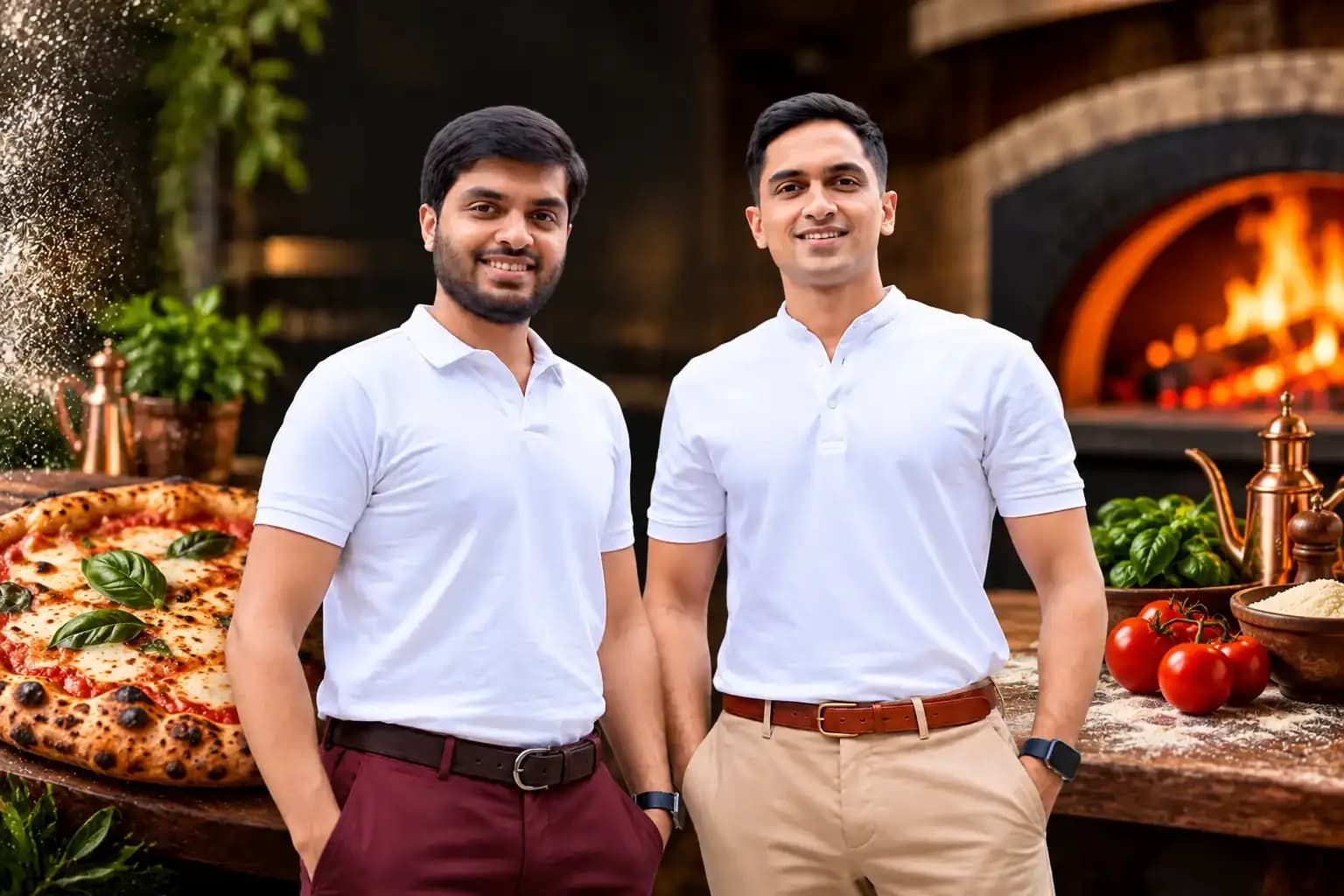
Bengaluru-based restaurant company Popo Global, the parent of The Pizza Bakery, has raised ₹532 crore from Artal Asia, marking its first external funding round and setting the stage for an aggressive expansion beyond its home market.
The investment gives Artal Asia, an affiliate of global investment firm Invus, a significant minority stake in Popo Global. The transaction comes at a pivotal point for the company, which has grown from a single Bengaluru outlet into a multi-brand restaurant platform with around 40 outlets and reported FY25 revenue of approximately ₹175 crore.
Unlike many Indian restaurant chains that use franchising as a key route to rapid expansion, Popo has built its business predominantly through a company-owned-and-operated model. The fresh capital could allow the group to scale that strategy across more Indian cities.
From one Bengaluru outlet to a multi-brand platform
Popo Global's story began in 2017, when founders Nikhil Gupta and Abhijit “AB” Gupta started The Pizza Bakery in Bengaluru.
The brand gradually expanded beyond its original pizza proposition. Popo subsequently built a portfolio that includes Paris Panini, a sandwich-focused concept, and Smash Guys, its burger brand.
The company now operates approximately 40 outlets across these brands.
The growth has largely been achieved without institutional capital, making the latest transaction particularly significant. Popo is now moving from a predominantly bootstrapped growth phase to one backed by a global investment platform.
₹532 crore investment: What we know
Artal Asia has invested ₹532 crore, or roughly $56 million, in Popo Global for a significant minority stake.
The company has not publicly disclosed the exact percentage acquired by Artal Asia or the final transaction valuation.
However, media reports had previously indicated that Popo was being valued in the range of ₹1,100 crore to ₹1,350 crore during discussions with potential investors. Subsequent reporting has pegged the final valuation at around ₹1,500 crore, although this figure has not been officially confirmed by the company.
The distinction is important: the ₹532 crore investment is disclosed, while the final valuation and precise stake remain subject to reported figures.
The transaction follows months of investor interest in the Bengaluru-based restaurant company.
Reports earlier this year indicated that Popo was exploring a stake sale of around ₹550–600 crore, with several institutional investors, including Norwest Venture Partners, A91 Partners, TR Capital and Temasek, reportedly evaluating the opportunity.
By July, reports suggested that Invus was close to investing approximately ₹500 crore in the business. The eventual transaction with Artal Asia has now closed at ₹532 crore.
Popo's financial performance
The investment comes after a strong financial year for the restaurant group.
Popo Global's revenue reportedly increased from approximately ₹120 crore in FY24 to ₹175 crore in FY25.
That represents year-on-year growth of around 46%.
More importantly, the company was reportedly profitable in FY25, giving the business a different profile from many high-growth consumer and restaurant startups that have historically prioritised expansion over profitability.
At roughly 40 outlets, the reported FY25 revenue translates to approximately ₹4.4 crore per outlet annually on a simple group-revenue-to-store-count basis.
This should not be interpreted as store-level revenue or same-store sales, since the portfolio includes multiple brands and individual outlets have different operating histories. Nevertheless, it provides an indication of the scale Popo has achieved before taking institutional capital.
Why Artal Asia's investment matters
The investor behind the transaction is almost as important as the size of the cheque.
Artal Asia is affiliated with Invus, a global investment group with experience across consumer and food businesses.
The group has exposure to food and restaurant businesses internationally, including US fast-casual restaurant company CAVA. Its India investment history also includes Capital Foods, the company behind brands such as Ching's Secret and Smith & Jones, which was acquired by Tata Consumer Products in a deal valued at ₹5,100 crore-plus.
Artal's investment therefore points to a broader thesis around the scalability of Indian consumer and food brands rather than simply a bet on the pizza category.
For Popo, the investment provides both capital and an institutional partner as it enters its next phase of growth.
The company-owned model could be Popo's biggest differentiator
One of the most notable aspects of Popo's expansion strategy is its reliance on company-owned and company-operated restaurants.
Franchising has become a popular growth model for Indian QSR companies because it allows brands to expand their footprint while transferring a substantial portion of store-level capital expenditure to franchise partners.
Popo has taken a more capital-intensive route.
By owning and operating restaurants itself, the company retains greater control over:
Product quality
Kitchen operations
Customer experience
Pricing
Staff training
Store execution
Brand positioning
Product innovation
The trade-off is that every new store requires significantly more capital.
That makes the ₹532 crore investment particularly relevant.
The fresh funding could give Popo the balance sheet required to replicate its Bengaluru playbook in other markets without immediately shifting to a heavily franchised model.
The next phase: Taking the brands beyond Bengaluru
The immediate priority for Popo is expected to be geographical expansion.
The company intends to take its restaurant brands to more Indian cities, with the new capital supporting the opening of additional outlets and the scaling of its existing brands.
The opportunity extends beyond The Pizza Bakery.
Popo's three-brand portfolio gives it exposure to multiple segments of the organised food-service market:
The Pizza Bakery — pizza and Italian-inspired offerings
Paris Panini — sandwiches and café-style food
Smash Guys — burgers and QSR
This multi-brand strategy could allow Popo to operate different concepts across different customer occasions and price points while sharing elements of its underlying operating infrastructure.
That could become increasingly valuable as the company moves into markets outside Bengaluru.
A larger bet on India's homegrown QSR market
The Popo transaction comes at a time when India's organised food-service industry is attracting increasing investor attention.
For years, the Indian QSR conversation was dominated by large international brands and established national chains. But the market has increasingly produced homegrown brands capable of building strong regional followings before attempting national expansion.
The latest investment reflects growing investor willingness to back these businesses once they demonstrate three critical characteristics:
Growth.
Profitability.
Scalable unit economics.
Popo appears to have reached that threshold.
The company's challenge now is considerably different from the one it faced during its bootstrapped years.
The question is no longer whether it can build a successful restaurant brand in Bengaluru.
It is whether the economics, customer proposition and operating model that worked in Bengaluru can be replicated across India's highly fragmented and geographically diverse restaurant market.
The ₹532 crore investment gives Popo Global substantial firepower for its next chapter.
The company enters that phase with a portfolio of three brands, approximately 40 outlets, reported FY25 revenue of ₹175 crore and a profitable operating base.
But scaling restaurants nationally is a very different proposition from building a successful regional chain.
Real estate costs, local food preferences, talent availability, supply-chain efficiency and store-level economics can vary significantly from one city to another.
How Popo manages those variables while retaining the quality and customer experience that helped build its brands will determine whether its next phase becomes a genuine national success story.
For India's F&B sector, however, the message from the transaction is already clear.
Global capital is increasingly willing to bet on homegrown Indian restaurant platforms — provided they can demonstrate growth, profitability and a credible path to national scale.
And with ₹532 crore now behind it, Popo Global is preparing to put that thesis to the test.